• Clinical
      |Clinical
    • Acute Coronary Syndromes
    • Cardiac Surgery
    • Covid-19
    • Heart Failure
    • Heart Health
    • Heart Rhythm
    • Hypertension
    • Interventional Cardiology
    • Mitral Valve
    • Pharmaceutics
    • Structural Heart Disease
    • TAVR
    • Tricuspid Valve
    • Vascular & Endovascular
  • Management
      |Management
    • Chest Pain Guidelines
    • Compensation
    • Economics
    • Education & Training
    • Legal News
    • Patient Care
    • Policy & Regulations
    • Professional Associations
    • Quality
    • Revenue
    • Staffing
  • Technology
      |Technology
    • AI
    • Cardiac Imaging
    • Cath Lab
    • CT
    • CVIS
    • ECG
    • Echo
    • EP Lab
    • Informatics
    • MRI
    • Nuclear Cardiology
    • Remote Monitoring
  • Videos
  • Conferences
      |Conferences
    • ACC
    • AHA
    • ASE
    • ASNC
    • ESC
    • EuroPCR
    • HFSA
    • HRS
    • HRS
    • SCAI
    • SCCT
    • SIIM
    • SNMMI
    • STS
    • TCT
    • VIVA
  • Custom Content
      |Custom Content
    • Experience Stories
    • Webinars & Videos
  • Subscribe
  • Forty Under 40 Award
      |Forty Under 40 Award
    • Class of 2026
    • Class of 2025

Search form

Home

News You Need to Know Today
CCTA vs. ICA for stable chest pain | Historic new study investigates IVL among female patients
Friday, September 23, 2022
Link to Twitter Link to Facebook Link to Linkedin Link to Vimeo

Today's News and Trends

Cardiac CT comparable to invasive angiography when assessing stable chest pain, new meta-analysis confirms

Researchers examined data from nearly 5,400 patients, tracking such outcomes as myocardial infarction, stroke and all-cause mortality. 

READ MORE >
A CTA scan being performed at Beaumont Hospital in Michigan by cardiac CT expert Kavitha M Chinnaiyan, MD. CCTA has largely been used at academic medical centers for the past decade, but it is now expanding in 2022 to community hospitals and clinics thanks to a Class 1A recommendation in the 2021 chest pain guidelines. #CCTA #CTA #Beaumont
Share on Twitter Share on Facebook Share on Linkedin

Cardiac CT comparable to invasive angiography when assessing stable chest pain, new meta-analysis confirms

Share on Twitter Share on Facebook Share on Linkedin
A CTA scan being performed at Beaumont Hospital in Michigan by cardiac CT expert Kavitha M Chinnaiyan, MD. CCTA has largely been used at academic medical centers for the past decade, but it is now expanding in 2022 to community hospitals and clinics thanks to a Class 1A recommendation in the 2021 chest pain guidelines. #CCTA #CTA #Beaumont
Researchers examined data from nearly 5,400 patients, tracking such outcomes as myocardial infarction, stroke and all-cause mortality. 
READ MORE >

Is IVL equally effective in male and female patients? Shockwave Medical aims to find out with a historic new study

Shockwave announced at TCT 2022 that it hopes to enroll up to 400 patients for a new all-female clinical trial.

READ MORE >
Intravascular lithotripsy (IVL) Shockwave Medical PCI PAD CAD trial prsented at SCAI 2022. #DisruptPAD, #DisruptCAD, #SCAI #SCAI22 #SCAI2022
Share on Twitter Share on Facebook Share on Linkedin

Is IVL equally effective in male and female patients? Shockwave Medical aims to find out with a historic new study

Share on Twitter Share on Facebook Share on Linkedin
Intravascular lithotripsy (IVL) Shockwave Medical PCI PAD CAD trial prsented at SCAI 2022. #DisruptPAD, #DisruptCAD, #SCAI #SCAI22 #SCAI2022
Shockwave announced at TCT 2022 that it hopes to enroll up to 400 patients for a new all-female clinical trial.
READ MORE >

Featured Articles

VIDEO: Addressing tricuspid valve regurgitation with new transcatheter interventions 

Joao Cavalcante, MD, of the Minneapolis Heart Institute, discusses new structural heart interventions to treat tricuspid valve regurgitation.

READ MORE >
The tricuspid valve anatomy is ofrten complicated for transcatheter structural heart interventions (TTVR) by the placement of pacemaker or ICD leads.
Share on Twitter Share on Facebook Share on Linkedin

VIDEO: Addressing tricuspid valve regurgitation with new transcatheter interventions 

Share on Twitter Share on Facebook Share on Linkedin
The tricuspid valve anatomy is ofrten complicated for transcatheter structural heart interventions (TTVR) by the placement of pacemaker or ICD leads.
Joao Cavalcante, MD, of the Minneapolis Heart Institute, discusses new structural heart interventions to treat tricuspid valve regurgitation.
READ MORE >

MitraClip and TriClip TEER devices continue to show positive results

Two late-breaking studies at the 2022 Transcatheter Cardiovascular Therapeutics (TCT) meeting provided positive data for Abbott's MitraClip transcatheter mitral valve repair (TMVR) device and the TriClip for transcatheter tricuspid valve repair (TTVR).

READ MORE >
Transcatheter mitral valve repair (TMVr) is associated with “promising” short-term outcomes among patients with a history of cancer, according to new research published in the American Journal of Cardiology. #TEER #TMVR
Share on Twitter Share on Facebook Share on Linkedin

MitraClip and TriClip TEER devices continue to show positive results

Share on Twitter Share on Facebook Share on Linkedin
Transcatheter mitral valve repair (TMVr) is associated with “promising” short-term outcomes among patients with a history of cancer, according to new research published in the American Journal of Cardiology. #TEER #TMVR
Two late-breaking studies at the 2022 Transcatheter Cardiovascular Therapeutics (TCT) meeting provided positive data for Abbott's MitraClip transcatheter mitral valve repair (TMVR) device and the TriClip for transcatheter tricuspid valve repair (TTVR).
READ MORE >

Pulmonary artery denervation shows promise to treat pulmonary arterial hypertension

Pulmonary artery denervation may offer a new therapy option for this difficult-to-treat population.

READ MORE >
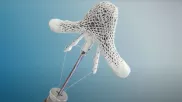
The Pulnovo pulmonary artery denervation catheter. In February 2021, the devices was granted the U.S. Food and Drug Administration (FDA) breakthrough device designation. #TCT2022 #PAH
Share on Twitter Share on Facebook Share on Linkedin

Pulmonary artery denervation shows promise to treat pulmonary arterial hypertension

Share on Twitter Share on Facebook Share on Linkedin
The Pulnovo pulmonary artery denervation catheter. In February 2021, the devices was granted the U.S. Food and Drug Administration (FDA) breakthrough device designation. #TCT2022 #PAH
Pulmonary artery denervation may offer a new therapy option for this difficult-to-treat population.
READ MORE >

In Case You Missed It

SAVR after TAVR is rare, but linked to a high mortality risk

Researchers tracked data from more than 2,000 patients, noting that surgical bailout, infective endocarditis and paravalvular leak were the most common reasons for surgery to be required after TAVR. The full study was published in the American Journal of Cardiology.

READ MORE >
surgery.jpg
Share on Twitter Share on Facebook Share on Linkedin

SAVR after TAVR is rare, but linked to a high mortality risk

Share on Twitter Share on Facebook Share on Linkedin
surgery.jpg
Researchers tracked data from more than 2,000 patients, noting that surgical bailout, infective endocarditis and paravalvular leak were the most common reasons for surgery to be required after TAVR. The full study was published in the American Journal of Cardiology.
READ MORE >

TEER safe and feasible for patients with atrial secondary mitral regurgitation

Atrial secondary mitral regurgitation has been linked to higher in-hospital mortality and hospitalization rates. 

READ MORE >
heart patient
Share on Twitter Share on Facebook Share on Linkedin

TEER safe and feasible for patients with atrial secondary mitral regurgitation

Share on Twitter Share on Facebook Share on Linkedin
heart patient
Atrial secondary mitral regurgitation has been linked to higher in-hospital mortality and hospitalization rates. 
READ MORE >

In Other News

New cardiac MR technique cuts scan time by more than half

Using a new 4D flow cardiac MRI scan, experts were able to complete cardiac examinations in just eight minutes.

READ MORE >
Share on Twitter Share on Facebook Share on Linkedin

New cardiac MR technique cuts scan time by more than half

Share on Twitter Share on Facebook Share on Linkedin
Using a new 4D flow cardiac MRI scan, experts were able to complete cardiac examinations in just eight minutes.
READ MORE >

Innovate Healthcare thanks our partners for supporting our newsletters.
Sponsorship has no influence on editorial content.

Interested in reaching our audiences, contact our team

*|LIST:ADDRESSLINE|*

You received this email because you signed up for newsletters from Innovate Healthcare.
Change your preferences or unsubscribe here

Contact Us  |  Unsubscribe from all  |  Privacy Policy

© Innovate Healthcare, a TriMed Media brand
Innovate Healthcare

Recent Newsletters

AI is gaining ground, but clinicians run the show | Siemens Healthineers doubles down | Electrophysiologist compensation
News Alert: FDA shares warning about heart valve tech after patient death
Cardiologist pay & productivity are up | FDA clears PE thrombectomy devices | Cardiology tech in spotlight | Gore's new approval
Cardiology salaries on the rise | The climbing costs of care | M&A trends | Siemens Healthineers, J&J make big business moves
Major MRI trends | Blood thinner recalled | When to perform PCI before TAVR | How to build a CCTA program | Steroids & the heart
CMS boosts coverage for heart failure tech | FDA approves CardioMEMS updates | LVADs linked to strokes, other risks
M&A activity in cardiology: Exploring key trends | Cardiac PET vs. SPECT | Doctors support Medicare covering TAVR for AR
Newsletter archive
  • Home
  • News
  • Article Archive
  • Custom Content
  • Webinars
  • Press Releases
  • Content Studio
  • Advertising
  • Submit Press Release
  • Contact Us
  • Terms of Use
  • Privacy Policy
  • Cardiovascular Business
  • HealthExec
  • Radiology Business
  • Press Releases
  • Submit Press Release
© 2026 Innovate Healthcare | All Rights Reserved. | Terms of Use | Privacy Policy
Design by Adaptive Theme