
Controlling the uncontrollable: A health system’s guide to implementing ultrasound renal denervation
Nearly half of all American adults over the age of 20 have hypertension, and they face an increased risk of cardiovascular disease, renal events and cerebrovascular events. Hypertension was a primary or contributing cause to nearly 700,000 deaths in 2024 alone.1
U.S. hospitals and health systems have faced significant challenges fighting this trend, leaving many patients feeling uncertain. However, the recent rise of renal denervation (RDN)—a minimally invasive therapy that targets and ablates overactive renal nerves—as a complimentary treatment option has cardiologists feeling more confident about treatment options for refractory hypertension.
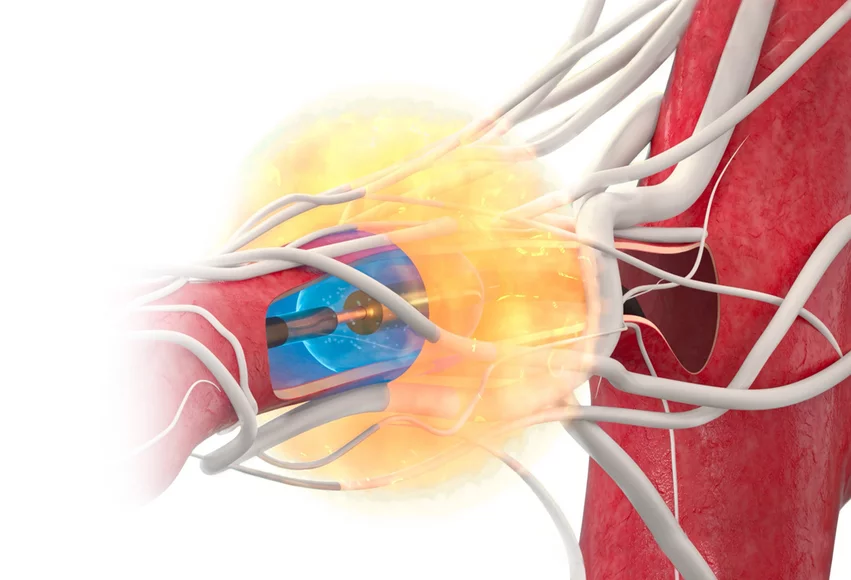
Wayne Batchelor, MD, MHS, MBA, President of the Medicine Service Line at the Inova Health System in Fairfax, Virginia, has years of experience fighting back against hypertension as an interventional cardiologist and an administrator. He and his team were early users of Recor Medical’s Paradise Ultrasound RDN (uRDN) system, which delivers 360° of ultrasound energy to a patient’s main renal arteries in two to three seven-second bursts, and they’ve continued to gain momentum ever since.
Inova did not just start offering uRDN overnight. Batchelor and his team have been working toward this goal for years now, and they still see plenty of room to grow in the future. Step one was meeting with Inova’s clinical and administrative leaders to decide whether embracing this new technology would be a wise investment.
“Whenever we look at deploying a new innovation across our health system, we always ask ourselves if it addresses an unmet need,” Batchelor says. “And at Inova, we’ve been really focused on developing appropriate care pathways for hypertension, which has a substantial impact on our community. This includes systemwide care pathways that begin with primary care. We felt that uRDN would be a great fit when it came to addressing patients with refractory hypertension for whom medications alone did not suffice.”
Getting the entire health system on board
Batchelor says he and Inova’s other leaders wanted to do much more than just try out a new technology; they wanted to deliver high-quality hypertension care across the entire health system. That meant getting everyone on board from day one, including clinical documentation, finance and revenue cycle teams.
“We didn’t just go into this blind,” he says. “Your finance team must understand the full financial implications, including the claims-submission process and a structured approach to denial management. We addressed these elements early to ensure alignment across all stakeholders.”
Another key piece of the puzzle was getting cardiologists involved with this new endeavor. Batchelor is a veteran interventional cardiologist himself and still works in the cath lab at least one day a week. He knew it was critical to get clinician buy-in as early as possible, and part of that process was working to strengthen the relationships between the cath lab and service line leadership. Batchelor identified highly skilled operators within the Inova Medical Group and among community physician partners, assembling a diverse team capable of supporting the program’s growth over time.
“We have really focused on helping those relationships grow,” he says. “You’re only able to deliver world-class healthcare when everyone is on the same page.”
Batchelor also identified a clinical champion, Benham N. Tehrani, MD, to lead this project and worked closely with Inova Schar Heart and Vascular Service Line President Chris O’Connor, MD, and administrator Andrew Gill.
“You need a clinical champion if you want to do something like this, and Tehrani was that champion for us,” Batchelor says. “He doubled down on helping us build a comprehensive program, and it really helped us turn that dream into a reality.”
“You need these patients to come in, receive treatment, recover and go home with the highest level of efficiency. And that has not been a problem thus far with ultrasound renal denervation.”
Wayne Batchelor, MD, MHS, MBA, President of the Medicine Service Line, Inova Health System

This is when Inova’s leaders started to hammer out more details. They established clear referral pathways to the hypertension program, standardized patient assessments, worked out the data collection details and refined how patients with refractory hypertension are evaluated across the system. It was important, Batchelor explains, to have a fully developed plan instead of just pushing ahead without thinking through all the elements.
Putting uRDN to the test: Real-world data demonstrate the technology’s value
Inova started small, first performing uRDN in Spring 2024. The focus was on patients with the most severe forms of hypertension, typically those with poorly controlled hypertension despite being on at least three medications. The early results were “very promising,” Batchelor says, making it clear they were onto something that could truly change the lives of appropriately selected patients.
Recently, Tehrani presented data on Inova’s early success with uRDN at the 2026 Transcatheter Cardiovascular Therapeutics (TCT) meeting in San Diego.[2] Inova was one of eight hospitals that participated in a real-world multicenter experience tracking more than 200 patients with uncontrolled hypertension who underwent uRDN. uRDN was found to be both safe and effective, with patients averaging a one-year reduction in office systolic blood pressure (OSBP) of approximately 24 mmHg. This early success and excellent procedural safety helped Inova realize it was on the right path; now the system is working to expand and reach even more patients with this advanced technology.
“We do have to recognize that these are office-based readings and uRDN may not work for every patient,” Batchelor says. “But these real-world data give us the clinical foundation on which we are able to build a successful program and offer real value for our patients who need it the most.”
He adds that there was “a lot of skepticism” about RDN early on. Could it really make an impact? Would the real-world data be even close to what clinicians were able to achieve in clinical trials? The one-year data seen at Inova and elsewhere helps address those questions and gives cardiologists the confidence they need to feel comfortable recommending these procedures to their patients. So do positive results from other healthcare systems across the nation.
“It’s not always a guarantee that you will be able to reproduce in the real world what you see in clinical trials,” Batchelor says. “The good news is that the real-world experience has been encouraging. I think this is a combination of careful case selection and offering the therapy first to experienced operators who know how to deliver it effectively.”
If uRDN was only associated with mild improvements in OSBP, he adds, it may not be worth the investment—both from a clinical perspective and a financial perspective. With reasonably consistent double-digit reductions in systolic BP, however, the data demonstrate that uRDN can make a lasting impact on the patients who need it most.
How to introduce RDN without creating bottlenecks
Whenever new procedures or technologies are being implemented, it’s critical that we understand the new challenges facing operations and the care team. When Inova started performing RDN, Batchelor worked to minimize any changes that could throw off the cath lab’s established rhythms.
Early on, for instance, they found that the most effective way to schedule uRDN was to bundle them and perform multiple procedures on a specific day.
“It just helps everyone get prepared ahead of time,” he says. “The proceduralist knows what their day looks like, as do the technicians, the nursing teams and the recovery teams. There’s more efficiency when you are doing two or three of these in a row in the cath lab than when you are just doing one at a time.”
Batchelor adds that the procedure times for uRDN are quite predictable. There is “very little variability,” he says, which makes scheduling easier than it is for, say, complex percutaneous coronary interventions.
“You have to ensure you’re not cannibalizing a lot of cath lab time or compromising capacity,” he says. “You need these patients to come in, receive treatment, recover and go home with the highest level of efficiency. And that has not been a problem thus far with uRDN.”
The patient experience remains as important as ever
Hospitals and health systems offering RDN also must consider the patient experience. Batchelor says clinicians should be upfront about both the risks and benefits of RDN. Patients typically experience transient discomfort during the procedure, for example, but this is short lived since each delivery of uRDN lasts only seven seconds. Thus, it is important that these procedures are performed using the appropriate level of sedation and analgesics that help patients relax and remain as comfortable as possible.
“The patient experience is extremely important,” he says. “You must be transparent about the risk of discomfort, rare complications and that some patients simply don’t respond as much as expected to the therapy. In our experience, it has been rare to require anything beyond moderate sedation. But when it comes to patients at higher risk of respiratory compromise, such as those with severe obstructive sleep apnea, morbid obesity, poor airway anatomy, or previous complications from anesthetic, we have a low threshold for getting an anesthesiology consult.”
Looking back—and looking ahead
Batchelor and his colleagues at Inova have learned a lot about these minimally invasive procedures over the last several years. Looking back, he says his biggest lesson for other administrators is that they can’t just build an RDN program in isolation.
“You should first establish robust, evidence-based hypertension treatment pathways, then integrate RDN as an appropriate option within that broader care model,” he says. “Programs are destined to fail if they don’t start with the basics. It all comes back to those at-risk patients and what we can do for them. RDN is an added tool that we can now offer that can make a meaningful impact.”
And what comes next once the program has been established? Batchelor says it’s all about scaling the program and reaching the patients who stand to benefit the most.
“You could theoretically fill up a cath lab all day long, seven days a week, doing these procedures,” he says. “For now, it’s about being thoughtful about your program’s goals and determining how uRDN can help you manage hypertension across the entire enterprise.”
Reference:
1. U.S. Centers for Disease Control and Prevention (2026, June). High Blood Pressure Facts. https://www.cdc.gov/high-blood-pressure/data-research/facts-stats/index.html.
2. Tehrani, et al. Sustained Blood Pressure Reduction, High Clinical Success, and Favorable Safety Following Ultrasound Renal Denervation: A Multicenter US Experience. Presented at TCT 2026 on Nov. 2, 2026.
~~~
This article is sponsored by Recor Medical.
Dr. Wayne Batchelor is a paid consultant of Recor Medical, Inc., and has been compensated for his time and expertise in participating in this content. The views expressed in the article are his own and based on his own personal experience with the Paradise System. Results may vary.
Important Safety Information
Rx Only. Brief Summary - Prior to use, please reference the Instructions for Use
Indications for Use
The Paradise® Ultrasound Renal Denervation System (Paradise® System) is indicated to reduce blood pressure as an adjunctive treatment in hypertension patients in whom lifestyle modifications and antihypertensive medications do not adequately control blood pressure.
Contraindications
The Paradise Catheter is contraindicated in any of the following:
• Renal arteries diameter <3 mm and >8mm
• Renal artery Fibromuscular disease (FMD)
• Stented renal artery
• Renal artery aneurysm
• Renal artery diameter stenosis >30%
• Pregnancy
• Presence of abnormal kidney (or secreting adrenal) tumors
• Iliac/femoral artery stenosis precluding insertion of the catheter
Warnings
• Failure to use the recommended balloon size may result in renal artery stenosis, dissection, perforation, aneurysm, significant vasospasm requiring intervention, ablation of unintended tissues or structures, and/or no ablation of target tissue achieved.
• Energy emission in an unintended location may result in unintended tissue damage.
• Do not move the Paradise Catheter during sonication.
• Do not sonicate in renal artery at locations with visible plaque.
• Do not deliver sonications in an overlapping arterial target zone.
Precautions
• Patients with known allergy to contrast medium may be at increased risk of hypersensitivity reactions.
• Only use specified coolant (Sterile water) for fluid supply. DO NOT USE SALINE.
• Avoid multiple balloon inflations to achieve apposition of the balloon to the renal artery wall; multiple balloon inflations may result in increased vessel trauma.
• The Paradise Catheter is for single use only. Do not resterilize or reuse. Reuse, reprocessing, or resterilization will compromise device integrity which may result in patient injury, illness, or death.
• Do not touch the Paradise Catheter balloon during sonication, as it may result in serious injury.
• The Paradise System may interfere with or adversely affect the operation of cardiac pacemakers or other active implants, unless proper precautions have been taken or managed per the manufacturer’s instructions. When in doubt regarding possible hazards, seek qualified advice and/or consult with the manufacturer(s) prior to initiating a procedure. The Paradise Catheter is a Type CF, defibrillation-proof Applied Part.
Potential risks of renal denervation procedure/response to treatment
Ablation or thermal injury to vessel, adjacent tissue or other structures, Acute kidney injury, Angina, Anxiety, Arrhythmia, Atrial tachycardia, Bradycardia, Gastrointestinal complications (diarrhea, nausea, vomiting), Hypotension/ Dizziness and/or Headaches, Hypertension, Hyperhidrosis, Pain (transient abdominal, lower back), Renal failure or renal insufficiency, Renal artery aneurysm or pseudoaneurysm, Renal infarction, Renal artery dissection, or perforation, Renal artery stenosis, Vasospasm, Vasovagal response, Stroke or transient ischemic event
Potential risks of arterial catheterization procedure
Allergic reaction to contrast, Arterio-enteric fistula, Arterio-venous fistula, Bleeding, Cardiopulmonary arrest, Complications related to pain and anti-anxiety medications, Death, Deep vein thrombosis, Edema, Embolism (pulmonary, renal, peripheral vasculature, plaque), Hematuria, Infection, Myocardial infarction, Pain, Vascular access site complications (pseudoaneurysm, pain, swelling, hematoma)
*This is a subset of the full list of precautions outlined in the Instructions for Use.
Individual results may vary.
The Paradise® System is FDA approved for sale in the United States and is CE marked and approved for sale in markets where the CE mark is accepted per approved indications for use. The Paradise System has received regulatory approval in Japan.
© 2026 Recor Medical, Inc. All rights reserved. RECOR MEDICAL, RECOR, PARADISE, HYDROCOOLING, SONOWAVE 360, and the Swirl logo are registered trademarks of Recor Medical, Inc in the United States. RADIANCE and the GLOBAL PARADISE SYSTEM STUDY US logo are also trademarks of Recor Medical, Inc.

Michael has more than 19 years of experience as a professional writer and editor. He has written at length about cardiology, radiology, artificial intelligence and other key healthcare topics.