
A Practical Guide to Cardiovascular Strategic Planning for Better Care Delivery
Sponsored by MedAxiom

Joel Sauer is the executive vice president of MedAxiom’s Care Transformation Services, the nation’s foremost cardiovascular-focused consulting team. MedAxiom’s consulting services span the full spectrum of cardiovascular strategy – from operations and finance to clinical care and innovation. To learn more, visit MedAxiom.com/CareTransformationServices.
Nothing to disclose.
For hospitals, health systems and physician groups, effective cardiovascular strategic planning is the foundation for better cardiovascular care delivery, stronger service line performance and sustainable program growth. Cardiovascular strategic planning is the process of aligning clinical, operational, financial and workforce priorities to improve cardiovascular care delivery while advancing long-term organizational goals. The best plans align clinical priorities, operations, workforce needs, market realities and stakeholder engagement around a clear mission and vision, then translate that alignment into a practical set of choices.
After facilitating many cardiovascular strategic planning efforts, one lesson becomes clear: the plan itself is rarely the hard part. The harder work is building a process that engages the right people, clarifies the few priorities that matter most, and creates enough accountability that the plan survives long after the retreat ends.
Too often, strategic planning is treated as a single event, such as a Saturday retreat where leaders spend the day in discussion and breakout groups. A retreat can be useful, but it should not be the whole process. When done well, strategic planning is an ongoing discipline that requires preparation, structured input, clear decision-making, repeated communication, execution tracking and periodic adjustment.
This article offers a practical approach for cardiovascular leaders who want a service line strategy that is more than a document. The process begins with mission and vision alignment, moves through focused workgroups and stakeholder engagement, and ends with deliberate communication and execution accountability.
What Are the Key Steps in Cardiovascular Strategic Planning?
- Align mission and vision
- Form focused workgroups
- Prioritize strategic initiatives
- Use retreats for decision-making
- Communicate and execute the plan
Step 1: Anchor the Plan in Mission and Vision
Strategic planning is not just about reacting to market forces, chasing new technology or responding to the latest operational pressure. It should begin with a more basic question: what is the cardiovascular program trying to accomplish on behalf of patients, the community and the organization? Mission and vision provide the answer. Together, they act as guideposts for choices about access, program growth, technology, staffing, partnerships and capital investment.
- Mission defines the organization’s fundamental reason for being. For cardiovascular providers, this often centers on delivering exceptional patient care, advancing cardiovascular health in the community, and supporting research, education or innovation where appropriate. A strong mission statement should be concise, memorable and easily understood by physicians, staff, leaders and patients.
- Example: To provide compassionate, high-quality cardiovascular care that improves the lives of our patients and advances the health of our community.
There can be only one organizational mission, and it typically does not change often. Cardiovascular services may have its own vision, but that vision should clearly support the broader mission of the group, hospital or health system.
- Vision describes the desired future state of the organization or cardiovascular service line. It should be ambitious enough to stretch the team, but concrete enough to guide decision-making. For a cardiovascular program, the vision might involve becoming the regional destination for advanced heart and vascular care, improving access across a defined geography, building a nationally recognized subspecialty program, reducing preventable cardiovascular morbidity, or becoming easier for patients and referring clinicians to navigate.
- Example: To transform cardiovascular care and improve heart health for all.
If the cardiovascular service line does not have a clear vision, pause and create one before attempting to identify strategic priorities. Without a shared future state, the planning process quickly becomes a collection of disconnected requests, capital needs and departmental wish lists.
Why Mission-Driven Planning Matters
In a field as complex and dynamic as cardiovascular care, mission and vision are essential for maintaining focus. Advances in technology, treatment options, artificial intelligence, ambulatory care models and reimbursement structures make it easy to chase the latest opportunity. A clear mission and vision do not make every decision easy, but they make the tradeoffs clearer.
In practice, if leadership must perform mental gymnastics to explain how a proposed initiative supports the organization’s purpose, the initiative probably needs to be reconsidered. The most useful plans help leaders say yes with confidence, but they also help them say no with discipline.
Mission and vision also matter because cardiovascular programs depend on scarce talent. Cardiologists, surgeons, advanced practice providers, nurses, technologists and administrators are more likely to stay engaged when they understand how their work connects to a larger purpose. In an era of workforce shortages, this should be treated as a strategic requirement, not a soft concept.
Innovation is another reason mission matters. There is no shortage of new tools, devices, platforms and care models competing for attention. A clear vision helps an organization identify where innovation is truly needed, where it is premature, and where it may create complexity without advancing the program’s most important goals.
Step 2: Use Focused Workgroups Before the Retreat
Strategic planning is not a spectator sport. Cardiovascular services include many interconnected clinical and operational components, and no single leader has a complete view of the program. A practical process should therefore include focused workgroups that bring the right content experts together before final priorities are selected.
The first step is to identify the relevant content areas. These will vary by organization, but common examples include market and competitor analysis, inpatient and ambulatory access, outreach and referral development, new program or service development, value-based care and risk opportunities, fee-for-service growth, imaging and diagnostics, procedural capacity, workforce planning, quality and outcomes, technology needs, and patient experience.
Once the content areas are defined, assemble a diverse group of stakeholders for each. Depending on the topic, this may include administrators, service line leaders, cardiologists, surgeons, advanced practice providers, nurses, technologists, schedulers, clinic managers, finance leaders, referring providers and patient representatives. The goal is a 360-degree view from individuals who either live in the content area or interact with it regularly.
A best practice is to assign dyad leadership to each workgroup, usually pairing a physician leader with an administrator or manager who has direct accountability for the content area. The dyad should be responsible for convening the group, clarifying the charge, ensuring the right data are reviewed, and preparing recommendations for leadership consideration.
Each workgroup should be asked to produce the same basic outputs:
- A brief current-state assessment
- The major constraints, risks or unresolved questions
- Three to five recommended strategic initiatives
- The data or assumptions behind those recommendations
- Early thoughts on owners, milestones and resource needs
This structure keeps workgroups from becoming open-ended discussion forums. It also makes the outputs easier to compare and synthesize across the entire cardiovascular service line.
The workgroups need enough time to develop thoughtful recommendations. A one-hour meeting is often insufficient if the group is expected to review data, challenge assumptions and generate useful ideas. Some topics may require a single three- to four-hour session. Others may require multiple shorter meetings. The overall process should allow enough time for good work, but not so much time that momentum is lost. For many organizations, the workgroup phase generally requires several weeks but should rarely stretch beyond three months.
Facilitation matters. The key is to assign someone who can manage the conversation without needing to defend a department, protect a prior decision, or dominate the discussion. That person may be internal or external, but the role must be clear: manage the process, draw out quieter voices, test assumptions, keep the group on task, and move the conversation toward decisions.
Step 3: Convert Workgroup Input Into Priorities
The value of focused workgroups is not simply participation. The value comes from using that participation to produce better priorities. Smaller groups focused on specific content areas often surface operational realities that are missed in large retreat settings. They also create room for voices that may not otherwise be heard, especially frontline leaders and staff who understand where strategy breaks down in daily operations.
The content focus also allows for better preparation. Data can be gathered before the workshop, assumptions can be tested, and participants can spend more time interpreting information rather than discovering it for the first time. This creates a more productive environment for identifying opportunities, risks and practical next steps.
Leadership should not expect every workgroup to produce transformational ideas. Most meaningful transformation in cardiovascular programs comes through a series of ordinary but well-executed improvements. Access gets easier. Referral pathways become clearer. Procedure blocks are used more effectively. Patient handoffs improve. Quality dashboards become actionable. Over time, these changes can produce substantial strategic movement.
A common mistake is allowing every workgroup recommendation to move forward as a strategic priority. That is not a strategy. It is an inventory. Once the workgroups have completed their work, leadership must synthesize the recommendations, identify overlap, resolve conflicts, and narrow the plan to a manageable number of priorities.
A useful test is whether each proposed priority can be explained in plain language, connected to the mission and vision, assigned to an accountable owner, supported with resources, and measured over time. If it cannot, the idea may still be valuable, but it may not yet be ready to become a strategic priority.
Step 4: Use the Retreat for Decision-Making, Not to Discover
Many organizations still use an extended retreat as part of the strategic planning process, and there can be real value in doing so. The retreat creates dedicated time for leaders to step away from daily operating pressures, review the workgroup findings, debate tradeoffs, and make decisions. It can also help build alignment among physicians, executives and operational leaders.
The retreat should not be where the organization first discovers its issues. It should be where leaders review prepared work, debate tradeoffs, make choices and commit to execution. If participants arrive with no shared data, no prior workgroup input and no clear decision framework, the retreat is likely to produce either generic priorities or an unrealistic list of initiatives.
Someone must take the outputs from the workgroups and convert them into a coherent service line strategy. That synthesis can occur during the retreat, or it can be prepared by a smaller leadership team before the retreat and then tested with the broader group. The right choice depends on the organization’s culture, size and appetite for group decision-making.
When done right, the final strategic plan should be simple and concise. It should include only a handful of strategic priorities that are aligned with the organization’s mission and vision. Each priority should identify the case for change, the intended outcome, major milestones, accountable champions and the first set of actions needed to begin execution.
This execution focus is essential. Without owners and timelines, a strategic plan becomes easy to admire and easy to ignore. One of the most common failures is returning a year later to update the plan, only to discover that little progress was made on the prior year’s priorities. That is not usually a failure of imagination. It is a failure of accountability.
Step 5: Communicate and Execute the Plan Until People Can Repeat It
Developing a strategic plan is a significant achievement, but it is only one step. To realize its value, the plan must be communicated and socialized throughout the organization. Physicians, nurses, staff, administrators and other stakeholders need to understand the strategic direction, why it matters, what their role is, and how their work connects to the larger picture.
If a strategic plan is 50 pages of single-spaced text, it is probably too complicated to be useful. The core plan should be presented in clear, concise and accessible language. Avoid jargon and overly technical language. Use visuals, simple summaries, storytelling and examples that connect the priorities to patient care, access, quality, growth and daily operations.
Most leadership teams underestimate the communication burden. Announcing the plan once at a town hall or posting it on the intranet is not socialization. People need to hear the priorities repeatedly, through multiple channels, from leaders they trust, and in language that connects to their daily work.
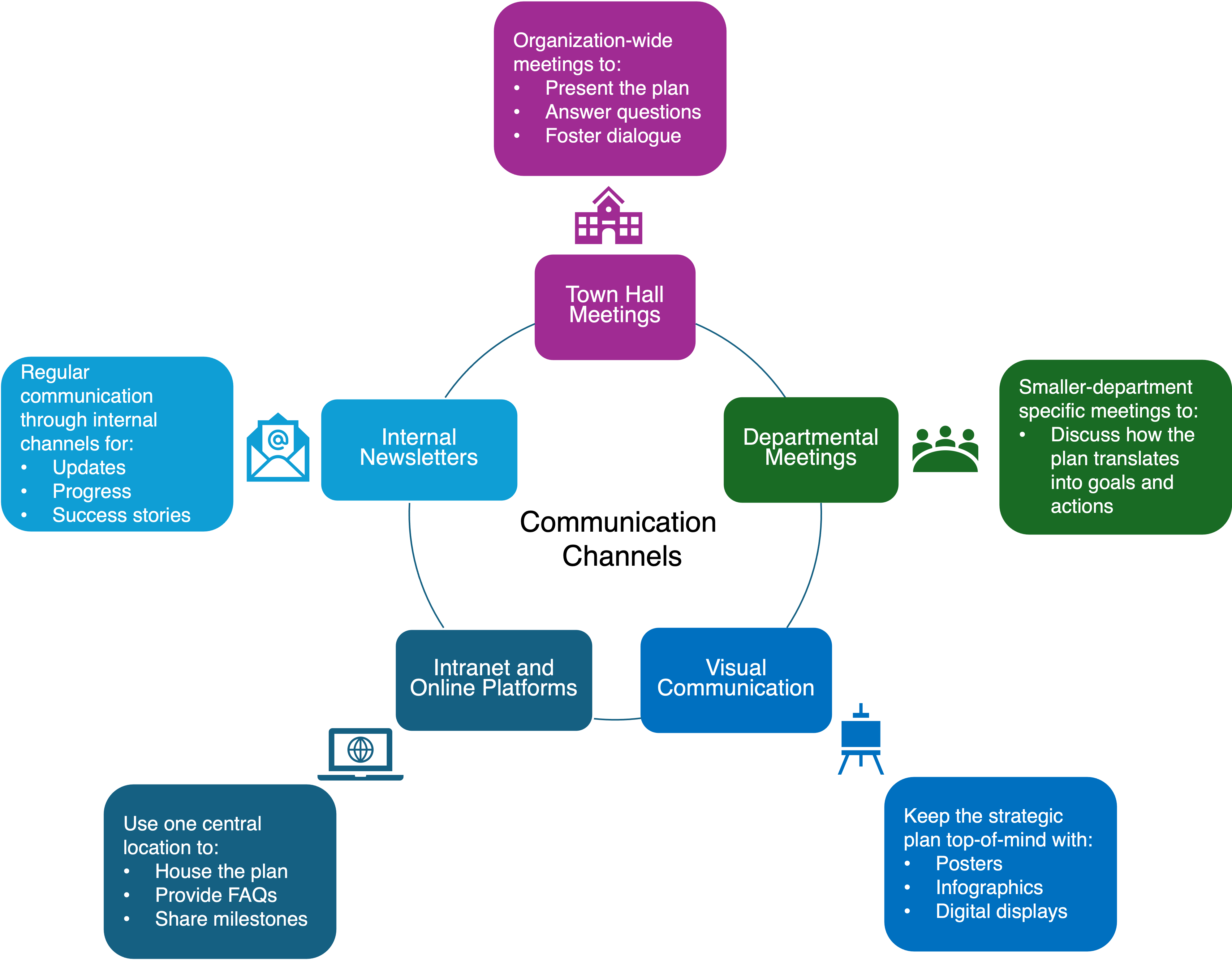
Metcalf’s Law was developed in the context of telecommunications, but the concept is useful for thinking about organizational communication. Nicholas Smith adapted the formula to quantify the number of communication channels in a group: n(n-1)/2, where n equals the number of people in the group.1 For a cardiovascular service line with 100 team members, there are 4,950 potential communication channels. The math is less important than the message: effective communication requires far more repetition and intentionality than leaders often assume. Traditional face-to-face conversations remain important, but they should be reinforced through multiple channels (Figure 1).
Figure 1: Internal Communication Channels
For communication to work, the team must believe leadership is serious about the plan. Too often, strategic planning becomes a task to complete rather than a discipline to manage. The document is finalized, the box is checked, and the plan sits on a shelf, literal or digital, until the next planning cycle. That pattern does more harm than good because it teaches people that planning is ceremonial rather than operational.
Conclusion: Build a Plan That Gets Used
There are several ways to conduct cardiovascular strategic planning, but the effective processes share a few common elements. They are anchored in mission and vision. They involve a broad constituency of stakeholders. They look far enough ahead to create room for strategic thinking. They use structured workgroups to explore key content areas. They synthesize input into a small number of priorities. They communicate those priorities repeatedly. And they hold leaders accountable for execution.
Cardiovascular leaders should resist the temptation to make the plan too large or too complicated. While detailed work may be needed at the department, program or council level, the overall strategy should be easy to understand in a short amount of time. If the people expected to help execute the plan cannot explain it, the plan is not yet clear enough.
Rarely does the strategic planning process produce a single spectacular breakthrough, and that should not be the goal. Major improvement usually comes from a disciplined series of practical actions that build on one another over time. The work may look unremarkable in the moment, but the cumulative effect can be transformational.
A strong cardiovascular strategic plan is not defined by the size of the document or the energy in the retreat room. It is defined by whether the organization can name its priorities, explain why they matter, assign accountable owners and show measurable progress over time. The best plans are practical, concise and durable. They give teams enough direction to act, enough flexibility to adjust, and enough connection to mission that the work feels worth doing. For cardiovascular service lines, successful strategic planning creates a clear roadmap for growth, patient access, quality improvement and long-term community impact.
Ready to turn your vision into action? MedAxiom can help you build a strategic plan that drives results. Get started.
Reference:
1. Smith N. How To Calculate Communication Channels. Sciencing.com. Published April 24, 2017. Accessed February 24, 2025. https://www.sciencing.com/calculate-communication-channels-8015685/.