• Clinical
      |Clinical
    • Acute Coronary Syndromes
    • Cardiac Surgery
    • Covid-19
    • Heart Failure
    • Heart Health
    • Heart Rhythm
    • Hypertension
    • Interventional Cardiology
    • Mitral Valve
    • Pharmaceutics
    • Structural Heart Disease
    • TAVR
    • Tricuspid Valve
    • Vascular & Endovascular
  • Management
      |Management
    • Chest Pain Guidelines
    • Compensation
    • Economics
    • Education & Training
    • Legal News
    • Patient Care
    • Policy & Regulations
    • Professional Associations
    • Quality
    • Revenue
    • Staffing
  • Technology
      |Technology
    • AI
    • Cardiac Imaging
    • Cath Lab
    • CT
    • CVIS
    • ECG
    • Echo
    • EP Lab
    • Informatics
    • MRI
    • Nuclear Cardiology
    • Remote Monitoring
  • Videos
  • Conferences
      |Conferences
    • ACC
    • AHA
    • ASE
    • ASNC
    • ESC
    • EuroPCR
    • HFSA
    • HRS
    • HRS
    • SCAI
    • SCCT
    • SIIM
    • SNMMI
    • STS
    • TCT
    • VIVA
  • Custom Content
      |Custom Content
    • Experience Stories
    • Webinars & Videos
  • Subscribe
  • Forty Under 40 Award
      |Forty Under 40 Award
    • Class of 2026
    • Class of 2025

Search form

Home

News You Need to Know Today
One way AI can help cardiologists | FDA announces catheter recall due to stroke risk | Wearable tech company to go public
Wednesday, March 26, 2025
Link to Twitter Link to Facebook Link to Linkedin Link to Vimeo

Editor's Choice: Heart Rhythm

AI could help cardiologists predict bleeding, stroke risks in AFib patients on DOACs

Researchers developed several new AI models that could guide the management of patients with non-valvular atrial fibrillation. There is still some work to do in terms of accuracy, but they already appear to outperform the traditional risk scores being used today.

READ MORE >
AI cardiology heart artificial intelligence deep learning
Share on Twitter Share on Facebook Share on Linkedin

AI could help cardiologists predict bleeding, stroke risks in AFib patients on DOACs

Share on Twitter Share on Facebook Share on Linkedin
AI cardiology heart artificial intelligence deep learning
Researchers developed several new AI models that could guide the management of patients with non-valvular atrial fibrillation. There is still some work to do in terms of accuracy, but they already appear to outperform the traditional risk scores being used today.
READ MORE >

FDA announces catheter recall for Johnson & Johnson PFA system due to stroke risk

The recall comes after approximately 3% of patients treated with the device during the early stages of its U.S. rollout experienced a stroke or transient ischemic attack following surgery. The expected stroke rate is closer to 1%, the FDA explained.

READ MORE >
The late-breaking U.S. multicenter admIRE clinical trial at the Heart Rhythm Society 2024 meeting, showed positive data on the long-term safety and effectiveness of the the Biosense Webster Varipulse pulsed field ablation (PFA) system in patients with paroxysmal atrial fibrillation. #HRS #HRS2024 #PFA
Share on Twitter Share on Facebook Share on Linkedin

FDA announces catheter recall for Johnson & Johnson PFA system due to stroke risk

Share on Twitter Share on Facebook Share on Linkedin
The late-breaking U.S. multicenter admIRE clinical trial at the Heart Rhythm Society 2024 meeting, showed positive data on the long-term safety and effectiveness of the the Biosense Webster Varipulse pulsed field ablation (PFA) system in patients with paroxysmal atrial fibrillation. #HRS #HRS2024 #PFA
The recall comes after approximately 3% of patients treated with the device during the early stages of its U.S. rollout experienced a stroke or transient ischemic attack following surgery. The expected stroke rate is closer to 1%, the FDA explained.
READ MORE >

‘A new alternative’: Tiny pacemakers for infants show early promise

A team of pediatric specialists worked closely with representative from Medtronic to develop the new pacemakers. Overall, the tiny devices—approximately one-quarter the size of a traditional pacemaker—were found to be both safe and effective. They are still under development.


READ MORE >
Chest X ray in AP projection of a neonate with an epicardial left ventricular bipolar pacing lead connected to a pediatric implantable pulse generator (IPG) in the left upper abdominal pocket. Image and caption courtesy of the American Heart Association and Circulation: Arrhythmia and Electrophysiology.
Share on Twitter Share on Facebook Share on Linkedin

‘A new alternative’: Tiny pacemakers for infants show early promise

Share on Twitter Share on Facebook Share on Linkedin
Chest X ray in AP projection of a neonate with an epicardial left ventricular bipolar pacing lead connected to a pediatric implantable pulse generator (IPG) in the left upper abdominal pocket. Image and caption courtesy of the American Heart Association and Circulation: Arrhythmia and Electrophysiology.
A team of pediatric specialists worked closely with representative from Medtronic to develop the new pacemakers. Overall, the tiny devices—approximately one-quarter the size of a traditional pacemaker—were found to be both safe and effective. They are still under development.
READ MORE >

Wearable heart device company to go public, raise up to $155M

Kestra Medical Technologies, known for its wearable heart monitors and defibrillators, intends to sell 10 million common shares priced somewhere between $14 and $16 per share. 

READ MORE >
Kestra Medical Technologies
Share on Twitter Share on Facebook Share on Linkedin

Wearable heart device company to go public, raise up to $155M

Share on Twitter Share on Facebook Share on Linkedin
Kestra Medical Technologies
Kestra Medical Technologies, known for its wearable heart monitors and defibrillators, intends to sell 10 million common shares priced somewhere between $14 and $16 per share. 
READ MORE >

Abbott’s Amulet LAAO device linked to long-term safety, effectiveness

Researchers explored five-year data from more than 1,800 patients with nonvalvular AFib who underwent LAAO with Abbott's Amulet or Boston Scientific's Watchman 2.5. 

READ MORE >
Amplatzer Amulet Left Atrial Appendage Occluder (LAAO) from Abbott
Share on Twitter Share on Facebook Share on Linkedin

Abbott’s Amulet LAAO device linked to long-term safety, effectiveness

Share on Twitter Share on Facebook Share on Linkedin
Amplatzer Amulet Left Atrial Appendage Occluder (LAAO) from Abbott
Researchers explored five-year data from more than 1,800 patients with nonvalvular AFib who underwent LAAO with Abbott's Amulet or Boston Scientific's Watchman 2.5. 
READ MORE >

In Case You Missed It

New research highlights rising interest in LBBAP

The first patient has been enrolled in a new study of an optimized lead for LBBAP, an area with an explosion of interest in EP as a way to improve patient outcomes.

READ MORE >
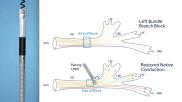
The Medtronic SelectSecure MRI SureScan Model 3830 cardiac lead already gained FDA approval for His-Bundle pacing back in 2018. Now, the lead is also approved for left bundle branch area pacing, providing users with another option when treating patients for bradycardia. According to Medtronic, this marks the first time the FDA has approved a device for this indication.
Share on Twitter Share on Facebook Share on Linkedin

New research highlights rising interest in LBBAP

Share on Twitter Share on Facebook Share on Linkedin
The Medtronic SelectSecure MRI SureScan Model 3830 cardiac lead already gained FDA approval for His-Bundle pacing back in 2018. Now, the lead is also approved for left bundle branch area pacing, providing users with another option when treating patients for bradycardia. According to Medtronic, this marks the first time the FDA has approved a device for this indication.
The first patient has been enrolled in a new study of an optimized lead for LBBAP, an area with an explosion of interest in EP as a way to improve patient outcomes.
READ MORE >

Innovate Healthcare thanks our partners for supporting our newsletters.
Sponsorship has no influence on editorial content.

Interested in reaching our audiences, contact our team

*|LIST:ADDRESSLINE|*

You received this email because you signed up for newsletters from Innovate Healthcare.
Change your preferences or unsubscribe here

Contact Us  |  Unsubscribe from all  |  Privacy Policy

© Innovate Healthcare, a TriMed Media brand
Innovate Healthcare

Recent Newsletters

Medtech giant makes big move | The world’s top hospitals for heart surgery | New CPT codes | PET vs. SPECT | TAVR tech recalled
AI is gaining ground, but clinicians run the show | Siemens Healthineers doubles down | Electrophysiologist compensation
News Alert: FDA shares warning about heart valve tech after patient death
Cardiologist pay & productivity are up | FDA clears PE thrombectomy devices | Cardiology tech in spotlight | Gore's new approval
Cardiology salaries on the rise | The climbing costs of care | M&A trends | Siemens Healthineers, J&J make big business moves
Major MRI trends | Blood thinner recalled | When to perform PCI before TAVR | How to build a CCTA program | Steroids & the heart
CMS boosts coverage for heart failure tech | FDA approves CardioMEMS updates | LVADs linked to strokes, other risks
Newsletter archive
  • Home
  • News
  • Article Archive
  • Custom Content
  • Webinars
  • Press Releases
  • Content Studio
  • Advertising
  • Submit Press Release
  • Contact Us
  • Terms of Use
  • Privacy Policy
  • Cardiovascular Business
  • HealthExec
  • Radiology Business
  • Press Releases
  • Submit Press Release
© 2026 Innovate Healthcare | All Rights Reserved. | Terms of Use | Privacy Policy
Design by Adaptive Theme
Trimed Popup