• Clinical
      |Clinical
    • Acute Coronary Syndromes
    • Cardiac Surgery
    • Covid-19
    • Heart Failure
    • Heart Health
    • Heart Rhythm
    • Hypertension
    • Interventional Cardiology
    • Mitral Valve
    • Pharmaceutics
    • Structural Heart Disease
    • TAVR
    • Tricuspid Valve
    • Vascular & Endovascular
  • Management
      |Management
    • Chest Pain Guidelines
    • Compensation
    • Economics
    • Education & Training
    • Legal News
    • Patient Care
    • Policy & Regulations
    • Professional Associations
    • Quality
    • Revenue
    • Staffing
  • Technology
      |Technology
    • AI
    • Cardiac Imaging
    • Cath Lab
    • CT
    • CVIS
    • ECG
    • Echo
    • EP Lab
    • Informatics
    • MRI
    • Nuclear Cardiology
    • Remote Monitoring
  • Videos
  • Conferences
      |Conferences
    • ACC
    • AHA
    • ASE
    • ASNC
    • ESC
    • EuroPCR
    • HFSA
    • HRS
    • HRS
    • SCAI
    • SCCT
    • SIIM
    • SNMMI
    • STS
    • TCT
    • VIVA
  • Custom Content
      |Custom Content
    • Experience Stories
    • Webinars & Videos
  • Subscribe
  • Forty Under 40 Award
      |Forty Under 40 Award
    • Class of 2026
    • Class of 2025

Search form

Home

News You Need to Know Today
How to integrate AI into existing workflows | New CCTA recommendations | GE HealthCare announces 3 new ultrasound systems
Monday, September 7, 2026
Link to Twitter Link to Facebook Link to Linkedin Link to Vimeo

Editor's Choice: Cardiac Imaging

How to integrate AI into cardiac imaging workflows

Implementing advanced AI models into daily practice takes much more than simply installing software. It requires a clinical champion and multiple stakeholders to coordinate the effort.

READ MORE >
Ron Blankstein, FACC, FASNC, FSCCT, FASPC, director of cardiac computed tomography, Brigham and Women's Hospital, and professor of medicine, radiology, at Harvard Medical School, explains how cardiac imaging departments need to plan for the involved process of integrating artificial intelligence (AI) algorithms into clinical practice. #SCCT #YesCCT
Share on Twitter Share on Facebook Share on Linkedin

How to integrate AI into cardiac imaging workflows

Share on Twitter Share on Facebook Share on Linkedin
Ron Blankstein, FACC, FASNC, FSCCT, FASPC, director of cardiac computed tomography, Brigham and Women's Hospital, and professor of medicine, radiology, at Harvard Medical School, explains how cardiac imaging departments need to plan for the involved process of integrating artificial intelligence (AI) algorithms into clinical practice. #SCCT #YesCCT
Implementing advanced AI models into daily practice takes much more than simply installing software. It requires a clinical champion and multiple stakeholders to coordinate the effort.
READ MORE >

SCCT shares updated CCTA recommendations

A lot has changed in the world of CCTA since the previous guideline was published back in 2014. This new expert consensus document was developed by an international team of imaging experts.

READ MORE >
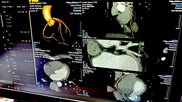
 The Society of Cardiovascular Computed Tomography (SCCT) this week released a new expert consensus document on interpretation and reporting of coronary CT angiography (CCTA). The update replaced the 2014 guidance and incorporates advances in scanner technology, image reconstruction, plaque assessment and revised standardized reporting incorporating CAD-RADS 2.0. Image in Philips booth at RSNA 2025, photo by Dave Fornell.
Share on Twitter Share on Facebook Share on Linkedin

SCCT shares updated CCTA recommendations

Share on Twitter Share on Facebook Share on Linkedin
 The Society of Cardiovascular Computed Tomography (SCCT) this week released a new expert consensus document on interpretation and reporting of coronary CT angiography (CCTA). The update replaced the 2014 guidance and incorporates advances in scanner technology, image reconstruction, plaque assessment and revised standardized reporting incorporating CAD-RADS 2.0. Image in Philips booth at RSNA 2025, photo by Dave Fornell.
A lot has changed in the world of CCTA since the previous guideline was published back in 2014. This new expert consensus document was developed by an international team of imaging experts.
READ MORE >

FDA clears new imaging software from AI company founded by cardiologists

The new software from Tennessee-based Heartvue.ai uses advanced AI algorithms to view, process and evaluate cardiac MRI scans. It was built to work with any existing cardiology or radiology workflow.

READ MORE >
artificial intelligence AI predictive analytics
Share on Twitter Share on Facebook Share on Linkedin

FDA clears new imaging software from AI company founded by cardiologists

Share on Twitter Share on Facebook Share on Linkedin
artificial intelligence AI predictive analytics
The new software from Tennessee-based Heartvue.ai uses advanced AI algorithms to view, process and evaluate cardiac MRI scans. It was built to work with any existing cardiology or radiology workflow.
READ MORE >

Are sex-specific thresholds needed for coronary CT?

The question is further complicated by possibly needing different thresholds for pregnant, premenopausal, and postmenopausal woman.

READ MORE >
Purvi Parwani, MD, MPH, FACC, MBBS, cardiologist and assistant professor of medicine, director of the Women’s Heart Health Clinic, Loma Linda University Health, explains evidence that sex specific cut offs for treatment and risk factors in coronary CT angiography (CCTA) metrics may be needed because women often fall out of range in some risk measures for plaque, FFR-CT and stenosis. #SCCT #YesCCT #womenhearthealth
Share on Twitter Share on Facebook Share on Linkedin

Are sex-specific thresholds needed for coronary CT?

Share on Twitter Share on Facebook Share on Linkedin
Purvi Parwani, MD, MPH, FACC, MBBS, cardiologist and assistant professor of medicine, director of the Women’s Heart Health Clinic, Loma Linda University Health, explains evidence that sex specific cut offs for treatment and risk factors in coronary CT angiography (CCTA) metrics may be needed because women often fall out of range in some risk measures for plaque, FFR-CT and stenosis. #SCCT #YesCCT #womenhearthealth
The question is further complicated by possibly needing different thresholds for pregnant, premenopausal, and postmenopausal woman.
READ MORE >

GE HealthCare announces 3 new ultrasound imaging systems

Each system is powered by GE HealthCare's cSound imaging architecture and includes advanced AI capabilities.

READ MORE >
GE HealthCare has unveiled three major new additions to its Vivid cardiovascular ultrasound portfolio: Vivid Explorer, Vivid Advanced and Vivid Focus.
Share on Twitter Share on Facebook Share on Linkedin

GE HealthCare announces 3 new ultrasound imaging systems

Share on Twitter Share on Facebook Share on Linkedin
GE HealthCare has unveiled three major new additions to its Vivid cardiovascular ultrasound portfolio: Vivid Explorer, Vivid Advanced and Vivid Focus.
Each system is powered by GE HealthCare's cSound imaging architecture and includes advanced AI capabilities.
READ MORE >

The burnout crisis among cardiac CT specialists is getting worse

Six in 10 cardiovascular imagers report feelings of burnout, and many of them are thinking about leaving the field altogether. 

READ MORE >
Kavitha Chinnaiyan, MD, immediate past-president of the SCCT, and a professor of medicine at Corewell Health William Beaumont University Hospital, Royal Oak, Michigan, explains how to prevent workforce burnout and promote well-being in cardiac CT. #SCCT #SCCT2026 #YesCCT
Share on Twitter Share on Facebook Share on Linkedin

The burnout crisis among cardiac CT specialists is getting worse

Share on Twitter Share on Facebook Share on Linkedin
Kavitha Chinnaiyan, MD, immediate past-president of the SCCT, and a professor of medicine at Corewell Health William Beaumont University Hospital, Royal Oak, Michigan, explains how to prevent workforce burnout and promote well-being in cardiac CT. #SCCT #SCCT2026 #YesCCT
Six in 10 cardiovascular imagers report feelings of burnout, and many of them are thinking about leaving the field altogether. 
READ MORE >

Digital twin technology shows ability to personalize ablation planning

Digital twins may be used in the near future to help clinicians plan ahead before EP ablation procedures. They could preview how the patient's heart will react to treatment, for example, increasing the odds of a positive outcome.

READ MORE >
Natalia Trayanova, PhD, FNAI, FHRS, FAHA, FACC, FESC, FEHRA, FIAMBE, FBMES, FAIMBE, FIUPS, FIEEE, Professor of Biomedical Engineering, Director of the Alliance for Cardiovascular Diagnostic and Treatment innovation (ADVANCE), and director of AI research in health and medicine, at the Data Science and AI Institute at Johns Hopkins University, explains how her team has developed a digital twin to copy the electrical function of a specific patient's heart to test various ablation strategies.
Share on Twitter Share on Facebook Share on Linkedin

Digital twin technology shows ability to personalize ablation planning

Share on Twitter Share on Facebook Share on Linkedin
Natalia Trayanova, PhD, FNAI, FHRS, FAHA, FACC, FESC, FEHRA, FIAMBE, FBMES, FAIMBE, FIUPS, FIEEE, Professor of Biomedical Engineering, Director of the Alliance for Cardiovascular Diagnostic and Treatment innovation (ADVANCE), and director of AI research in health and medicine, at the Data Science and AI Institute at Johns Hopkins University, explains how her team has developed a digital twin to copy the electrical function of a specific patient's heart to test various ablation strategies.
Digital twins may be used in the near future to help clinicians plan ahead before EP ablation procedures. They could preview how the patient's heart will react to treatment, for example, increasing the odds of a positive outcome.
READ MORE >

AI-powered opportunistic screening could help find patients with undetected aortic stenosis

Having AI that can recognize and report signs of aortic stenosis in noncardiac imaging scans would make a major impact on patient care. 

READ MORE >
Aortic stenosis opportunistic CT AI imaging from SCCT 2026 presentation by Ofir Koren, MD, Cedards-Sinai.
Share on Twitter Share on Facebook Share on Linkedin

AI-powered opportunistic screening could help find patients with undetected aortic stenosis

Share on Twitter Share on Facebook Share on Linkedin
Aortic stenosis opportunistic CT AI imaging from SCCT 2026 presentation by Ofir Koren, MD, Cedards-Sinai.
Having AI that can recognize and report signs of aortic stenosis in noncardiac imaging scans would make a major impact on patient care. 
READ MORE >

Incidental CT findings help predict TAVR mortality

Incidental lung findings can help identify TAVR patients who may require additional follow-up care after treatment. 

READ MORE >
Tablet projecting metaphorical medical hologram
Share on Twitter Share on Facebook Share on Linkedin

Incidental CT findings help predict TAVR mortality

Share on Twitter Share on Facebook Share on Linkedin
Tablet projecting metaphorical medical hologram
Incidental lung findings can help identify TAVR patients who may require additional follow-up care after treatment. 
READ MORE >

FDA clears Bracco’s new ultrasound contrast delivery system for cardiovascular imaging

The VueJect ultrasound contrast delivery system was designed to improve workflow efficiency and provide consistency from one user to the next.

READ MORE >
Bracco Imaging has secured U.S. Food and Drug Administration (FDA) clearance for VueJect, a new ultrasound contrast delivery system built specifically for cardiovascular imaging procedures. This represents the latest addition to Bracco’s contrast-enhanced ultrasound (CEUS) portfolio.
Share on Twitter Share on Facebook Share on Linkedin

FDA clears Bracco’s new ultrasound contrast delivery system for cardiovascular imaging

Share on Twitter Share on Facebook Share on Linkedin
Bracco Imaging has secured U.S. Food and Drug Administration (FDA) clearance for VueJect, a new ultrasound contrast delivery system built specifically for cardiovascular imaging procedures. This represents the latest addition to Bracco’s contrast-enhanced ultrasound (CEUS) portfolio.
The VueJect ultrasound contrast delivery system was designed to improve workflow efficiency and provide consistency from one user to the next.
READ MORE >

Innovate Healthcare thanks our partners for supporting our newsletters.
Sponsorship has no influence on editorial content.

Interested in reaching our audiences, contact our team

*|LIST:ADDRESSLINE|*

You received this email because you signed up for newsletters from Innovate Healthcare.
Change your preferences or unsubscribe here

Contact Us  |  Unsubscribe from all  |  Privacy Policy

© Innovate Healthcare, a TriMed Media brand
Innovate Healthcare

Recent Newsletters

Medtech giant makes big move | The world’s top hospitals for heart surgery | New CPT codes | PET vs. SPECT | TAVR tech recalled
AI is gaining ground, but clinicians run the show | Siemens Healthineers doubles down | Electrophysiologist compensation
News Alert: FDA shares warning about heart valve tech after patient death
Cardiologist pay & productivity are up | FDA clears PE thrombectomy devices | Cardiology tech in spotlight | Gore's new approval
Cardiology salaries on the rise | The climbing costs of care | M&A trends | Siemens Healthineers, J&J make big business moves
Major MRI trends | Blood thinner recalled | When to perform PCI before TAVR | How to build a CCTA program | Steroids & the heart
CMS boosts coverage for heart failure tech | FDA approves CardioMEMS updates | LVADs linked to strokes, other risks
Newsletter archive
  • Home
  • News
  • Article Archive
  • Custom Content
  • Webinars
  • Press Releases
  • Content Studio
  • Advertising
  • Submit Press Release
  • Contact Us
  • Terms of Use
  • Privacy Policy
  • Cardiovascular Business
  • HealthExec
  • Radiology Business
  • Press Releases
  • Submit Press Release
© 2026 Innovate Healthcare | All Rights Reserved. | Terms of Use | Privacy Policy
Design by Adaptive Theme
Trimed Popup