
Q&A: How IVL helps this cardiologist treat NYC’s sickest patients
Dimitrios Bliagos, MD, associate director of interventional cardiology with NYU Langone Health, has always liked treating challenging patients. If they get turned away elsewhere, he says, he wants the opportunity to step in and make a difference.
It’s a passion that started at Columbia University. Bliagos trained under the guidance of world-renowned interventionalists Jeffrey Moses, MD, and Martin B. Leon, MD—and continues to practice a little further downtown at NYU, where he helps lead one of the top cardiology programs in the United States.
Bliagos treats patients with chronic total occlusions (CTOs), low ejection fractions and other high-risk symptoms. Many of them, he says, present with severe coronary calcification that make it difficult to perform percutaneous coronary intervention (PCI). And that’s where intravascular lithotripsy (IVL) comes in.
“Dealing with calcium is a multiple times-per-day endeavor here at NYU,” Bliagos says. “Having IVL to break down that calcium has been huge for us as we continue to see these high-risk patients.”
Bliagos spoke to Cardiovascular Business about IVL and how it has evolved and impacted his patient care. Read the full conversation below:
Cardiovascular Business: The rise of IVL has been one of healthcare’s biggest ongoing trends. Why is this technology so important to interventional cardiologists?
We've had IVL at NYU for several years now and have treated a large number of patients with it. As the technology continues to evolve and gain wider adoption, it's fundamentally changing how we approach coronary calcium.
PCI is already technically challenging. The coronary arteries have complex geometry and tortuosity that aren't always fully appreciated on angiography because we're interpreting a three-dimensional structure from two-dimensional images. When you add heavily calcified plaque to the equation, the procedure becomes even more difficult. Calcium creates significant resistance, making it harder to deliver and expand devices—and in some cases, equipment can even become trapped.
“I don’t think you can really have a cath lab nowadays without having IVL on your shelf.”
— Dimitrios Bliagos, MD, Associate Director of Interventional Cardiology, NYU Langone Health

Having a technology like IVL that modifies calcium before stent implantation has been transformative. In the past, if a calcified lesion wouldn't adequately expand, our options were limited. Even with atherectomy or specialty balloons, achieving optimal lesion preparation could be difficult. IVL has given us another highly effective tool to fracture deep calcium, improve lesion compliance, and achieve better stent expansion.
That matters because optimal stent expansion is one of the strongest predictors of long-term procedural success. By improving stent expansion, IVL helps us reduce the patient's risk of future adverse cardiovascular events while allowing us to treat even the most complex calcified lesions with greater confidence.
How else has IVL changed patient care?
Before IVL, one of the biggest challenges in treating severe coronary calcification was our reliance on atherectomy. Atherectomy remains an important part of our practice at NYU, and we use it routinely. But that level of experience isn't universal. It requires technical expertise, and many operators perform it less frequently.
IVL is much more intuitive because it is delivered like a standard balloon catheter, making it easier to incorporate into everyday practice. That lowers the barrier to treating complex calcified lesions, particularly for physicians who are less experienced with atherectomy.
The result is that more interventional cardiologists can confidently treat patients with severe coronary calcium rather than referring them elsewhere or opting for less effective strategies. Ultimately, that's a win for patients. It expands access to advanced calcium modification, allows more people to receive appropriate PCI and helps physicians deliver better outcomes in cases that were once considered especially difficult.
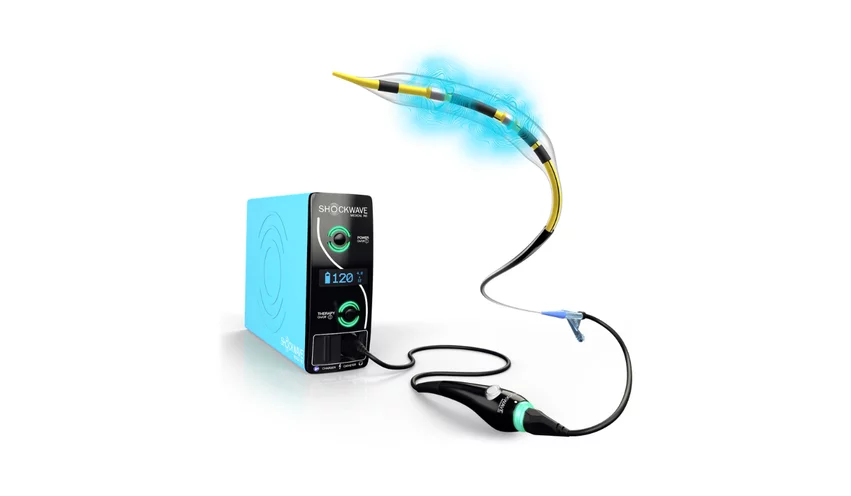
Shockwave Medical launched its next-generation coronary IVL catheter, the Shockwave C2 Aero, in May 2026. What has been your experience with the new device?
There have been several meaningful improvements with the C2 Aero. The balloon itself has evolved—it has a lower crossing profile and is much easier to deliver through the coronary arteries. You can now reach lesions that were much more difficult, if not impossible, to access with earlier generations of the technology.
The C2 Aero has also simplified procedural workflow. Previous IVL balloons were bulkier, and it often took significant effort just to get the device to the lesion so you could begin modifying the calcium. In some cases, you couldn't even reach the lesion, forcing you to switch to atherectomy. With the C2 Aero, routine pre-dilatation with a non-compliant balloon is often all that's needed before advancing the IVL balloon. In many cases, we can now bypass atherectomy altogether and proceed directly to IVL.
Another important improvement is the reduced downtime between pulse sequences. Earlier IVL systems required a 10-second pause after every 10 pulses before treatment could resume. With the C2 Aero, that interval has been reduced to about five seconds. While that may seem like a small change, it adds up quickly during longer cases where you're delivering 100 or 120 pulses.
In interventional cardiology, every second matters. A few seconds saved at each step can translate into a noticeably more efficient procedure, benefiting both the operator and the patient.
How do these improvements affect outcomes?
Less preparation translates into shorter procedures, and shorter procedures are better for patients. They also improve efficiency for physicians, cath labs, and hospitals.
Another important benefit is that we can avoid atherectomy in many cases. While atherectomy remains an excellent tool when it's needed, it is associated with a slightly higher risk of complications such as periprocedural myocardial infarction and coronary perforation. If we can achieve adequate calcium modification with IVL alone, we can often reduce those procedural risks while still achieving an excellent result.
Ultimately, the combination of improved deliverability, a more streamlined workflow and reduced reliance on atherectomy makes the C2 Aero an important advancement for treating patients with heavily calcified coronary disease.
You specialize in treating the most challenging heart patients. How does IVL help you and your colleagues take care of those patients?
We stay incredibly busy here at NYU. I'll probably perform around 600 PCIs this year alone. Our patients come from all over the region. New York is a highly competitive environment, and we receive referrals from other physicians as well as patients who seek us out for second opinions.
Many of these patients have severe, long-standing coronary artery disease that went undiagnosed or untreated for years. They often present with decompensated heart failure, diabetes, a significant smoking history, and multiple other comorbidities. They're frequently very frail, and it's our responsibility to provide the safest and most effective care possible.
IVL has become an essential part of how I care for these patients every day. It allows us to treat heavily calcified coronary lesions in a way that's both safe and efficient. These are not patients you want spending unnecessary time in the cath lab. The sooner we can perform a successful intervention, the sooner they can begin their recovery. IVL has played a meaningful role in helping us achieve that goal.
Would you recommend this technology to other interventional cardiologists?
Oh, there’s no doubt. I don’t think you can really have a cath lab nowadays without having IVL on your shelf.
It is one of the essential tools of the trade now. I don’t know where we’d be without it.

Michael has more than 19 years of experience as a professional writer and editor. He has written at length about cardiology, radiology, artificial intelligence and other key healthcare topics.