
Cleerly's AI-powered plaque assessments outperform cardiac stress testing
Artificial intelligence (AI)-guided care based on coronary CT angiography (CCTA) evaluations outperformed the standard of care, according to late-breaking data presented at the American Heart Association's Scientific Sessions 2026.
The PARAMOUNT trial is believed to be the first randomized trial comparing advanced AI evaluations of CCTA results with usual care based on stress testing. Overall, the AI did much better, pinpointing ischemic coronary artery disease (CAD) 46.7% of the time compared to usual care detecting it 23.4% of the time.
PARAMOUNT met its primary prespecified hierarchical composite endpoint at 180 days. AI-enabled plaque assessments were favored over usual care with a win difference of 16.6 percentage points. Diagnostic certainty and lowering LDL-C drove the result. The data show there was improved certainty if a patient’s chest pain was caused by CAD.
“For decades, we’ve evaluated patients with chest pain by looking for blockages or reduced blood flow,” Todd C. Villines, MD, co-principal investigator of PARAMOUNT and the Donald C. Barnes Professor of Cardiology in Internal Medicine at the University of Virginia, said in a statement. “PARAMOUNT shows that when we measure plaque directly and use it to guide care, physicians gain clearer answers and patients are far more likely to start preventive therapy."
Villines said plaque-based care resulted in more certainty about each patient's condition, which resulted in significantly fewer patients without obstructive CAD being sent to the cath lab. For patients who were sent on for invasive coronary angiography, 62% of patients in the AI-guided arm needed to be revascularized with percutaneous coronary intervention (PCI) or bypass surgery (CABG) compared to 40% in the usual care arm.
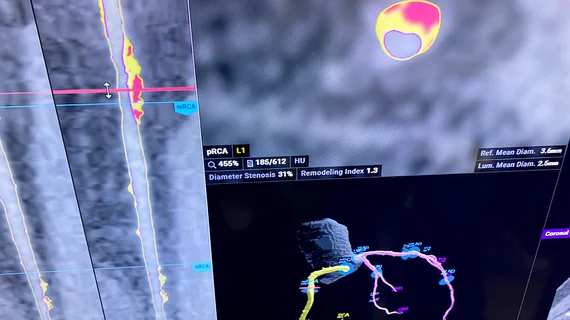
The trial used Cleerly's AI-based quantitative coronary CT analysis (AI-QCT) technology to quantify coronary soft plaques and create a plaque-based ischemia assessment. This information improved diagnostic certainty and led to more patients receiving lipid-lowering therapy.
PARAMOUNT enrolled 530 patients between January 2025 and February 2026 at 21 sites. They were randomized to either receive care guided by AI-QCT or usual care guided by functional stress testing. Women made up 57% of participants, a rare majority in cardiovascular research, where women have historically been underrepresented.

Dave Fornell has covered healthcare for more than 17 years, with a focus in cardiology and radiology. Fornell is a 5-time winner of a Jesse H. Neal Award, the most prestigious editorial honors in the field of specialized journalism. The wins included best technical content, best use of social media and best COVID-19 coverage. Fornell was also a three-time Neal finalist for best range of work by a single author. He produces more than 100 editorial videos each year, most of them interviews with key opinion leaders in medicine. He also writes technical articles, covers key trends, conducts video hospital site visits, and is very involved with social media. E-mail: [email protected]