
Single injection could help heal heart attack damage
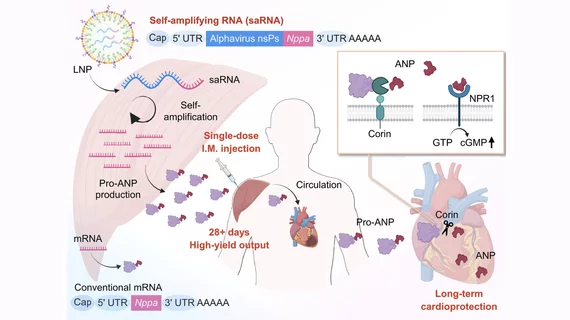
A team of researchers from Columbia University, Oxford and Texas A&M University believe one injection in the arm might be able to heal myocardial tissue following heart attacks for weeks after the initial injury. Their analysis was published this month in Science.[1]
Myocardial infarction (MI) causes an irreversible loss of cardiomyocytes and remodeling of the heart which can lead to heart failure. While previous research to help repair the heart has focused on stem cells, this new approach might have a better effect in addition to being easier to implement.
One of the body’s natural responses after MIs is to release a hormone called atrial natriuretic peptide (ANP) that helps reduce stress on the heart and limit long‑term damage. Unfortunately, the body only produces small amounts that are not enough to make a major difference in recovery, so researchers focused on ways to try to increase ANP production.
It was known that ANP, encoded by natriuretic peptide type A (Nppa), has strong expression observed in neonatal hearts. The team used a self-amplifying RNA (saRNA) therapy to drive additional Nppa expression in adults who experience a heart attack. A single injection of saRNA into mice induced robust ANP secretion lasting at least four weeks, outperforming the use of a similar delivery system using messenger RSNA (mRNA) at equivalent doses.
"In mouse models of acute MI and ischemia/reperfusion injury, saNppa treatment markedly improved left ventricular ejection fraction, reduced infarct size, and attenuated fibrosis. These therapeutic benefits were consistently reproduced in aged, atherosclerotic, and diabetic MI models. In addition, large-animal studies in a swine ischemia/reperfusion model further confirmed that a single intramuscular injection effectively preserved cardiac function and limited maladaptive remodeling," the authors wrote.
The researchers said that single-nucleus transcriptomics showed that saNppa treatment reshaped the profile of the natriuretic peptide receptor 1–positive (Npr1+) on endothelial and epicardial cells. This created a microenvironment that promoted cardiomyocyte cell-cycle reentry and suppressed fibrotic processes that lead to fibrosis and scar tissue in infarct tissue. They said the saNppa treatment safety assessments only found short durations of local inflammation.
“This is about helping the heart tap into its own healing mechanisms,” co-author Ke Huang, MD, PhD, assistant professor of pharmaceutical sciences with the Texas A&M Irma Lerma Rangel College of Pharmacy, said in a statement. “We’re trying to give patients a treatment that works with the body rather than against it. And the idea that a single shot might offer support for weeks is very exciting.”
He said the goal is to protect the heart when it is most vulnerable during immediate recovery by relieving early stress and supporting repair. This may be able to avoid the common trajectory in patients toward heart failure and reduce the risk of long‑term complications.
The team still needs to continue study of the safety, timing and dosing before this therapy can enter human trials. But the simplicity of a single injection makes its future potential promising.
“It’s easy to imagine a treatment like this being given quickly and safely,” Huang said. “That accessibility is what makes this work so compelling. If future studies continue to show strong results, this could become a meaningful new tool for heart attack care.”

Dave Fornell has covered healthcare for more than 17 years, with a focus in cardiology and radiology. Fornell is a 5-time winner of a Jesse H. Neal Award, the most prestigious editorial honors in the field of specialized journalism. The wins included best technical content, best use of social media and best COVID-19 coverage. Fornell was also a three-time Neal finalist for best range of work by a single author. He produces more than 100 editorial videos each year, most of them interviews with key opinion leaders in medicine. He also writes technical articles, covers key trends, conducts video hospital site visits, and is very involved with social media. E-mail: [email protected]