
Impella 5.5 shows promise in certain non-shock, high-risk cardiac surgery patients
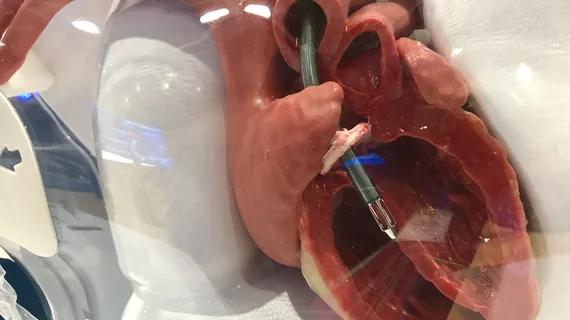
One of the key trials presented at the 106th Annual Meeting of the American Association for Thoracic Surgery (AATS) in Chicago looked at using planned Impella 5.5 hemodynamic support prior to weaning high-risk patients off of cardiopulmonary bypass. The IMPACT (IMpella Protected cArdiaC surgery Trial) data showed favorable post-operative outcomes and may pave the way for a new strategy to lower adverse events in high-risk patients.
This analysis evaluated 100 non-shock cardiac surgery patients with a left ventricular ejection fraction (LVEF) at or below 35%. These patients traditionally have much higher perioperative risks, including increased rates off renal failure, stroke, post-cardiotomy cardiogenic shock and death.
Overall, researchers found that this practice, which is not yet approved by the U.S. Food and Drug Administration, was both safe and feasible.
“IMPACT was designed to evaluate whether a planned strategy of prophylactic Impella 5.5 support initiated prior to separation from cardiopulmonary bypass could be implemented safely and feasibly in high-risk cardiac surgery patients who are particularly vulnerable to post-cardiotomy heart failure,” Edward Soltesz, MD, MPH, surgical director of the Kaufman Center for Heart Failure and Recovery at Cleveland Clinic and the study's principal investigator, said in a statement from Abiomed/Johnson & Johnson MedTech. “These early positive findings support the feasibility of this approach and provide an important foundation for future studies focused on improving outcomes in this challenging patient population.”
The Impella 5.5 microaxial flow pump is already a primary therapy of choice for post-cardiotomy shock and low cardiac output syndrome. The device is specifically included in the 2025 guidelines from the European Association for Cardiothoracic Surgery (EACTS), the Society of Thoracic Surgeons (STS) and AATS. These guidelines categorize the early use of temporary mechanical circulatory support as a Class I recommendation for patients with cardiogenic shock to improve survival and prevent organ damage.
With that established recommendation in mind, the IMPACT trial set out to see if the Impella 5.5 could be used to help smooth the fragile transition period when patients are weened off of bypass.
The Impella device in this trial is the largest microaxial catheter heart pump made by Abiomed/Johnson & Johnson MedTech, offering 5.5 liters per minute of forward flow. Although the pump is housed in a catheter delivered into the left ventricle of the heart, its large 21 French size requires a surgical cut down of the artery to gain vascular access.
The smaller Impella CP pumps have a 14 French outer diameter pump and are more commonly used in percutaneous coronary interventions (PCI) where they can be delivered without the need for surgical cut downs. They offer flow rates up to 4.7 L/min.
“IMPACT results set the stage for future study of planned Impella 5.5 use in this complex high-risk patient population,” Navin Kapur, MD, chief medical and scientific officer of heart recovery with Johnson & Johnson MedTech, said in the same statement.
Extended use of Impella 5.5 gaining popularity
Another session from the AATS annual meeting focused at using Impella 5.5 devices for periods of more than the indicated 14 days. Researchers analyzed data from the SURPASS Registry, a prospective, multi-center observational study. A total of 1,015 patients were included from 15 participating centers. Of these, 243 were supported for an extended period beyond 14 days, and data was compared with the bulk of patients treated for 14 days or less. There were no major differences, which may open the door to wider long-term use.
"Extended duration of support with Impella 5.5 has become increasingly common, with 28% of patients in this cohort supported for more than 14 days," explained Ahmad Zeeshan, MD, a cardiothoracic surgeon who is part of the shock, ECMO, LVAD, heart and lung transplant programs at Advent Health Orlando. He presented the findings during the annual meeting.
Patients with extended support were younger and predominately supported due to acute decompensated heart failure (ADHF). More than 63% received other mechanical circulatory support prior to the Impella 5.5

Dave Fornell has covered healthcare for more than 17 years, with a focus in cardiology and radiology. Fornell is a 5-time winner of a Jesse H. Neal Award, the most prestigious editorial honors in the field of specialized journalism. The wins included best technical content, best use of social media and best COVID-19 coverage. Fornell was also a three-time Neal finalist for best range of work by a single author. He produces more than 100 editorial videos each year, most of them interviews with key opinion leaders in medicine. He also writes technical articles, covers key trends, conducts video hospital site visits, and is very involved with social media. E-mail: [email protected]