
New off-the-shelf conduit for CABG shows promise in first-in-human study

A new bioengineered medical device has shown early potential to function as a reliable off-the-shelf conduit during coronary artery bypass graft (CABG) procedures. More research is still required, but a first-in-human analysis published in JACC: Case Reports suggests the device could be an effective alternative to saphenous vein grafts.[1]
The device in question was an acellular tissue-engineered vessel (ATEV) with an external support structure (ESS) developed by Vascudyne, a Minnesota-based medtech company focused on developing bioengineered devices for the treatment of cardiovascular disease. It is capable of regenerating into a living vessel.
“Efforts to develop off-the-shelf conduits for CABG have historically been unsuccessful, particularly in the small-diameter coronary setting,” wrote first author Adrian Ebner, MD, a cardiovascular specialist with Sanatorio Italiano Hospital in Asunción, Paraguay, and colleagues. “Synthetic vascular grafts that perform adequately in large-diameter, high-flow peripheral applications have consistently failed in coronary-sized targets due to thrombosis and neointimal hyperplasia. The coronary circulation presents unique biological and hemodynamic challenges, including low-flow states and high sensitivity to endothelial dysfunction, which demand rapid endothelialization and biologic integration, features not achieved by traditional prosthetic materials. ATEVs represent a different paradigm: the vessels are designed to support host-mediated endothelialization and smooth muscle repopulation, enabling biological integration with the native coronary circulation while providing immediate availability.”
Ebner et al. explored the device’s potential in three patients who presented with multivessel coronary artery disease that was confirmed with angiography. These patients were all between the ages of 45 and 75 years old with a life expectancy of at least four years.
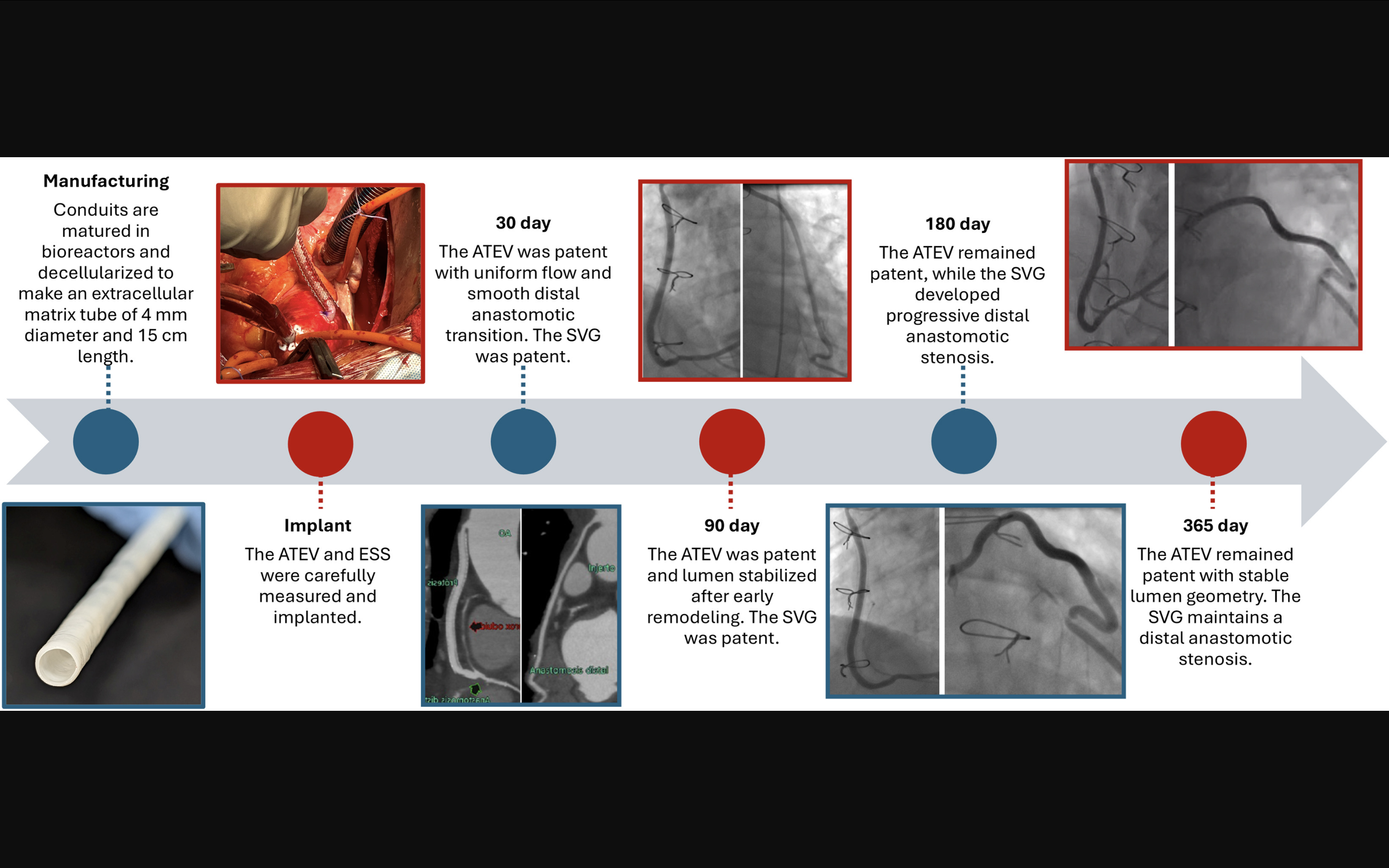
Timeline for a new first-in-human clinical trial focused on a new-look medical device from Vascudyne. Graphic courtesy of JACC: Case Reports and Ebner et al.
All patients received a left internal mammary artery to left anterior descending artery graft as the primary bypass. The first implant was aborted early due to a length mismatch, and the patient received a standard CABG procedure. The other two implant procedures, however, were a success. The implanted ATEVs were patent after six months with no signs of thrombus formation, bleeding or any other major adverse cardiac or cerebrovascular events. One of the two implants occluded before the end of the first year due to proximal anastomotic distortion. The other implant was still patent after 12 months.
“The observed 12-month patency without device-related events in a planned coronary target supports the broader clinical evaluation of the tissue-engineered conduit as an off-the-shelf alternative to a saphenous vein graft for coronary artery bypass,” the authors wrote.
Ebner and colleagues also emphasized that the use of off-the-shelf conduits saves patients from the significant risks of harvesting.
“Collectively, these early findings support expanded clinical evaluation of the ATEV-ESS as a regenerative coronary bypass conduit for patients lacking suitable autologous vessels,” they concluded.
Click here to read the full first-in-human analysis in JACC: Case Reports, an American College of Cardiology journal.
Vascudyne feeling ‘energized’ after first-in-human analysis
Vascudyne issued a statement to help put a spotlight on these new data.
“We believe these early findings support expanded clinical evaluation of the ATEV as a regenerative alternative for coronary bypass,” the company wrote. “There is much more work ahead, and we’re energized by the path forward.”

Michael has more than 19 years of experience as a professional writer and editor. He has written at length about cardiology, radiology, artificial intelligence and other key healthcare topics.