
Researchers receive $3.2M in federal funding to test new heart pump for children
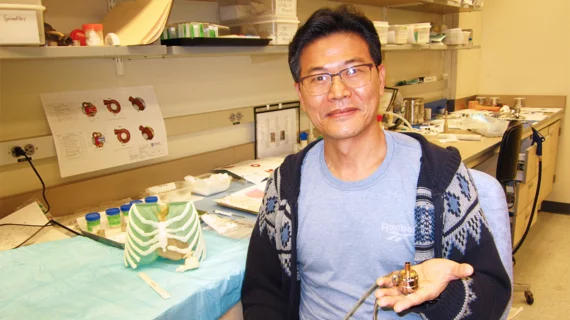
The National Heart Lung and Blood Institute is funding continuing development of a small ventricular assist device (VAD) for pediatric patients.
The institute previously funded work on a prototype device, the PSU Child VAD, designed to serve as a long-term bridge to heart transplant for patients between the ages of one and 11 years old. The device acts like a pump, helping sustain the young patient’s heart while they await good news about a new heart.
The U.S. Food and Drug Administration (FDA) has previously given a greenlight to VADs for young infants and for adults. Currently, however, the FDA has not approved any VADs for this specific age and size range.
“It’s a specific gap,” Choon-Sik Jhun, MS, PhD, an associate professor of surgery at Penn State School of Medicine and principal investigator of this research, said in a statement. “Over 10,000 pediatric patients are hospitalized with heart failure and one in five will die while waiting for a donor heart. We need to fill this gap.”
With this latest grant, Jhun et al. hopes he and his team can succeed where previous attempts have failed. This means serving a wide variety of patients and reducing the risk of post-transplant complications.
The current prototype of PSU Child VAD can fit comfortable in patients who weight between 22 and 77 pounds. In addition, it was specifically developed to provide enough blood flow for older children when necessary. Early research on the VAD was published in ASAIO Journal in September.[1]
“Penn State is uniquely suited for this work because of the expertise we bring together across multiple disciplines—engineering, surgery and pathology—which allows us to do such complex applied science all in one place,” Jhun said.

Michael has more than 19 years of experience as a professional writer and editor. He has written at length about cardiology, radiology, artificial intelligence and other key healthcare topics.