
FDA clears autoinjector drug for home treatment of heart failure edema
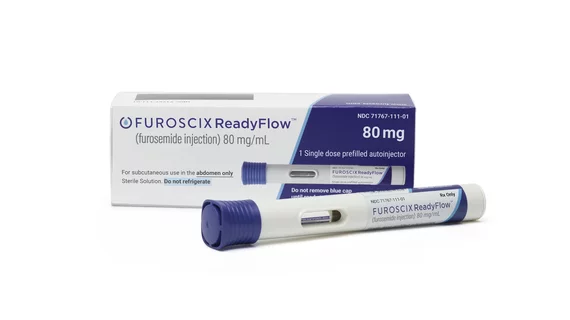
The U.S. Food and Drug Administration (FDA) has approved the first home-use, IV-equivalent diuretic therapy for edema in adults with heart failure (HF) or chronic kidney disease (CKD). Furosemide injection (Furoscix ReadyFlow) uses a first-of-its-kind autoinjector for the patient to self-administer therapy, eliminating the need to go to the hospital for IV administration.
Maker MannKind Corp. said the drug and its delivery format could be a transformative care delivery option. The idea is to support earlier management of worsening fluid overload.
The autoinjector will reduce administration time from five hours with current IV administration to 10 seconds or less with an 80 mg/mL furosemide dose in a single administration. The company said symptom relief may begin in an hour or less. This could be a more cost-effective therapy and may help lower healthcare costs associated with heart failure, a major driver of Medicare spending.
“Too often, patients living with heart failure or chronic kidney disease find themselves caught in a cycle of worsening fluid overload, which can disrupt daily life and lead to ER visits and hospitalization,” explained Hunter Champion, MD, PhD, Emory University Healthcare Network and director of the heart failure and pulmonary hypertension program at Southeastern Cardiology Associates in Columbus, Georgia, in prepared remarks. “An at-home option that delivers similar IV-equivalent furosemide exposure through a simple autoinjector gives clinicians an important new tool to intervene as soon as signs and symptoms of fluid overload appear helping appropriate patients manage congestion outside the hospital setting while reducing the disruption and burden associated with hospital-based treatment.”
The FDA previously approved furosemide injection (Furoscix) for delivery via an on-body infuser for adults with HF edema in 2022 and for those with CKD in 2025. The new Furoscix ReadyFlow autoinjector systems are expected to be commercially available in the United States by the end of August.
The FDA approval was supported by positive clinical data demonstrating Furoscix ReadyFlow achieved its primary pharmacokinetic endpoint. Data also demonstrated equivalent urine output, sodium excretion and potassium excretion at six, eight and 12 hours compared to IV furosemide. Studies further found the drug used with the autoinjector was generally well tolerated, notching a safety profile consistent with known effects of oral and intravenous furosemide.
MannKind said heart failure impacts about 6.7 million adults in the United States and is projected to increase to more than 8 million by 2030. Fluid overload is a primary driver of worsening symptoms and one of the most common reasons patients with heart failure or chronic kidney disease require emergency department visits, hospitalization or readmissions. Heart failure is one of the costliest chronic conditions in the U.S., with hospitalizations accounting for about 80% of heart failure-related healthcare costs.
By 2030, U.S. heart failure costs are expected to be at least $70 billion per year.
“The approval of Furoscix ReadyFlow marks an important milestone for patients living with heart failure or chronic kidney disease who experience fluid overload,” said Michael Castagna, PharmD, chief executive officer of MannKind Corp. in a statement. “By combining IV-equivalent diuretic performance with the simplicity of an autoinjector, Furoscix ReadyFlow has the potential to advance how fluid overload is managed outside traditional care settings and reach appropriate patients at different intervention points, from the onset of worsening symptoms and, when hospitalization cannot be avoided, through the transition home. We believe this represents a meaningful step forward for patients, practitioners, payers and hospitals—helping ease fluid burden for patients while reducing pressure on an increasingly burdened healthcare system.”

Dave Fornell has covered healthcare for more than 17 years, with a focus in cardiology and radiology. Fornell is a 5-time winner of a Jesse H. Neal Award, the most prestigious editorial honors in the field of specialized journalism. The wins included best technical content, best use of social media and best COVID-19 coverage. Fornell was also a three-time Neal finalist for best range of work by a single author. He produces more than 100 editorial videos each year, most of them interviews with key opinion leaders in medicine. He also writes technical articles, covers key trends, conducts video hospital site visits, and is very involved with social media. E-mail: [email protected]