
PFA associated with heightened stroke risk

Pulsed field ablation (PFA) is associated with a significantly higher 30-day risk of stroke or transient ischemic attack (TIA) than radiofrequency ablation (RFA), according to new data presented at the European Heart Rhythm Association (EHRA) 2026 meeting in Paris.
PFA is still quite safe overall, researchers noted, but it is important for care teams to know about these differences in risk when exploring treatment options for atrial fibrillation (AFib).
This study included data from more than 4,000 AFib ablation procedures performed at a high-volume U.S. academic center from 2022 to 2026. While 49% of patients underwent PFA, the other 51% underwent RFA. A variety of device types were used by a total of 12 different operators.
The mean patient age was 67 years old, and 31% of patients were women. Patient characteristics were similar for the two treatment groups.
Overall, the 30-day stroke/TIA rates were 0.47% for PFA and 0.10% for RFA. The group noted that stroke/TIA events were distributed evenly over the course of this study.
The mean procedure times were significantly shorter for PFA than RFA—108 minutes vs. 144 minutes, respectively—and posterior wall isolation was more common during PFA.
Researcher shares his perspective
Lead author Enrico Ferro, MD, a cardiology fellow with Beth Israel Deaconess Medical Center, presented his team’s work at EHRA 2026. He then spoke to Cardiovascular Business, highlighting the importance of these findings.
“We were not surprised by the study findings, but certainly worried about the possibility of uncovering this concerning result,” he explained. “We developed this research idea based on our initial observations when performing PFA procedures under intracardiac echocardiography guidance, when we started to notice microbubble formation while ablating.”
Ferro also noted that his team was unable to identify the specific mechanism responsible for this increased risk of thromboembolic events. It could be the energy source, for example, the “more extensive amount of ablation performed with PFA catheters” or something else entirely.
“More research with larger cohorts is needed to achieve sufficient power for mediation analyses,” Ferro said.
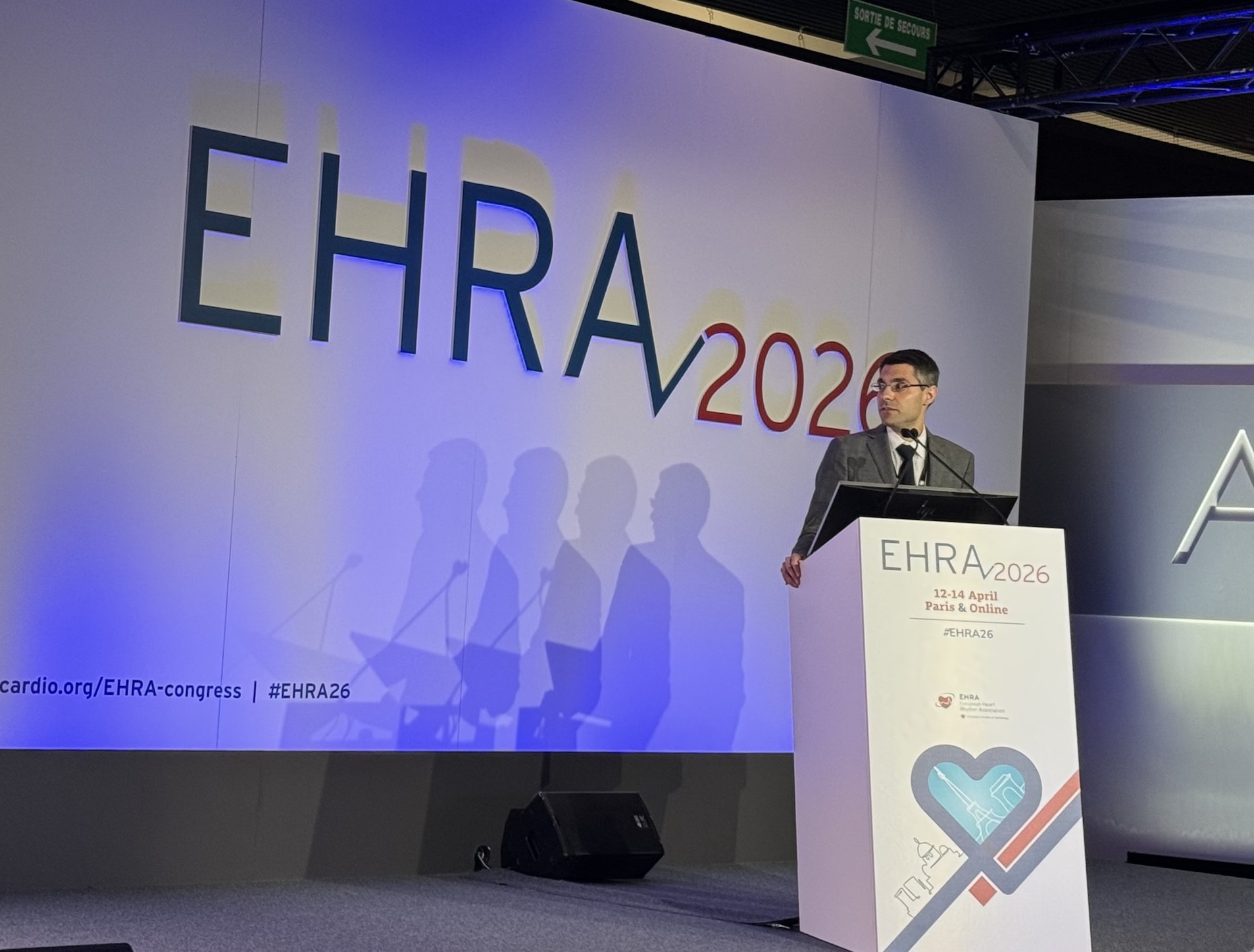
Enrico Ferro, MD, presenting new data at EHRA 2026. Image courtesy of Enrico Ferro.
‘PFA is here to stay’
Finally, Ferro emphasized that strokes and TIAs were still rare after PFA. This was reassuring to find, he said, considering how widely utilized PFA already is throughout the world.
“PFA is here to stay, but the significant increase in the relative stroke risk with PFA should renew our commitment to rigorous post-market surveillance,” he said. “This should not be based on reporting single-arm absolute event rates for individual PFA platforms, but should offer a comparative evaluation against well-established safety benchmarks, initially from the RFA era. Pretty soon, a contemporary safety benchmark from the first generation of PFA platforms can be developed, and can be used as reference as new PFA platforms enter the market.”
More and more cardiologists turning to PFA
The recent rise of PFA among cardiologists has been one of cardiology’s biggest stories. PFA uses high-voltage electrical pulses to treat paroxysmal and persistent AFib as opposed to the heat and cold used by RFA and cryoablation, respectively. It is consistently linked to positive patient outcomes and a superior safety profile, and cardiologists are increasingly turning to PFA as a go-to treatment option.
As this treatment option has picked up steam, however, the potential side effects have concerned some within the field of electrophysiology. One 2025 study, for example, linked PFA with an increased risk of nerve damage.
Click here to read a recent Q&A interview about PFA with Peter Weiss, MD, a veteran electrophysiologist with Banner – University Medical Center Phoenix.

Michael has more than 19 years of experience as a professional writer and editor. He has written at length about cardiology, radiology, artificial intelligence and other key healthcare topics.