
Abbott now enrolling patients for new research on Cephea mitral valve replacement device

Abbott has launched the CROWN-MV trial to evaluate the safety and effectiveness of its Cephea transcatheter mitral valve replacement (TMVR) device. In addition, the company announced that 30-day early feasibility study results for the device will be presented at the TCT 2026 in San Diego this weekend.
The prospective trial will include up to 585 patients who are not candidates for surgery or transcatheter repair in the U.S., Canada and Europe. To qualify, patients need to be diagnosed with moderate-to-severe or severe mitral regurgitation or have mitral valves that are not functioning properly due mitral annular calcification (MAC).
The first patient was enrolled at Ascension Via Christi Hospital in Wichita, Kansas, led by Bassem Chehab, MD.
"Patients with severe symptomatic mitral valve disease often cannot undergo conventional surgery or transcatheter mitral valve repair, and therapeutic options for these patients have been extremely limited," Juan F. Granada, MD, president and CEO of the Cardiovascular Research Foundation and CROWN-MV trial chair, said in a statement. "The initiation of the CROWN-MV trial represents an important step forward in bringing a dedicated single-step catheter-based replacement option to clinical practice for these high-risk patients. Designed to treat complex mitral anatomies, Cephea has the potential to address a significant unmet patient need."
Anchoring transcatheter valves in the mitral annulus has been a technical challenge that slowed down device development over the past decade. There is a very small landing zone without a lot of space to anchor, valves that are too long can block the left ventricular outflow tract (LVOT), and the D-shaped annulus presents issues with sealing to prevent paravalvular leak. By comparison, it was much easier to engineer transcatheter aortic and tricuspid valve replacement devices, which leapfrogged the transcatheter mitral valves in terms of U.S. Food and Drug Administration (FDA) clearances.
The investigational Cephea Mitral Valve System is implanted through a catheter introduced through the femoral vein. The bioprosthetic valve has a self-expanding nitinol frame with a top and bottom skirt that sandwiches the mitral valve annulus to firmly anchor it and seal the D-shaped mitral valve opening.
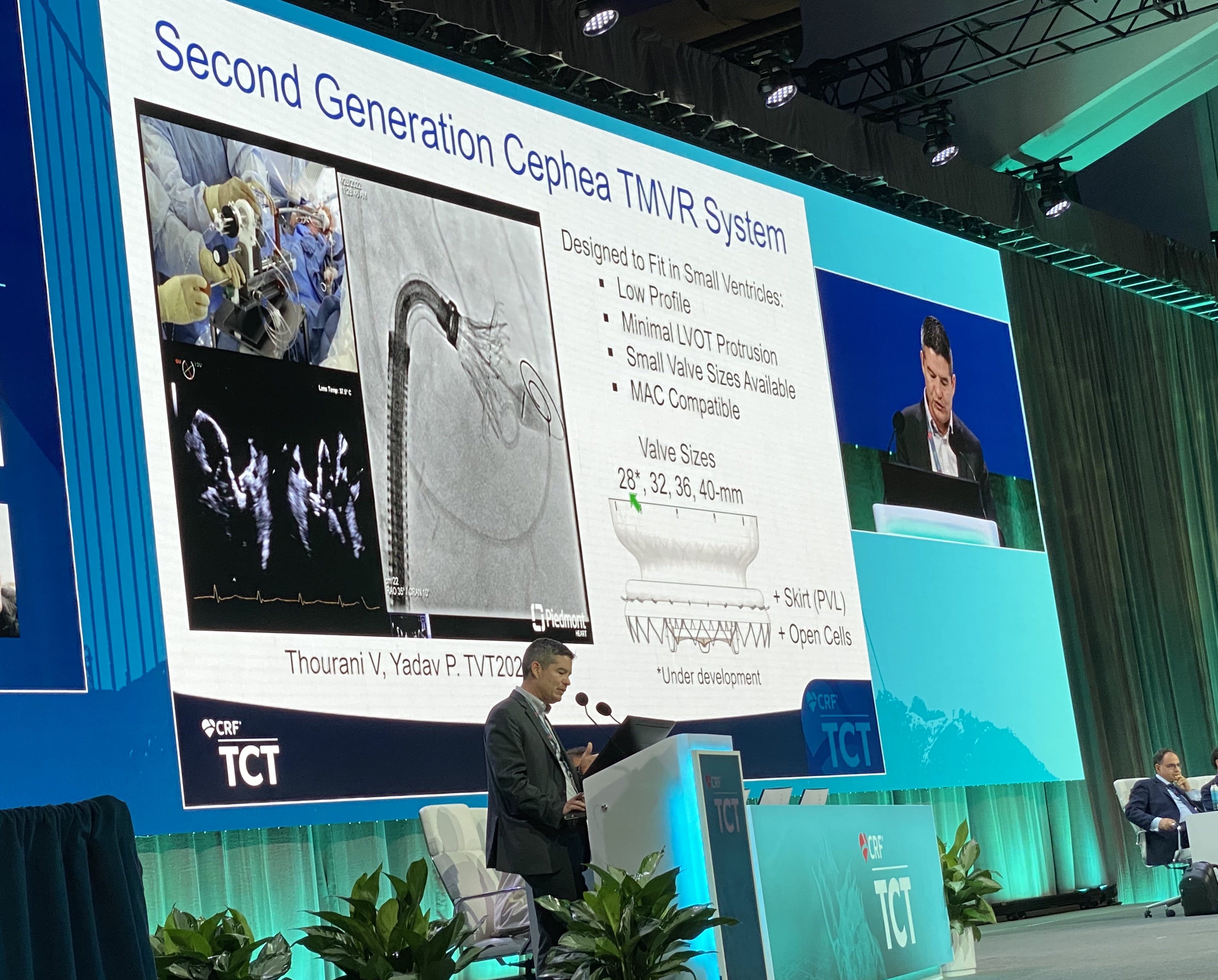
Juan Granada, MD, presents on the Cephea TMVR device at TCT 2023. Photo by Dave Fornell
Abbott already has a commercially available TMVR device. The Tendyne transcatheter valve was cleared by the FDA in May 2025. That first-generation TMVR system solved the anchoring problem by using a cord to hold the valve in place that is anchored at the apex of the heart and requires a small incision in the chest. The Cephea system would enable much easier and less invasive valve implantations.
Abbott also offers the MitraClip, a transcatheter repair system that clips together the valve leaflets to mimic and open heart procedure to get a better leaflet commissure seal to reduce or eliminate regurgitation. However, the repair cannot be used on patients with a calcified annulus or leaflets.
At TCT, researchers will present the first 30-day early feasibility study outcomes for patients treated with the third-generation Cephea delivery system. The data will be presented 2:57 p.m. PT, Sunday, Nov. 1. The company said the data will demonstrate the device's performance in reducing MR and improving quality of life.
Abbott first gained the Cephea device with it acquired Cephea Valve Technologies back in 2019.

Dave Fornell has covered healthcare for more than 17 years, with a focus in cardiology and radiology. Fornell is a 5-time winner of a Jesse H. Neal Award, the most prestigious editorial honors in the field of specialized journalism. The wins included best technical content, best use of social media and best COVID-19 coverage. Fornell was also a three-time Neal finalist for best range of work by a single author. He produces more than 100 editorial videos each year, most of them interviews with key opinion leaders in medicine. He also writes technical articles, covers key trends, conducts video hospital site visits, and is very involved with social media. E-mail: [email protected]