
3-in-1 TAVR guidewire linked to faster procedures, less radiation
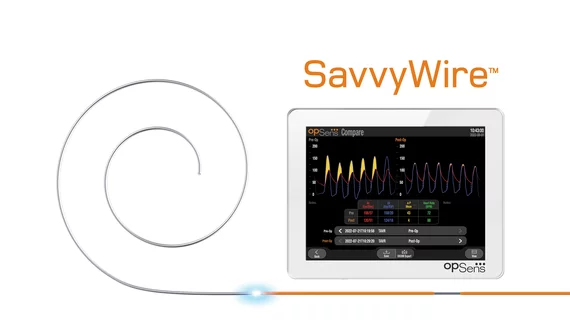
A 3-in-1 transcatheter aortic valve replacement (TAVR) guidewire is associated with shorter procedure times and less radiation exposure for patients, according to new data published in Circulation: Cardiovascular Interventions.[1] Importantly, the authors noted, these benefits were achieved without clinical safety taking a hit.
The new study focused on the SavvyWire device, an sensor-guided guidewire that delivers continuous hemodynamic measurements and rapid left ventricular pacing. It received FDA approvaI in 2022 and is believed to be the first TAVR guidewire of its kind. SavvyWire was originally developed and manufactured by OpSens, but it was acquired by Haemonetics Corp. in 2023 for more than $250 million.
Researchers tracked 272 consecutive TAVR patients treated at a single facility from January 2022 to June 2024. After making exclusions, they landed on 100 patients treated with the SavvyWire device and another 95 who treated with a stiff guidewire and a temporary transvenous pacer (TVP).
Overall, the SavvyWire patients were associated with a significantly lower median fluoroscopy time (10 minutes vs. 13 minutes) and median dose area product (32 Gy∙cm2 vs. 40 Gy∙cm2) than standard care. In addition, the median procedure time was significantly shorter (59 vs. 76 minutes) for SavvyWire patients.
The procedural success rates, meanwhile, were 98% for the SavvyWire and 100% for the stiff guidewire and TVP.
“The two failed TAVR-Savvy cases were due to failure of threshold testing and were successfully completed using a TVP for pacing and the SavvyWire for valve delivery,” wrote first author César E. Soria Jiménez, MD, a cardiologist with the Sulpizio Cardiovascular Center at University of California, San Diego, and colleagues. “Failure was due to wire-induced premature ventricular contractions and occurred early in our SavvyWire experience. After the standard pacing rate of threshold testing was increased, all subsequent cases passed the threshold test.”
Jiménez et al. also found that the median postoperative transvalvular pressure gradients were 9 mm Hg for the SavvyWire patients and 12 mm Hg for the stiff guidewire patients. Adverse event rates were low for both groups.
“Our findings indicate that use of the SavvyWire is associated with a significant reduction in radiation exposure and procedure time, without affecting major adverse cardiovascular events,” the authors wrote. “This novel device streamlines TAVR by eliminating the need for venous access for TVP placement and reducing multiple catheter-wire exchanges for direct transvalvular gradient measurements. These improvements translate to enhanced resource utilization and potential cost reduction, while minimizing radiation exposure for both patients and clinical staff, all without sacrificing clinical safety.”
Click here to read the full study. For an earlier analysis funded by OpSens that lacked a control arm, click here.

Michael has more than 19 years of experience as a professional writer and editor. He has written at length about cardiology, radiology, artificial intelligence and other key healthcare topics.