
Self-expanding TAVR valves from Medtronic, Abbott consistently linked to positive outcomes
Transcatheter aortic valve replacement (TAVR) with a contemporary self-expanding transcatheter heart valve is both safe and effective up to one year after treatment, according to a new meta-analysis of periprocedural and one-year data published in Structural Heart.[1] The study’s authors highlighting the many benefits of these procedures while pointing to a few areas where there is still room for improvement.
“As TAVR indications expand to younger and lower-risk patients, differences in valve performance, hemodynamic profile, effects on the conduction system, and durability carry increasing clinical importance,” wrote first author Shawn Shaji, MBBS, a researcher with SRTR Government Medical College in India, and colleagues.
Shaji et al. explored data from more than 21,000 patients who participated in one of 52 different studies. The mean age was 82 years old, 61.9% of patients were women and the mean Society of Thoracic Surgeons risk score was 4.8%.
All patients underwent TAVR with contemporary self-expanding valves from Medtronic (the Evolut PRO, Evolut PRO+ or Evolut FX) or Abbott (the Navitor). However, it is worth noting that Medtronic and Abbott did not fund this analysis in any way.
Diving into the data
Device success rates were high across the board, with no significant difference from one platform to the next. In terms of patient safety, all-cause mortality and major bleeding events were consistently low after 30 days. All-cause mortality was still low a full one year after treatment.
The 30-day stroke rates were low, but higher for Evolut patients (2.8%) than Navitor patients (1.7%). After one year, the stroke rate was once again higher for Evolut patients (4.7%) than it was for Navitor patients (2.4%).
Post-TAVR mean gradients were comparable for the two patient groups. At discharge, the pooled mean gradients were 7.9 mmHg for Evolut patients and 7.7 mmHg for Navitor patients. After 30 days, the mean gradients were 7.3 mmHg and 7.5 mmHg, respectively. After one year, they were 7.7 mmHg and 7.3 mmHg, respectively.
The pooled effective orifice area (EOA) data, on the other hand, slightly favored Evolut patients. At discharge, mean EOAs were 2 cm2 for Evolut patients and 1.9 cm2 for Navitor patients, and remained the same after 30 days. After one year, they were 2.1 cm2 and 1.8 cm2, respectively.

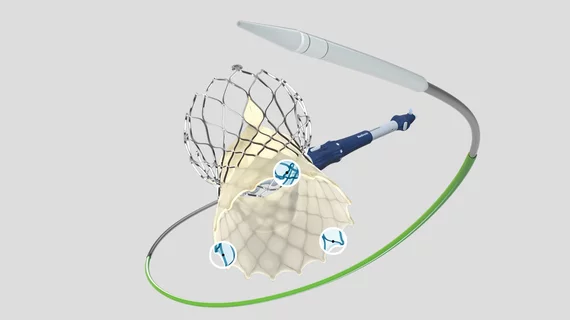
The Navitor TAVR valve. Image courtesy of Abbott.
“In contemporary TAVR, long-term hemodynamic performance is increasingly important as treatment expands to younger and lower-risk patients,” the authors wrote. “In this study, hemodynamic performance was favorable with both platforms.”
Room for improvement in the future
The study’s authors highlighted the improved paravalvular leak (PVL) rates seen with these contemporary self-expanding TAVR valves compared to older technologies. However, 19.9% of patients presented with mild PVL after one year, “highlighting continued opportunities to further optimize annular sealing through iterative valve design and procedural strategies.”
Conduction disturbances associated with permanent pacemaker implantation (PPI) remain “the most prevalent complication” after TAVR, the group added. The one-year PPI rate was 15.9%, and there was no significant difference from one platform to the next.
Click here to read the full analysis.

Michael has more than 19 years of experience as a professional writer and editor. He has written at length about cardiology, radiology, artificial intelligence and other key healthcare topics.