
TAVR’s next big challenge: Providing consistent relief for heart patients with aortic regurgitation

Aortic regurgitation (AR), when blood pumped out of the left ventricle leaks back into the chamber, is associated with an increased risk of death or heart failure. It is also widely believed to be both underdiagnosed and undertreated, and surgical treatments are associated with considerable challenges.
These are just some of the reasons researchers and medtech companies have been so invested in the identifying dependable interventional treatments for AR. JenaValve and JC Medical—now a part of Edwards Lifesciences—have been working on their own transcatheter aortic valve replacement (TAVR) valves for AR for years, with other vendors scrambling to catch up.
A new analysis in The American Journal of Cardiology explored this topic at length, calling AR “the next frontier” for TAVR care.[1]
“At initial evaluation, nearly one-third of patients present with at least moderate concomitant AR,” wrote first author Stephan Nienaber, MD, a cardiologist with Heart Center Cologne in Germany, and colleagues. “In addition, bicuspid valve morphology is strongly associated with aneurysmal dilatation of the ascending aorta, largely attributed to altered transvalvular flow patterns and abnormal aortic wall stress. Evidence from large cohort studies indicates that clinically relevant AR is at least as common as aortic stenosis (AS).”
Where things stand today
Nienaber et al. noted that evaluations of patients with suspected AR typically start with transthoracic echocardiography (TTE). Transesophageal echocardiography (TEE) is often the next step when any signs of even moderate AR are detected, though the group did highlight some of the limitations associated with TEE exams. It requires conscious sedation, for example, and it increases the risk of injury. Cardiac MRI gives care teams another imaging option, though it is “primarily recommended in situations where echocardiography is not feasible or yields inconclusive results.”
A regurgitant fraction (RF) of 40-50% is typically the threshold for severe AR, the authors explained, though there may be room for improvement.
“While an RF of 40-50% is highly specific for severe AR, it seems plausible that this threshold may lack sensitivity leading to delayed identification of relevant AR when left ventricular remodeling is already present and adverse outcomes become inevitable,” they wrote. “Recent studies suggest that using an RF of approximately 32-35% as a cut-off value may be more appropriate for AR evaluation.”
Aortic valve surgery is the most common recommendation when patients present with severe AR. Because these surgeries are associated with certain risks, however, the off-label use of TAVR valves for AS to treat AR is becoming more common.
While off-label TAVR for AR is certainly feasible, researchers have found that many patients still go on to require a second valve. In addition, residual AR that is moderate or worse occurs in a significant number of patients.
“AR is often associated with concomitant dilatation of the annulus and the aortic root and usually lacks significant leaflet or annular calcification which is essential for anchoring conventional TAVR protheses,” the authors wrote. “Procedurally, this translates into insufficient fluoroscopic visualization of the native aortic valve. These hostile features, in combination with a relevant regurgitant jet, frequently lead to transcatheter heart valve embolization or migration, and relevant residual AR.”
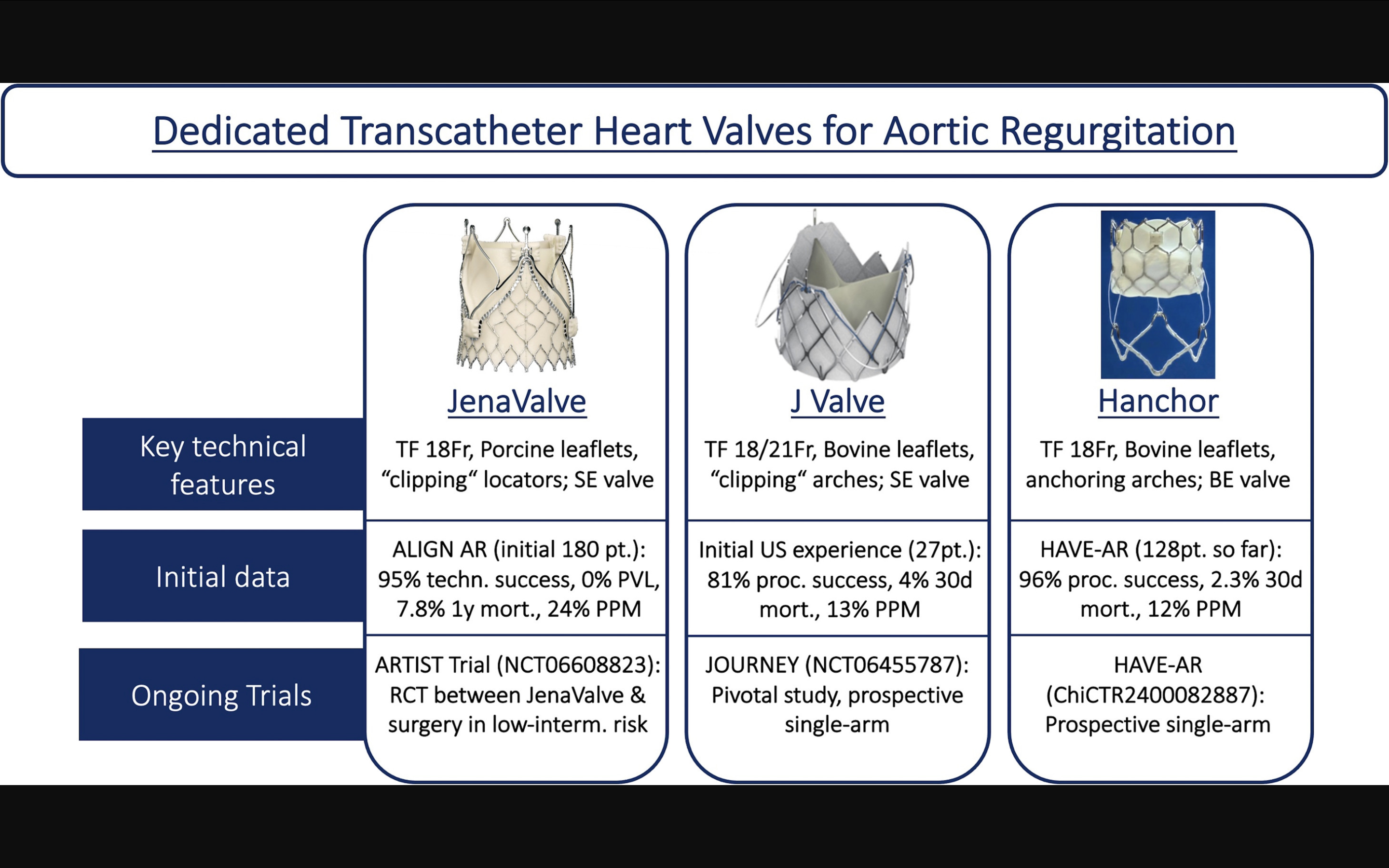
Overview of current dedicated transcatheter heart valve systems for the treatment of pure aortic regurgitation. Image and caption courtesy of Nienaber et al. and The American Journal of Cardiology.
TAVR valves specifically built for treating AR
Two TAVR valves specifically designed to treat AR are the Trilogy Heart Valve System from JenaValve and J-Valve System from Edwards Lifesciences. Neither has been approved by the FDA, but they both appear to be on their way to reaching that milestone.
Nienaber and colleagues also highlighted another valve under development, the balloon-expandable Hanchor Valve from Healing Medical Technology in China. They pointed to early evidence of the valve’s potential, but it is still early.
Challenges remain, and more research is still necessary
The authors noted that the treatment of severe AR is still linked to several challenges care teams need to solve. In addition, they wrote, even once TAVR valves for AR start to secure FDA approval, it will still take time for awareness of these devices to grow and for clinicians to know when, exactly, treatment is recommended.
“In order to appropriately address the above-mentioned challenges, it is of utmost importance to promote widespread awareness and ensure that referring cardiologist stay informed about upcoming valve protheses and new technical innovations for AR patients,” the authors wrote. “In addition, referring cardiologists must be encouraged to refer patients to tertiary care centers, already at early disease stages where only moderate AR is suspected or when impaired sonographic conditions are present. At such centers, a comprehensive multimodality assessment can be conducted when clinically indicated to secure optimal patient care.”
Click here for the full review article, which includes many more details about this topic.

Michael has more than 19 years of experience as a professional writer and editor. He has written at length about cardiology, radiology, artificial intelligence and other key healthcare topics.