
The fight for improved cardiologist certification is still alive
The American Board of Cardiovascular Medicine (ABCVM) is still going strong. Despite its efforts to create and independent cardiovascular board being shot down a year ago by the American Board of Medical Specialties (ABMS), ABCVM said it will continue to push for major changes to how cardiologists are certified.
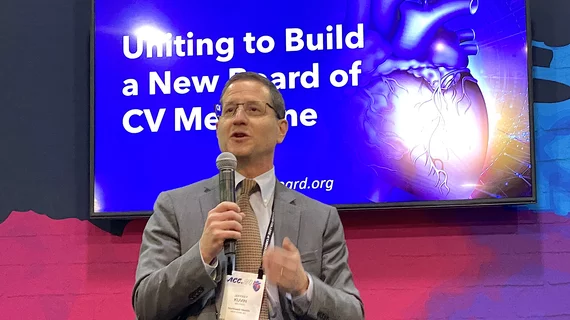
ABCVM President Jeffrey Kuvin, MD, and American College of Cardiology (ACC) President Christopher M. Kramer, MD, shared the update in a new joint statement.
"While ABMS allows for reapplication after two years, their failure to recognize cardiovascular medicine as a distinct specialty and reluctance to embrace modern competency models makes a clear path forward uncertain," the two authors explained.
Cardiologists are currently certified through the American Board of Internal Medicine (ABIM). However, the ABCVM believes cardiology has evolved over the past 50 years and now has multiple subspecialties of its own that require specialized training the ABIM is not providing. These issues gained the ABCVM support from most leading cardiology societies, including the ACC, American Heart Association, Heart Failure Society of America, Heart Rhythm Society and Society for Cardiovascular Angiography and Interventions.
Next steps to for the ABCVM
Although ABIM has expressed interest in modernization, collaboration with ABCVM has not materialized. The group is exploring alternatives for certification through partnerships with organizations like the National Board of Physician and Surgeons, the American Board of Physician Specialties and the American Osteopathic Association. However, the two authors explained, differences in scale, resources, recognition and philosophy may limit those options.
"We remain committed to identifying viable pathways that align with our mission: creating a competency model that is formative, personalized, and integrated into daily practice, Kuvin and Kramer said.
ABCVM wants certification that includes adaptive assessment tailored to specialty, practice focus, and patient outcomes. This could even include leveraging AI, data analytics and real-time feedback to transform certification from episodic testing to ongoing professional development.
"This evolution requires collaboration among societies, certifying bodies, payers, regulators, and clinicians, along with a shared commitment to measuring impact on patient care and physician experience. A 'lifelong learning portfolio' of competency would provide an opportunity for each cardiologist, from training to retirement, to identify and fill knowledge gaps and catalog multi-source data specific to their practice setting," Kuvin and Kramer said.
Read the full statement here.
Why do cardiologists want their own certification board?
Dissatisfaction with ABIM is on the rise among cardiologists, which has has fueled the push for independence. A major concern has been the financial burden and complexity of the recertification process under ABIM.
For decades, cardiologists who trained before 1990 were "grandfathered in," meaning they were not required to recertify. However, a sudden policy shift by the ABIM removed these exemptions, forcing long-practicing cardiologists to undergo costly and time-consuming recertification.
The methodology of the ABIM’s certification exams have also been criticized, with a system based largely on punitive, pass-fail testing rather than an informative process that identifies areas for improvement.
ABCVM wants to change this system so that doctors answer questions to show clear areas of weakness where they nee to brush up on their knowledge.
Another major issue cardiologists face with current policies is the broad scope of the recertification exam. Cardiology has become increasingly specialized, with fields such as electrophysiology, interventional cardiology, congenital heart and heart failure each requiring distinct expertise. Cardiologists argue that these all require separate tests that ask questions specific to those areas, not a broad set of questions that are outside the primary cardiology scope of the person being tested.
The ABCVM Board of Directors includes several noted cardiologists from several subspecialities, including Kuvin (president), Mark Drazner (treasurer), Jodie Hurwitz (secretary), Katie Berlacher, Renee Bullock-Palmer, Peter Duffy, David Faxon, Edward Fry, Judith Hochman, Esther Kim, Michelle Kittleson, Daniel Kolansky, Gregory Michaud, William Roach and Karen Stout.

Dave Fornell has covered healthcare for more than 17 years, with a focus in cardiology and radiology. Fornell is a 5-time winner of a Jesse H. Neal Award, the most prestigious editorial honors in the field of specialized journalism. The wins included best technical content, best use of social media and best COVID-19 coverage. Fornell was also a three-time Neal finalist for best range of work by a single author. He produces more than 100 editorial videos each year, most of them interviews with key opinion leaders in medicine. He also writes technical articles, covers key trends, conducts video hospital site visits, and is very involved with social media. E-mail: [email protected]