
AI uses routine CT images to evaluate cardiovascular risk

Heart researchers have developed a new way to determine a person’s cardiovascular age, sharing their findings in the European Heart Journal.[1] Their secret? A combination of artificial intelligence (AI) and routine CT exams.
The group, a research team at Emory University’s Empathetic AI for Heart Institute in Atlanta, focused their work on the fat that surrounds a person’s aorta. By evaluating that fat, they believed they may be able to detect whether someone’s cardiovascular health is older or younger than their real age.
“The aorta is the body’s largest blood vessel and carries blood from the heart to the rest of the body,” first author Mendel Lebowtiz, a graduate student with Emory University, explained in a statement. “We wanted to see whether the fat surrounding it could tell us something about how a person’s heart and blood vessels are aging.”
Lebowitz et al. used advanced AI to evaluate more than 48,000 chest CT examinations. More than 4,000 exams were used to train their AI model and then more than 44,000 exams were used to validate that model. By the end, they found that this method was able to estimate an individual’s “true cardiovascular age” and gain a better understanding of the health risks they may face over time.
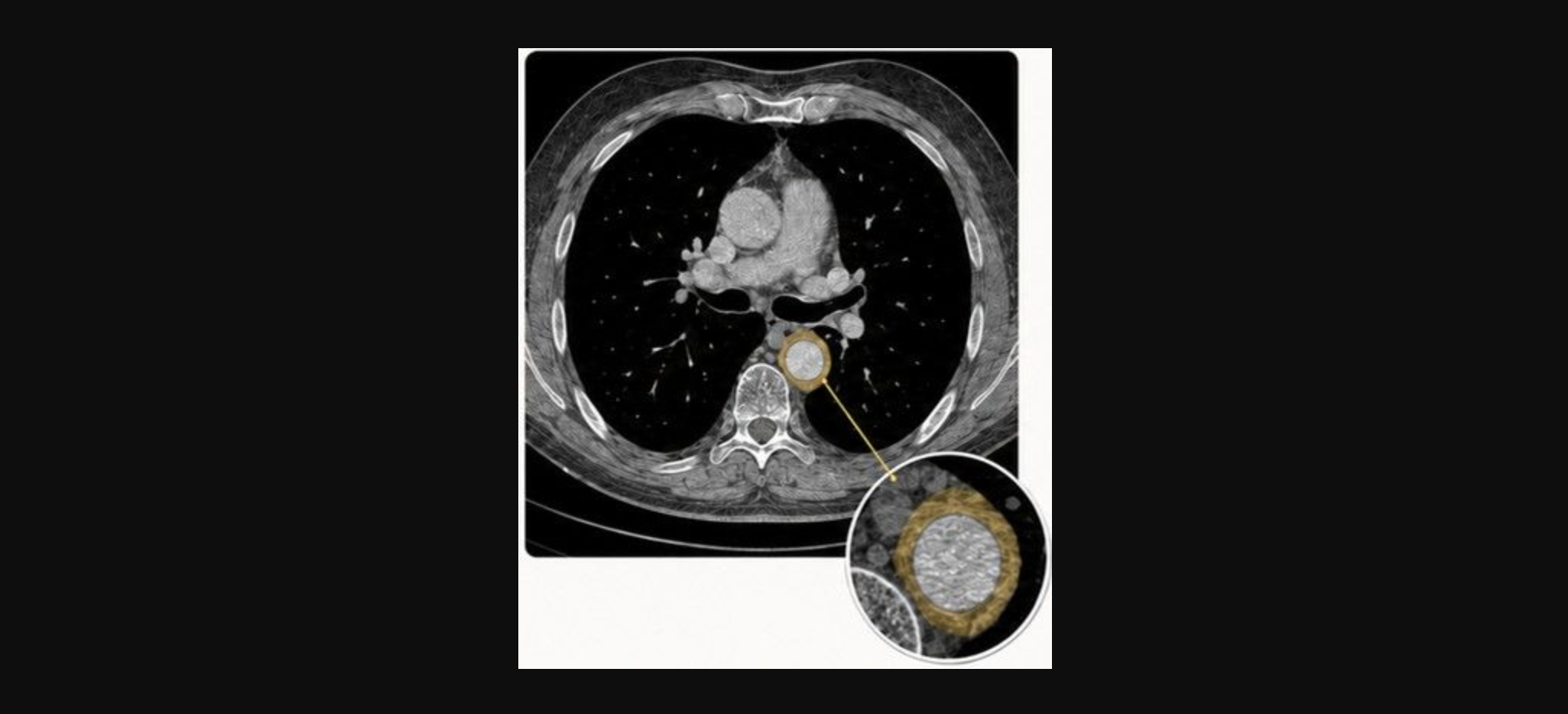
Scanned image of periarotic fat. Image courtesy of Mendel Lebowitz/Emory University.
When a person’s cardiovascular age was significantly higher than their actual age, for example, they appear to face a 51% higher risk of experiencing a major adverse cardiovascular event (MACE) than someone with cardiovascular and actual ages that match. Likewise, individuals with a cardiovascular age significantly lower than their actual age appear to face a 30% lower MACE risk.
“We found that this fat around the aorta clearly predicts cardiovascular outcomes,” Anant Madabhushi, PhD, executive director of the Empathetic AI for Heart Institute and senior author of this study, said in the same statement. “Someone can have a low-risk profile, but it may not be the full picture for them. With this tool, people can get a better understanding of their heart health and be empowered to get intervention if needed.”
“This is a non-invasive, frugal way for people to personalize their cardiovascular risk assessment beyond just how many birthdays they’ve had,” Lebowitz added.
Click here to read the full study in the European Heart Journal, a European Society of Cardiology publication.

Michael has more than 19 years of experience as a professional writer and editor. He has written at length about cardiology, radiology, artificial intelligence and other key healthcare topics.