
FDA clears Elucid's new AI-enabled FFR-CT software
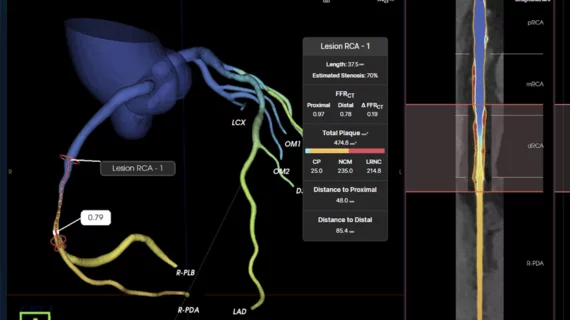
The U.S. Food and Drug Administration (FDA) has cleared Elucid's FFR-IQ software for the noninvasive estimation of fractional flow reserve from coronary CT angiography (FFR-CT). The artificial intelligence (AI)-based technology incorporates coronary anatomy and plaque composition into its estimation of coronary physiology to provide more accuracy.
“Plaque composition, coronary anatomy and physiology are closely connected,” Amir Ahmadi, MD, clinical associate professor of medicine (cardiology) at the Icahn School of Medicine at Mount Sinai and Elucid’s lead scientific advisor, said in a statement. “BioIntegrated FFR-CT incorporates anatomy and plaque characteristics into the physiological estimate itself. Together with plaque assessment, this approach can help physicians evaluate the significance of an individual lesion while also addressing the patient’s broader atherosclerotic disease and need for preventive treatment.”
Elucid said physicians told the company they want a more accurate FFR-CT algorithm that considered other factors that could impact hemodynamics; this newly approved algorithm does just that.
Elucid is now the third vendor to offer FFR-CT commercially in the U.S., following prior approvals by Heartflow in 2016 and KeyaMed in 2022. Other vendors are also developing their own versions of FFR-CT. Interest in the technology has also increased rapidly recently as coronary CT angiography (CCTA) continues to rapidly gain momentum among care teams.
This technology was cleared by the FDA based on the ELUCIDATE FFR-CT study data. It demonstrated an overall sensitivity of 92.2% and specificity of 93.1%, which Elucid said is the highest seen in any FFR-CT validation study.
This announcement follows the FDA's clearance of Elucid's Plaque-IQ coronary plaque assessment software in October 2024. Plaque-IQ was trained and validated using vessel histology. It can objectively quantify and classify plaque morphology, and was trained using ground-truth histology. The technology can identify lipid-rich necrotic core (LRNC) plaques, and had a high correlation to NIRS-IVUS.
These plaque measurements are used to inform the FFR-IQ algorithm, including the plaque type and volume influence on the vessel's vasodilatory capacity and coronary flow, even in lesions with similar sized stenosis. According to Elucid, this integration supports lesion-specific assessments and personalized medical and interventional decisions.
The results of the ELUCIDATE FFR-CT study, which detail the diagnostic performance of Elucid’s BioIntegrated FFR-IQ product, will be presented Nov. 1 at TCT 2026 in San Diego. The company is also planning two hands-on sessions within the TCT Physiology Training Pavilions on Nov. 1.

Dave Fornell has covered healthcare for more than 17 years, with a focus in cardiology and radiology. Fornell is a 5-time winner of a Jesse H. Neal Award, the most prestigious editorial honors in the field of specialized journalism. The wins included best technical content, best use of social media and best COVID-19 coverage. Fornell was also a three-time Neal finalist for best range of work by a single author. He produces more than 100 editorial videos each year, most of them interviews with key opinion leaders in medicine. He also writes technical articles, covers key trends, conducts video hospital site visits, and is very involved with social media. E-mail: [email protected]