
Cardiology still No. 2 in FDA-cleared clinical AI algorithms, trailing only radiology
The U.S. Food and Drug Administration (FDA) has now cleared approximately 1,250 clinical artificial intelligence (AI) algorithms for direct patient care in the United States. More than 1,000 of these are specific to medical imaging.
While a vast majority of these algorithms are used in radiology, 116 are used in cardiology, giving it the second most out of any healthcare specialty. That number balloons to 184 if including cardiac-specific imaging AI listed under radiology.
The FDA has updated its AI-enabled device approval list for the first time in months, showing that the regulatory agency has reached a total of 1,247 approved algorithms. In the past year, there have been a total of 300 new clinical AI clearances.
The last FDA update in September 2024 showed an average of about 21 approvals per month. In the last seven months since, that has increased to closer to 30 per month. In May 2025 alone, 39 new algorithms gained FDA clearance, the highest number ever.
In 2022, the average approvals per month were about 13.5, and in 2019 it was 7. The numbers show the rapid growth in AI over the past few years. The first clinical AI algorithms cleared by the FDA were in 1995, and only 10 were cleared in the decade after.
The FDA's latest update includes the following cardiology-focused AI algorithms:
• DeepRhythmAI, Medicalgorithmics S.A., is a cloud-based software using AI to assess cardiac arrhythmias using single- or two-lead ECG data from adult patients. It is intended for use by a healthcare solution integrator to build web, mobile or another types of applications to let qualified healthcare professionals review and confirm the analytic result. The product supports downloading and analyzing data recorded from ECG devices such as Holter, event recorder, and outpatient cardiac telemetry devices. It can be interfaced with ECG management systems.
• InVision Precision Cardiac Amyloid, InVision Medical Technology Corp., is an adjunctive cardiac amyloidosis status indicator based on sensor technology or image data. It uses automated machine learning-based decision support to provide information to an interpreting clinician in detecting cardiac amyloidosis.
• Volta AF-Xplorer, Volta Medical, assists operators in the real-time manual or automatic annotation of 3D anatomical and electrical maps of human atria for the presence of multipolar intra-cardiac atrial electrograms exhibiting spatiotemporal dispersion during atrial fibrillation or atrial tachycardia.
• AT-Patch, ATsen, is intended to measure, analyze, edit and report continuous ECG information for long-term recording (ATP-C130: up to 14 days, ATP-C70: up to 7 days) by attaching to the patient’s torso. ECG records are saved in the device and are not intended for real-time monitoring. After the wear period is completed, the ECG data is transmitted to the AT-Report with a primary analysis performed by the algorithms and then a physician report after a secondary analysis by a clinician.
• VitalRhythm, VitalConnect Inc., is a cloud-based application for continuous and automatic analysis of cardiac arrhythmias in outpatient cardiac telemetry and patient monitoring in non-critical healthcare settings.
• Loss of Pulse Detection, Fitbit, is a mobile medical application for consumer wrist-worn products that will analyze pulse data to identify loss of pulse events and provides audio, visual and haptic alerts to the user. If the user remains unresponsive to these alerts, the AI will attempt to prompt a call to emergency services through the user's connected compatible hardware, such as a smartphone or smartwatch. It is intended for over-the-counter (OTC) use.
• Informed Vital Core Application (IVC App), Mindset Medical Inc., is intended for noninvasive optical camera-based spot measurement of pulse rate, heart rate, breathing rate, and respiratory rate of adult patients in home use, hospitals, clinics and long-term care settings.
• EchoGo Amyloidosis, Ultromics Ltd., is an automated machine learning-based decision support system, indicated as a screening tool for adult patients aged 65 years and over with heart failure undergoing cardiovascular assessment using echocardiography. It provides information alerting the physician for referral to confirmatory investigations. Indicated in adult patients aged 65 years and over with heart failure.
• BrightHeart View Classifier, BrightHeart, is intended to analyze fetal 2D ultrasound images and video clips using machine learning to automatically detect standard views during fetal heart scanning. It is an adjunct to the acquisition and interpretation of fetal anatomic ultrasound examinations at the second or third trimester of pregnancy performed with transabdominal probes.
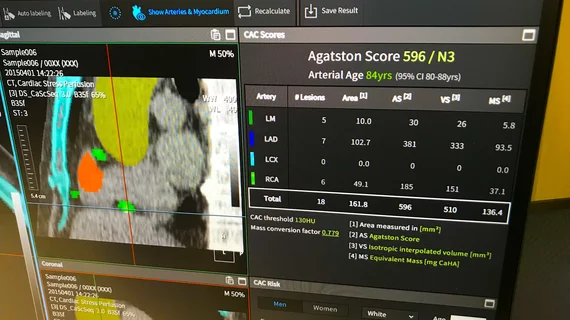
• AVIEW CAC, Coreline Soft Ltd., provides a quantitative analysis of calcified plaques in the coronary arteries using non-contrast/non-gated chest CT scans. It enables automated calculation of the Agatston score for coronary artery calcification, segmenting and evaluating the right coronary artery and left coronary artery. This algorithm can also provide risk stratification based on calcium score, gender, and age, offering percentile-based risk categories by established guidelines. Use should be limited to CT scans acquired on GE Healthcare scanners.
• TeraRecon Cardiac.Chambers.MR, TeraRecon Inc., is intended to automatically segment cardiac chambers as anatomical structures on contrast and non-contrast MRI scans in adult patients.
• Strain AI, Exo Inc., is intended for noninvasive automated processing of cardiac ultrasound images to provide measurements of global longitudinal strain of adult patients with suspected disease.
• ClearRead CT CAC, Riverain Technologies Inc., is an image processing software designed to aid physicians in assessing coronary artery calcification (CAC) on non-gated, non-contrast, standard, or low-dose chest CT scans of adult patients age 30 or older. The AI locates calcified coronary lesions and assigns them to one of the coronary arteries and then calculates an Agatston score for each artery while also providing the total across all coronary arteries.

Dave Fornell has covered healthcare for more than 17 years, with a focus in cardiology and radiology. Fornell is a 5-time winner of a Jesse H. Neal Award, the most prestigious editorial honors in the field of specialized journalism. The wins included best technical content, best use of social media and best COVID-19 coverage. Fornell was also a three-time Neal finalist for best range of work by a single author. He produces more than 100 editorial videos each year, most of them interviews with key opinion leaders in medicine. He also writes technical articles, covers key trends, conducts video hospital site visits, and is very involved with social media. E-mail: [email protected]