
AI-powered CCTA assessments show ‘close agreement’ with IVUS
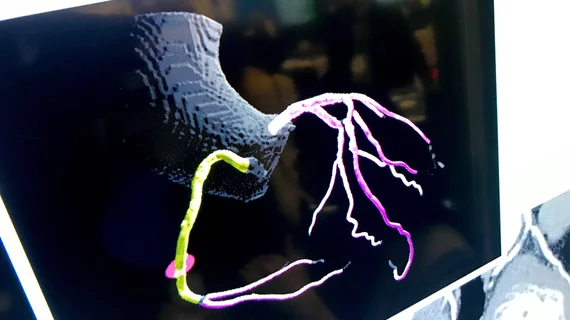
Coronary CT angiography (CCTA) evaluations performed by advanced artificial intelligence (AI) algorithms are associated with “high correlations and close agreement” with intravascular ultrasound (IVUS), according to new registry data published in European Radiology.[1]
The study’s authors focused on 85 patents who underwent IVUS, often considered the “gold standard” of invasive imaging, and then had their CCTA results assessed by advanced Cleerly software. All data came from the INVICTUS registry.
Overall, the group found that Cleerly’s AI-enabled quantitative CT (AI-QCT) software and IVUS were strongly correlated in terms of external elastic membrane volume, lumen volume, plaque volume, length-normalized percent atheroma volume and calcium index across the whole coronary segment. The AI software also delivered 99.1% agreement when classifying the predominant plaque type at the minimum lumen area and delivered strong correlations in segments with non-calcified plaque and low attenuation.
“AI-QCT demonstrated high agreement with IVUS in localizing the MLA site and quantifying the lumen area stenosis without human interaction,” wrote first author Rine Nakanishi, MD, PhD, a researcher with Toho University Graduate School of Medicine, and colleagues. “These results support the incorporation of AI-QCT into clinical practice as a fast, reproducible, and accurate tool for quantification of total atherosclerotic burden and quantification of stenosis severity.”
Cleerly helped fund this analysis, though researchers also received support from multiple grants.
“Every time we reach a scientific milestone that makes accurate plaque characterization more accessible and less invasive, we get closer to our goal of eliminating heart attacks,” James K. Min, MD, founder and CEO of Cleerly, said in a statement. “IVUS has long been the gold standard in invasive plaque imaging, and the findings from INVICTUS represent an important advance in establishing the clinical validity of noninvasive plaque quantification. The strong correlations across multiple metrics support AI-QCT as a reliable tool for comprehensive coronary plaque assessment.”
These data were first presented to the public at ECR 2026 in Vienna in early March.
Findings highlight a major trend in medical imaging
AI-enabled CCTA evaluations continue to be one of the biggest trends in both cardiology and radiology. For example, the U.S. Food and Drug Administration (FDA) has already approved noninvasive CCTA analysis tools from Cleerly, Heartflow, Elucid, Circle Cardiovascular Imaging, Caristo Diagnostics and Artrya that help cardiologists provide preventive care and develop treatment strategies. These technologies have also received improved Medicare coverage, new Category 1 CPT codes and an updated payment policy that more than doubled the reimbursements hospitals receive for performing CCTA.
The American College of Cardiology and American Heart Association even issued separate scientific statements about these use of these noninvasive CCTA analysis tools in late 2025.[2, 3]

Michael has more than 19 years of experience as a professional writer and editor. He has written at length about cardiology, radiology, artificial intelligence and other key healthcare topics.