
Looking ahead to the future of FFR-CT
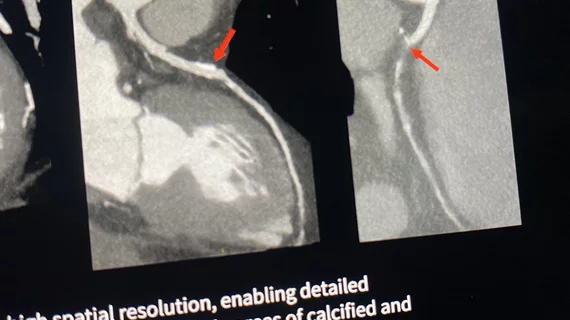
A recent Society of Cardiovascular Computed Tomography (SCCT) expert consensus document calling for the standardization of coronary CT angiography (CCTA)-derived fractional flow reserve (FFR-CT) also included a section on new areas that will expand this technology.[1]
Additional hemodynamics calculations for FFR-CT
Current research suggests this technology is on its way to impacting more areas of cardiac care. This includes adding additional hemodynamic parameters beyond the FFR pressure gradient with wall shear stress and axial plaque stress. The authors said this could significantly improve predictions for future heart attacks. In addition, they added that these additional parameters can be calculated without extra segmentation or computational cost.
The consensus document mentions the EMERALD and EMERALD II studies, which used FFR-CT to examine the mechanism of plaque rupture in acute coronary syndrome (ACS). The computational fluid dynamics used in this study demonstrated the integration of wall shear stress, and axial plaque stress significantly improved FFR-CT's ability to predict the future occurrence of heart attacks.
"Given that these forces interact with the adjacent plaque, with the structural integrity of this dependent on the tissue type, it would follow that risk of ACS would depend not only on the forces within the lumen, but the plaque composition," the authors wrote. They added his is what was also observed in EMERALD studies, where low-attenuation plaque further improved the model for predicting future ACS.
Prospective research work is still needed to understand how to integrate plaque, CT-FFR and other parameters together to best guide patient management.
Stent planning using FFR-CT
Some interventional cardiology departments are already using CCTA imaging and FFR-CT data to improve planning before percutaneous coronary intervention (PCI) procedures. Interventional cardiologists who use the technologies say it takes surprises out of the procedures when traditionally an invasive angiogram in the cath lab is the first look at what is going on. The authors of the statement said this combination of the focality presence of a localized disease and its hemodynamic significance may be a big help determining which lesions need preemptive revascularization.
Preliminary studies suggest FFR-CT could further enhance PCI planning by using a simulated stent deployment within a digital anatomical model to see the hemodynamic impact. This is a technology Heartflow has been working on for years now. The diameter, length and position of the simulated stent can be changed and the predicted CT-FFR model rerun under thee new assumptions of geometry to estimate the functional impact of any intervention before going into the cath lab.
"Stent simulation FFR-CT models have been shown to have better agreement with post-PCI FFR, and to anticipate the post-PCI FFR more accurately than estimation based on pre-PCI FFR pullback, with prospective trials of their clinical impact underway," the consensus documents said. "In the future this may add significantly to the ability to make provisional decisions regarding need and suitability for revascularization and even whether it should be by PCI or coronary bypass graft (CABG) in an heart team employing just noninvasive data."
Photon counting CT will increase accuracy of FFR-CT
The authors wrote that the single greatest source of error in calculating CT-FFR is inaccuracies in the geometry of the artery due to the current limits of spatial resolution on conventional CT systems. This issue is due to the inherent limitations of CT scintillator detectors on current generation CT. However, photon counting CT (PCCT) detectors can help overcome this technical limitation and offer significantly higher resolution and accuracy in coronary delineation and stenosis assessment.
"New technologies are probably going to revolutionize the way we do imaging. For example, photon counting CT systems have a new type of detector that is much more efficient than the CTs we're using currently," explained Ronen Rubinshtein, MD, director of the heart institute at Edith Wolfson Medical Center in Holon, Israel and president elect of SCCT, in a recent interview with Cardiovascular Business.
Since photon counting systems have an inherent spectral imaging component, the technology allows for the dialing out of various periodic table elements from images. This includes removal of calcium to reduce calcification lesion blooming artifacts, or some types of metals to reduce metallic device streaking artifacts. This spectral imaging capability, with 70 keV virtual monoenergetic reconstructions, demonstrate the best agreement with standard CT for the calculation of CT-FFR, the authors said.
Early studies show good agreement between CT-FFR derived from photon counting detectors. Prospective studies comparing it to invasive FFR are in the works to provide additional correlation.
Siemens and GE Healthcare both offer FDA-cleared photon-counting CT systems, and Canon Medical showed its prototype in development at the Radiological Society of North America (RSNA) 2025 meeting this past December. Many radiology and cardiology imaging experts say PCCT will be the way of the future for workhorse CT system technology.

Dave Fornell has covered healthcare for more than 17 years, with a focus in cardiology and radiology. Fornell is a 5-time winner of a Jesse H. Neal Award, the most prestigious editorial honors in the field of specialized journalism. The wins included best technical content, best use of social media and best COVID-19 coverage. Fornell was also a three-time Neal finalist for best range of work by a single author. He produces more than 100 editorial videos each year, most of them interviews with key opinion leaders in medicine. He also writes technical articles, covers key trends, conducts video hospital site visits, and is very involved with social media. E-mail: [email protected]