
CT-FFR standardized in new SCCT-SCAI consensus statement

Coronary CT angiography (CCTA)-derived fractional flow reserve (FFR-CT) was first cleared by the FDA in 2014, becoming the first artificial intelligence algorithm to be added to any cardiac clinical guidance when it was included in the 2021 chest pain guidelines. But with several vendors now gaining FDA clearance for FFR-CT, standardization of its use has become a priority, promoting a new consensus statement to be released this week.
The Society of Cardiovascular Computed Tomography (SCCT), in collaboration with the Society for Cardiovascular Angiography and Interventions (SCAI) and endorsed by the American College of Cardiology (ACC), developed the new expert consensus document to provide evidence-based guidelines for the acquisition, interpretation and reporting of FFR-CT.[1] The statement emphasizes its role in improving diagnostic accuracy, guiding clinical management and reducing unnecessary invasive catheterization procedures.
"It was felt that the literature had reached a state of maturity where we could start to provide guidelines to the wider community that were based on what the evidence suggests we should do,” document co-chair Jonathan Weir-McCall, MBChB, PhD, FSCCT, said in a statement. He is clinical senior lecturer and cardiac radiologist, King's College London, a member of the SCCT Board of Directors, and member of the U.K. NICE Diagnostics Advisory Committee.
Weir-McCall said FFR-CT is becoming more common in community hospitals and reaching a point where there is a need to standardize practice. The technology also is seeing rapidly growing use in interventional cardiology to better assess if a patient needs to go to the cath lab, and if so, to help with pre-planning procedures. That fact is emphasized with the involvement of interventional cardiology society SCAI in the writing of this document.
Weir-McCall and co-chair Ronak Rajani, MD, PhD, FSCCT, said work on this statement took nearly five years of planning, which they credit to the extensive thought and consideration that goes into collaborative consensus documents. There is an emphasis on getting the best image quality, because the old mantra of "garbage in, garbage out" stands true for FFR-CT, where poor image quality will result in inaccurate assessments.
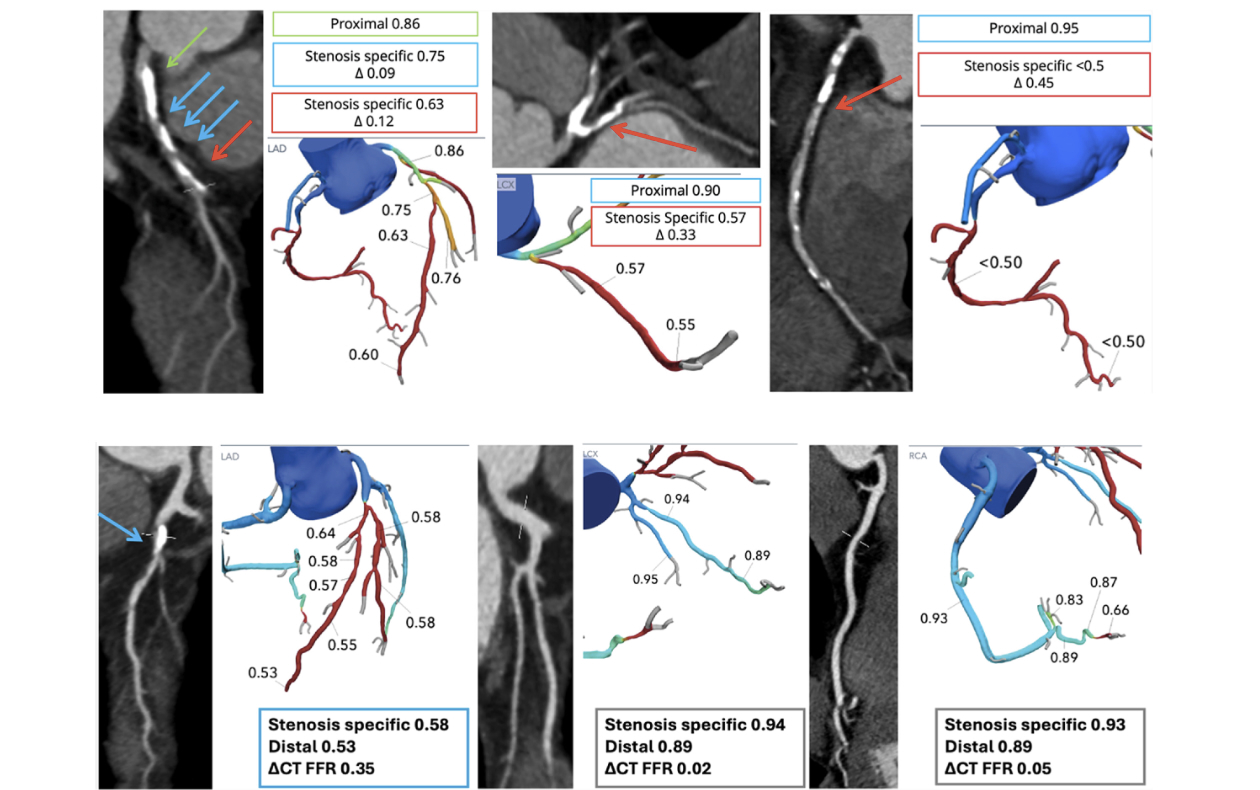
Key takeaways from the document include:
• High-quality CCTA imaging is essential for accurate FFR-CT computation.
• The use of nitroglycerin and heart rate control improve diagnostic accuracy.
• Motion artifacts and calcification can impact FFR-CT reliability.
• The biggest role for FFR-CT is in patients with stable chest pain and assessing intermediate stenosis to guide revascularization decisions.
• FFR-CT values should be integrated into CCTA reports, with stenosis-specific values measured 2 cm distal to the lesion.
“The 2 cm distal to the lesion seems to have the most robust evidence base, not only in terms of clinical outcomes but also in longer term prognosis,” Rajani explained in a statement. He is cardiology lead for cardiac CT and the nonstructural heart valve clinic at Guy's and St. Thomas' NHS Foundation Trust, and a professor of cardiovascular imaging at King's College London.
In addition to recommendations for acquisition and diagnostic accuracy, the document includes sections explaining how the technology works; clinical applications in stable chest pain, multivessel disease, stents, acute chest pain and special circumstances such as TAVR work ups and anomalous coronary arteries; prognostic value; reporting and future directions for FFR-CT to further expand its productive value and accuracy.
There are several companies that have commercialized FFR-CT and several more in the development stage. In the U.S., two companies have FDA market clearance for FFR-CT, Heartflow and Keya Medical Technology. Heartflow also has regulatory approval in Europe, the U.K., Japan, Canada, and India. Keya in Europe, U.K., China, and India. China also has three of its own home-grown vendors, Shukun Technology Inc., Raysight Medical and ArteryFlow Technology.
The consensus statement statement “Fractional flow reserve in coronary computed tomography angiography” was published in the Journal of Cardiovascular Computed Tomography (JCCT).

Dave Fornell has covered healthcare for more than 17 years, with a focus in cardiology and radiology. Fornell is a 5-time winner of a Jesse H. Neal Award, the most prestigious editorial honors in the field of specialized journalism. The wins included best technical content, best use of social media and best COVID-19 coverage. Fornell was also a three-time Neal finalist for best range of work by a single author. He produces more than 100 editorial videos each year, most of them interviews with key opinion leaders in medicine. He also writes technical articles, covers key trends, conducts video hospital site visits, and is very involved with social media. E-mail: [email protected]