
Biotech company receives second grant to develop gene therapy for AFib
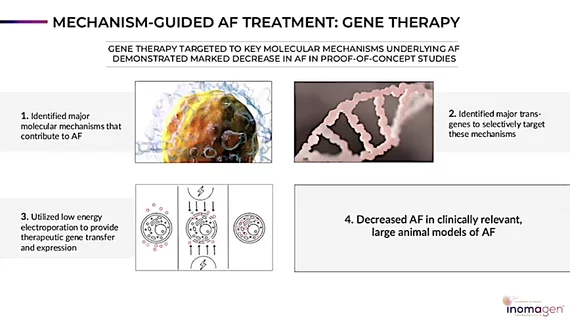
A $2.9 million Small Business Innovation Research (SBIR) grant from the National Heart, Lung, and Blood Institute (NHLBI) of the National Institutes of Health (NIH) has been awarded to Inomagen Therapeutics Inc. for the development of a new gene therapy for atrial fibrillation (AFib).
The therapy could eliminate the need for patients to use drugs or undergo invasive catheter ablation procedures, which are not always successful.
This grant will support preclinical and manufacturing activities for the company's proprietary investigational plasmid-based therapy. This two-year award provides $1.4 million during the first year and up to $2.9 million in total support based on satisfying specific progress goals of the program. This is the second time an SBIR grant has been awarded to Inomagen's AFib program; the first instance involved a grant worth $3.67 million in 2021.
“AFib is the most common heart rhythm disorder, affecting 10 million people in the U.S. alone and carrying a fivefold increased risk of stroke,” Rishi Arora, MBBS, founder and CEO of Inomagen and chief of cardiology at the University of Chicago, said in a statement. “Current treatments including medications and cardiac ablation have suboptimal efficacy for many patients with AFib, particularly those with more advanced or 'persistent' AFib. Inomagen’s novel gene therapy approach is being developed to provide a more effective treatment for these patients.”
Arora said the goal is to address an underlying molecular mechanism that contributes to AFib.
“Our approach is non-ablative and designed to reduce NADPH oxidase 2 (Nox2) expression and the oxidative stress that contributes to atrial remodeling in AFib," he explained. "Combined with our non-viral gene delivery platform, the approach can be transformative in the field of gene therapy."
The company has also developed a proprietary catheter-based electroporation system to facilitate non-viral gene delivery directly into cardiac tissue. The Travge delivery system uses low-energy pulsed field electroporation as opposed to high-energy pulsed field ablation (PFA) systems used to ablate cardiac tissue. This could help restore cardiac tissue to normal function rather that destroying the tissue with ablation.
Inomagen's goal is to attain 80% or better efficacy in persistent AFib with a single procedure. If it can hit that goal, the company believes it would be outperforming current ablation technologies.
The NIH grant will go toward evaluating therapeutic efficacy in a preclinical model of AFib that will support a future investigational new drug (IND) application to the U.S. Food and Drug Administration.

Dave Fornell has covered healthcare for more than 17 years, with a focus in cardiology and radiology. Fornell is a 5-time winner of a Jesse H. Neal Award, the most prestigious editorial honors in the field of specialized journalism. The wins included best technical content, best use of social media and best COVID-19 coverage. Fornell was also a three-time Neal finalist for best range of work by a single author. He produces more than 100 editorial videos each year, most of them interviews with key opinion leaders in medicine. He also writes technical articles, covers key trends, conducts video hospital site visits, and is very involved with social media. E-mail: [email protected]