
Q&A: Cardiologist explores CMS proposal to cover cardiac ablations performed in ambulatory surgical centers

In July, the Centers for Medicare and Medicaid Services (CMS) proposed adding procedure codes for cardiac ablations to the Ambulatory Surgical Center (ASC) Covered Procedures List as part of the 2026 Hospital Outpatient Prospective Payment System and ASC Payment System. If finalized, this policy shift would permit cardiac electrophysiologists to perform ablation procedures in ASCs outside of the hospital setting.
What are the benefits of such a move? Is there a potential downside? To learn more, Cardiovascular Business spoke to Arash Aryana, MD, PhD, a veteran cardiac electrophysiologist who has been closely following this topic. Aryana is the director of cardiovascular services and the cardiac electrophysiology laboratory at Mercy General Hospital in Sacramento, California. He has led multiple clinical studies on the safety and effectiveness of performing cardiac electrophysiology procedures in ASCs [1, 2]. In addition, he has met and communicated with CMS on multiple occasions to provide guidance as the agency considers pulling the trigger on this significant update.
Aryana moderated a panel about performing cardiac ablation procedures at ASCs during HRX 2025, an annual electrophysiology conference hosted by the Heart Rhythm Society (HRS). He also sat down with Cardiovascular Business for an in-person interview during the show.
Read below for the full conversation:
Cardiovascular Business: What was your initial reaction to the news that CMS had proposed allowing cardiac ablation procedures to be performed at ASCs?
Arash Aryana, MD, PhD: I would say, I was extremely encouraged. This is something that my colleagues and I have been dedicating all of our efforts to for over two years—including multiple meetings with CMS and regulatory bodies, as recently as a couple weeks ago—and we’re very hopeful that it will be finalized in November.
To date, CMS has approved a variety of cardiovascular procedures to be performed in the ASC setting. These include the implantation of cardiac implantable electronic devices such as pacemakers, defibrillators and implantable loop recorders, as well as performing coronary angiography, elective percutaneous coronary intervention and various diagnostic and interventional vascular procedures.
As my colleagues and I have repeatedly shown in our studies and published reports [1-5], cardiac electrophysiology procedures and catheter ablations are highly safe outpatient procedures associated with a low risk of adverse events that is often lower than—or at most, comparable to—all other types of cardiovascular and non-cardiovascular procedures that are performed in ASCs today. We strongly believe that the time has come for the codes for cardiac ablation to be approved.
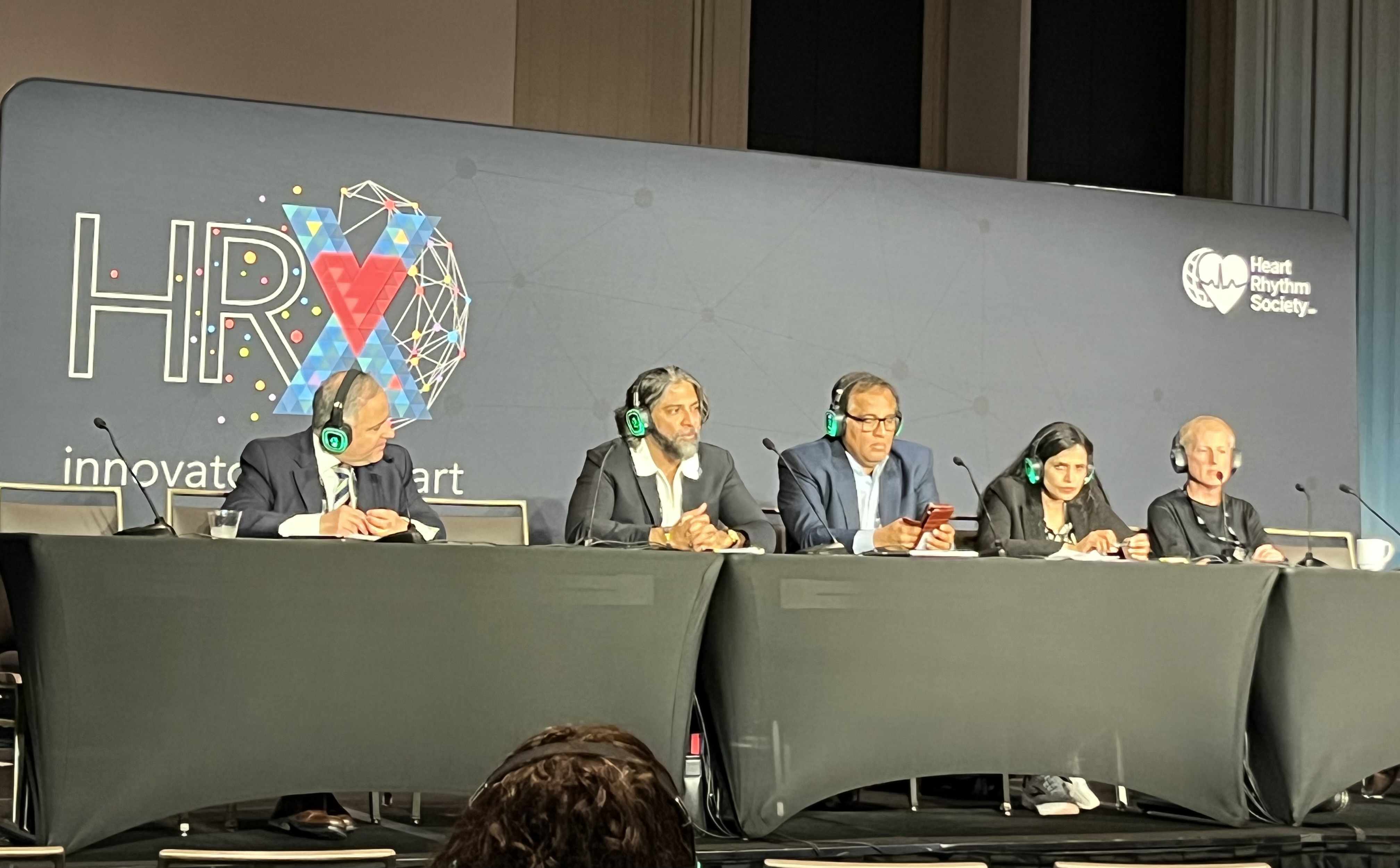
Arash Aryana, MD, PhD (left), moderates a session at HRX 2025 in Atlanta about the prospect of performing cardiac ablation procedures at ASCs. Other participants pictured include (left to right) Usman Siddiqui, MD; Dhanunjaya Lakkireddy, MD; Kamala Tamirisa, MD; and Chad Bonhomme, MD.
What would some benefits be of CMS finalizing this proposal?
The one consistent message that we hear from all of our cardiac electrophysiologist colleagues across the country is that they’re facing huge backlogs for their cardiac ablations, irrespective of where they practice. Currently, at most facilities, the procedure wait times range anywhere from 60 to more than 200 days for routine cardiac ablations. This holds true for those who practice in both academic and non-academic institutions. It’s the same whether you practice at the Cleveland Clinic or at a smaller community hospital, and it’s largely a reflection of the shortage of cardiac electrophysiology laboratories across hospitals and hospital outpatient departments in the country.
When you factor in the time it takes for a patient to be refereed to see a specialist—that is, the wait time from when a patient is referred to see a cardiac electrophysiologist to the time they actually undergo the cardiac ablation procedure to treat an arrhythmia, such as atrial fibrillation—the excessive and protracted delays in patient care are just not acceptable. Because the data clearly shows that delaying time to ablation/intervention can lead to unfavorable outcomes—including higher rates of death, heart failure, and stroke (12.2%), greater hospitalization rates (11.8%), more frequent emergency department visits (30.9%) and a higher cost to the healthcare system [6, 7]. Incidentally, the same types of delay apply to transesophageal echocardiography and cardioversion, for which the procedure wait times can be upwards of 30 to 40 days across many facilities. We are very hopeful that in November, CMS will also add the codes for these procedures to the ASC Covered Procedure List.

"As long as we all work together, this should be a positive change all around. I believe it will be important for clinicians and hospitals to cooperate, collaborate and remain aligned."
Arash Aryana, MD, PhD, Director of Cardiovascular Services and the Cardiac Electrophysiology Laboratory at Mercy General Hospital in Sacramento, California
All of this presents a huge public health problem to which we believe ASCs can offer a helpful solution. Allowing these procedures to be performed in ASCs can help to dramatically improve patient access and reduce procedure wait times. These are all routine outpatient electrophysiology procedures that, in the appropriately-selected patient, can be performed safely and feasibly in ASCs. Aside from offering patients additional places of service, ASCs typically offer shorter procedures wait times compared to hospitals owing to their improved efficiency and throughput, thereby, markedly reducing the delay in care.
Another key benefit to performing these procedures in ASCs has to do with cost savings—both to the patient and the healthcare system. In general, ASCs provide outpatient services at a lower cost than hospitals. Recently published data show that a gradual shift in cardiac ablations to ASCs can result in over a billion dollars in savings to Medicare and over three-quarters of a billion dollars to Medicare Advantage, over a 10-year horizon [8]. Similar savings to the tune of one-and-a-half billion dollars were shown to benefit commercial payers over the same time frame. But very importantly, the system would be able to pass on these savings to the patients—in the form of lower copays, etc. Because ASCs can typically offer outpatient procedures at lower costs than hospitals, they become more accessible for lower-income patients. In turn, this can help improve access for those who might otherwise face financial barriers to care as well as those with high-deductible insurance plans.
I also would like to elaborate a bit on the improvements in efficiency and throughput associated with ASCs. One of the greatest challenges that we currently face in healthcare is the optimization of patient throughput, which directly impacts access to care and its quality. Inefficient patient processing can negatively impact the success and sustainability of any healthcare enterprise—whether a managed care system, a solo practice, or an academic facility. By focusing on specific outpatient procedures, ASCs have the ability to streamline care and improve access. Additionally, ASCs can help reduce the burden on hospitals and hospital outpatient departments, especially in high-demand urban areas. The value of ASCs in this regard became very clear during the COVID-19 pandemic.
ASCs also tend to provide a more convenient option for patients in rural communities, who may have difficulty traveling to and from hospitals in farther urban areas. An epidemiologic study from the Centers for Disease Control has shown that age-adjusted mortality associated with atrial fibrillation is rising at steeper rates for patients with in rural areas as compared to their urban counterparts [9]. In turn, these disparities in access to care were found to be associated with increased mortality and higher costs to the healthcare system [10]. Thus, ASCs may not only bring lower-cost ablation services to CMS beneficiaries, but also to broader populations and geographies, particularly in rural areas.
If CMS finalizes this decision, are there any ablation procedures that should still be performed at the hospital?
Absolutely. When deciding on whether or not to perform a cardiac electrophysiology procedure or an ablation in an ASC, several factors should be carefully weighed in—the type of procedure being performed, the patient characteristics and the capabilities of the facility in question. Optimal patient selection is absolutely paramount to ensuring safety and efficacy. Adhering to evidence-based selection criteria and exclusion of high-risk patients can greatly optimize the outcomes.
My colleagues and I recently completed a joint Heart Rhythm Society/American College of Cardiology Scientific Statement—pending publication later this year—on guiding principles for performing cardiac ablations in ASCs. We believe this will serve as a helpful document and resource for our fellow colleagues.
Are there any potential downsides to this policy?
As long as we all work together, this should be a positive change all around. I believe it will be important for clinicians and hospitals to cooperate, collaborate and remain aligned. So far, I’m very encouraged by what I’m seeing nationally—and I hope to see more of these types of collaborations going forward.
Any closing thoughts?
For appropriately-selected patients, ASCs can offer a perfect opportunity to conduct cardiac electrophysiology procedures and ablations in a safe, efficient, and highly cost-effective environment. Given that the compound annual growth rate for cardiac ablation though 2030 is estimated at 14%, I believe ASCs will emerge to play a significant role in the cardiac electrophysiology space by the end of this decade.

Michael has more than 19 years of experience as a professional writer and editor. He has written at length about cardiology, radiology, artificial intelligence and other key healthcare topics.