
Mount Sinai researchers aim to learn more about treating SCAD
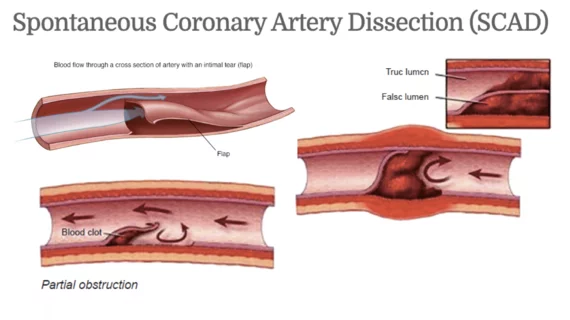
The Icahn School of Medicine at Mount Sinai was awarded a $2 million grant from the National Heart, Lung, and Blood Institute (NHLBI), part of the National Institutes of Health (NIH), to study which therapy is optimal for treating spontaneous coronary artery dissection (SCAD).
These sudden tears in the wall of a coronary arteries can reduce blood flow and cause an uncommon type of heart attack, often in women. However, there is not a clear consensus on how to best treat this atypical cardiac presentation.
“SCAD is a very different disease from the type of heart attack we encounter most often, yet many of the treatments we use today have been adopted from studies conducted in other patient populations. This trial gives us an opportunity to generate the rigorous evidence that patients with SCAD and their physicians have been waiting for,” Deepak L. Bhatt, MD, MPH, director of Mount Sinai Fuster Heart Hospital and a principal investigator of the clinical coordinating center, said in a statement.
Mount Sinai will use the funding for a one-year feasibility phase of the United States portion of a major international clinical trial to determine whether aspirin alone, or a more intensive combination of blood-thinning medications, is better for treating this condition. The study will provide evidence to better inform future SCAD treatment recommendations worldwide and improve outcomes.
Following a successful feasibility phase, Mount Sinai will receive about $14 million over seven years from NIH to launch a larger United States portion of the same clinical trial.
Between 80-95% of SCAD cases occur in women. It is seen as a key sex difference in heart attack presentations between men and women. Most of the women who present with SCAD are between the ages of 42 and 52 and may not have traditional cardiovascular disease risk factors such as high cholesterol or diabetes.
“Because SCAD disproportionately affects women, often at a relatively young age and without the traditional warning signs of heart disease, answering this question is particularly important," Roxana Mehran, MD, Mount Sinai professor in cardiovascular clinical research and outcomes, Icahn School of Medicine at Mount Sinai, said in the same statement. She is a principal investigator for the trial’s clinical coordinating center and serves as the current president of the American College of Cardiology.
"Our goal is to determine which treatment provides the best protection while exposing patients to the least unnecessary risk,” Mehran said.
After a typical heart attack, patients are often treated with antiplatelet medications to reduce the formation of myocardial infarction-causing clots. But because SCAD is caused by a problem within the artery wall rather than from cholesterol buildup, doctors do not have clear evidence about the best treatment. Most treatments currently used for SCAD patients are based on more common types of heart attacks and have never been adequately tested in a large, randomized trial specifically for SCAD.
The new SCAD-ALIGN trial will compare a moderate antiplatelet strategy of aspirin alone for three months with a more intensive strategy of dual antiplatelet therapy for three months, followed by nine months of single antiplatelet therapy. Researchers will enroll about 3,500 patients internationally. About 500 will be enrolled in the U.S. at 60 sites. Data will be collected to evaluate major cardiovascular outcomes, including cardiovascular death, myocardial infarction, recurrent SCAD, unplanned coronary revascularization, stroke, transient ischemic attack and bleeding.
“SCAD is relatively uncommon, so no single center or country can easily enroll enough patients to answer this question reliably. This project brings together research networks and national funding organizations across multiple countries under one common study protocol,” Alan Moskowitz, MD, a professor with Icahn School of Medicine at Mount Sinai and a principal investigator for the trial’s data coordinating center, said in the same statement.

Dave Fornell has covered healthcare for more than 17 years, with a focus in cardiology and radiology. Fornell is a 5-time winner of a Jesse H. Neal Award, the most prestigious editorial honors in the field of specialized journalism. The wins included best technical content, best use of social media and best COVID-19 coverage. Fornell was also a three-time Neal finalist for best range of work by a single author. He produces more than 100 editorial videos each year, most of them interviews with key opinion leaders in medicine. He also writes technical articles, covers key trends, conducts video hospital site visits, and is very involved with social media. E-mail: [email protected]