
Longest-distance robotic cardiac telesurgery ever performed over 12,500 miles
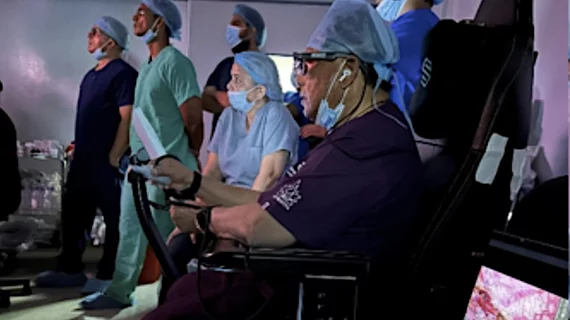
Many cardiology tech experts say robotic telesurgery may one day enable state-of-the-art, expert care anywhere in the world. A new milestone in that direction was recently accomplished with left internal mammary artery (LIMA) takedown robot-assisted heart procedure performed on a patient in India, with the surgeon located at Georgetown Public Hospital Corp. (GPHC) in Guyana, 12,500 miles away.
This milestone also marks an advancement for Guyana's healthcare system, which the country's president said will help set up it up as a regional center for telesurgery expertise.
This is the world’s longest-distance robotic telesurgery ever conducted. The procedure used a high-speed fiber communications network between Guyana and India. The procedure was performed using a SSi Mantra surgical robotic system developed by SS Innovations International Inc. The company developed surgical robotic technologies aimed at making robotic surgery affordable and more accessible to a global community
“The successful completion of this intercontinental cardiac telesurgery marks a historic milestone for SS Innovations and our SSi Mantra surgical robotic system. With each new remote procedure, we continue to push the boundaries of telesurgery and move closer to democratizing access to world-class surgical expertise globally," Dr. Sudhir Srivastava, who performed the remote procedure and is chairman of the board and chief executive officer of SS Innovations, said in a statement.
To date, 22 cardiac telesurgeries have been successfully performed using the SSi Mantra system, the only surgical robotic system globally that has been used for cardiac telesurgery. Prior to this historic event, the longest-distance robotic telesurgery spanned from Strasbourg, France to Indore, India, a distance of about 6,250 miles. To date overall, the company said its has successfully performed 173 telesurgeries globally.
The patient-side robotic setup was set up at Sri Aurobindo Institute of Medical Science in Indore, India, where the robotic arms and surgical instruments precisely replicated Srivastava's hand movements. The company said the robotic system functioned with a network latency of 290-300 milliseconds. In. India, the surgery was supported by Dr. Lalit Malik, chief cardiac surgeon at Manipal Hospitals Jaipur, Dr. Ram Shukla, consultant cardiac surgeon at Bhandari Hospital and Research Center, and Dr. Mohit Bhandari, bariatric and metabolic surgeon and president of IRCAD India.
Srivastava thanked the leadership of Guyana, especially the country's President Mohamed Irfaan Ali, and Health Minister Dr. Frank Anthony, for positioning the country to become a modern robotic surgery hub for the Caribbean.
“As Guyana celebrates its 60th Independence Anniversary, we are proud to mark the beginning of a transformative new chapter in our nation's healthcare journey," Irfaan Ali said in a statement. "Our vision has always been to position Guyana as a leader in advanced healthcare and medical innovation, and today we take a significant step forward with the adoption of robotic surgery technology, one of the most groundbreaking advancements in modern medicine. This landmark achievement showcases the immense potential of technology to transcend geographical boundaries, while placing Guyana at the forefront of next-generation healthcare innovation.”
He said Guyana wants to rapidly build a strong pool of skilled robotic surgery practitioners and expand access to advanced medical care. The president said this is part of a wider effort to strengthen Guyana’s position as an emerging, regional leader in healthcare innovation. The company received regulatory approval for the SSi Mantra from Guyana’s Government Analyst-Food and Drug Department (GA-FDD) in May 2026.
The SSi Mantra system features three to five modular robotic arms, an open-faced ergonomic surgeon command center, a large 3D 4K monitor, a touch panel monitor displaying patient related information, a real-time image of the robotic patient side arm carts, and the ability to superimpose 3D models from diagnostic imaging to aid procedural guidance. The system can use more than 40 types of robotic endosurgical instruments to support different specialties, including cardiac surgery, and 5 mm instruments for the pediatric population and ENT surgeries. The company said the system has been clinically validated in India in more than 170 different types of surgical procedures.

Dave Fornell has covered healthcare for more than 17 years, with a focus in cardiology and radiology. Fornell is a 5-time winner of a Jesse H. Neal Award, the most prestigious editorial honors in the field of specialized journalism. The wins included best technical content, best use of social media and best COVID-19 coverage. Fornell was also a three-time Neal finalist for best range of work by a single author. He produces more than 100 editorial videos each year, most of them interviews with key opinion leaders in medicine. He also writes technical articles, covers key trends, conducts video hospital site visits, and is very involved with social media. E-mail: [email protected]