
Robotic cardiac surgery building momentum thanks to RAVR, other breakthroughs
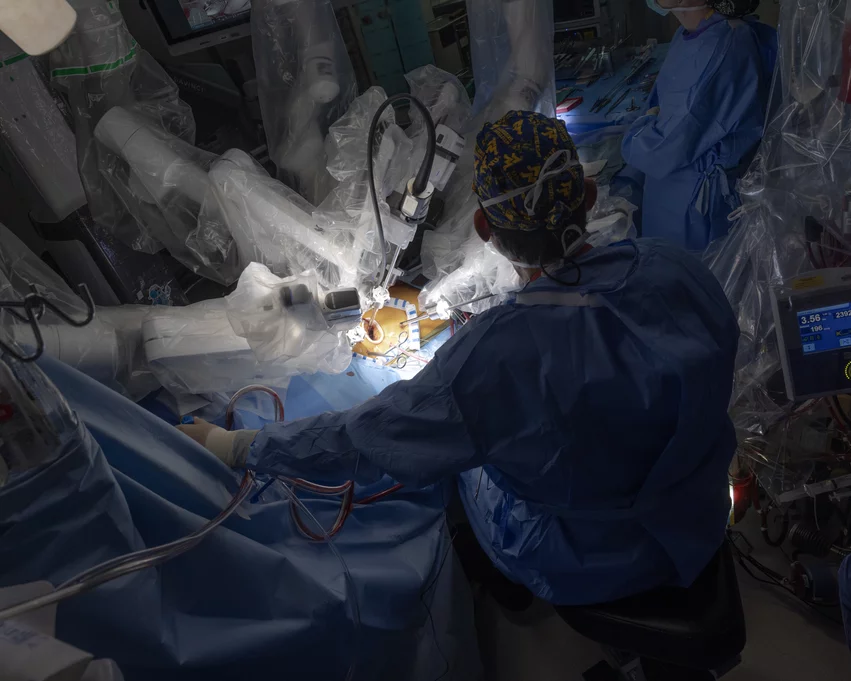
Early adopters have been using robotics to perform cardiac surgeries in the United States for years now, but multiple factors—including high costs and early concerns about patient outcomes—have held back widespread implementation.
According to a new commentary in The Annals of Thoracic Surgery, however, robotic cardiac surgery has gained considerable momentum in the last year. Is now the time for this trend to truly take off?
“A convergence of improved training frameworks, maturing technology and increasingly standardized quality processes have supported a broader and more sustainable growth,” wrote co-authors Andrea Amabile, MD, a cardiothoracic surgery resident with the University of Pittsburgh Medical Center (UPMC) Heart and Vascular Institute, and Johannes Bonatti, MD, director of the cardiac robotic surgery at the UPMC Heart and Vascular Institute. “In this context, the past year has brought forward a set of notable global milestones that collectively illustrate the evolving capabilities of robotic cardiac surgery.”
Amabile and Bonatti pointed to robotic aortic valve replacement (RAVR), a robotics-assisted alternative to transcatheter aortic valve replacement and surgery, as one of the biggest breakthroughs in robotic cardiac surgery. They cited research by Vinay Badhwar, MD, executive chair of the West Virginia University (WVU) Heart and Vascular Institute and the next president of The Society of Thoracic Surgeons, as a major reason for RAVR’s rise. Badhwar developed a RAVR technique that is now being adopted by care teams in the United States and abroad. In addition, he and his colleagues at WVU now host an annual RAVR symposium focused on educating surgeons and cardiologists alike about the procedure.
In addition to positive patient outcomes, another reason care teams are turning to these robotic-assisted procedures is the fact that the surgeon does not have to be in the same room—or even the same city—as the patient. In India, Amabile and Bonatti wrote, one patient underwent a remote internal mammary artery harvest and robotically-assisted beating-heart coronary artery bypass when the surgeon was more than 150 miles away.
“This case demonstrated the feasibility of telesurgery and suggested a possible future direction for providing subspecialty care independent of geography,” the two co-authors wrote.
Amabile and Bonatti also noted that Intuitive Surgical, the manufacturer of the da Vinci platform used for many of these surgeries, has started making cardiac care a bigger priority. The company now has a global vice president of cardiac surgery, for example, and has started gaining more U.S. Food and Drug Administration approvals for cardiac indications.
“Over the past year, cardiac surgery not only caught up: it leapt forward,” the authors wrote. “While resources, institutional commitment, and ongoing outcomes analysis remain essential, the trajectory of the field has become clearer: robotic cardiac surgery is no longer about proving what can be done, it is about discerning what should be done, and for whom."
Click here to read the full commentary in The Annals of Thoracic Surgery.

Michael has more than 19 years of experience as a professional writer and editor. He has written at length about cardiology, radiology, artificial intelligence and other key healthcare topics.