
Sutureless aortic valve linked to positive 7-year data
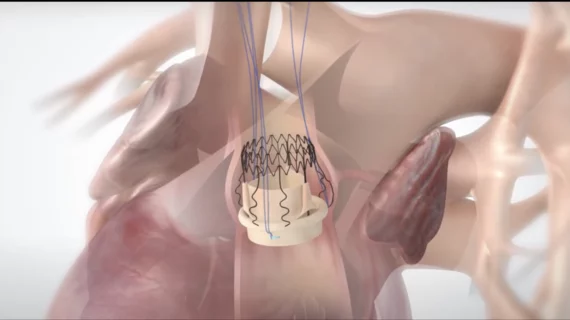
A subanalysis of the MANTRA clinical trial has found that the Corcym Perceval Plus sutureless surgical aortic valve is associated with excellent durability, safety and quality-of-life improvements a full seven years after treatment. The new data were presented at the European Association for Cardio-Thoracic Surgery (EACTS) 2026 meeting.
The Perceval Plus is the only sutureless and collapsible aortic surgical heart valve. It was designed to perform in any surgical scenario, including operations that include endoscopy and robotics. The company’s FREE tissue treatment addresses the two main causes of calcification, phospholipids and aldehydes, and the sutureless design enables faster procedures without the need to sew the valve into the annulus.
“This large study provides the longest clinical follow-up currently reported for the Perceval Plus valve and its FREE tissue technology, offering valuable insights into their sustained clinical and hemodynamic performance over time,” lead author Michael Ibrahim, MD, PhD, a researcher with the University of Virginia Health University Medical Center, said in a statement. “These data demonstrate a favorable hemodynamic profile, characterized by durably low transvalvular gradients and minimal paravalvular regurgitation, along with low rates of reintervention and permanent pacemaker implantation. The high freedom from structural valve deterioration and valve-related reintervention observed during follow-up demonstrates an excellent midterm durability profile.”
The subanalysis included 708 patients treated with the Perceval Plus device in routine clinical practice at 45 centers. It found a 99.7% freedom from structural valve deterioration (SVD) from three to seven years in addition to a 96.6% freedom from aortic valve reoperation from four to seven years. Patients had a 3.7% permanent pacemaker implantation (PPI) rate at 30 days.
Quality-of-life improvements included the fact that 96.3% of patients classified as NYHA class I-II at 30 days, a 32% improvement from baseline. In addition, more than 95% of these patients sustained that status at their 3-year follow-up appointment.
The mean Kansas City Cardiomyopathy Questionnaire-12 scores pointed to a 19% improvement from baseline to the 30-day follow-up. That improvement jumped to 31% from baseline by the end of the first year
The trial also assessed quality of life using the EQ-5D-5L Visual Analogue Scale, a quantitative, self-reported measure of a patient's overall health. There was an 11% improvement in mean scores from baseline after 30 days and an 18% improvement from baseline after one year.

Dave Fornell has covered healthcare for more than 17 years, with a focus in cardiology and radiology. Fornell is a 5-time winner of a Jesse H. Neal Award, the most prestigious editorial honors in the field of specialized journalism. The wins included best technical content, best use of social media and best COVID-19 coverage. Fornell was also a three-time Neal finalist for best range of work by a single author. He produces more than 100 editorial videos each year, most of them interviews with key opinion leaders in medicine. He also writes technical articles, covers key trends, conducts video hospital site visits, and is very involved with social media. E-mail: [email protected]