
Why right heart failure should be seen as a distinct cardiac condition
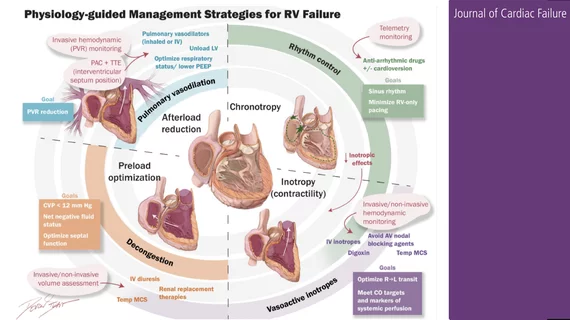
The Heart Failure Society of America (HFSA) has released a new scientific statement calling for right heart failure (RHF) to be recognized as its own distinct clinical syndrome instead of a secondary complication of left-sided heart disease.[1] The statement was published in full in the Journal of Cardiac Failure (JCF).[1]
By consolidating evidence and outlining clear knowledge gaps, the HFSA scientific statement aims to help clinicians apply a more consistent, pathophysiology-driven approach to RHF. Another goal is to lay the groundwork important research the writing group says is still needed to advance the field of heart failure care.
The authors of the statement provided a structured framework to guide the earlier recognition of RHF and more consistent management in clinical practice. The group noted that RHF is growing more common as pulmonary vascular disease advances, which results in longer hospitalizations, heavier ICU use and frequent hospital readmissions that place substantial strain on the healthcare system.
"RHF has too often been treated as an afterthought of left heart disease," Manreet K. Kanwar, MD, corresponding author of the statement and director of the heart failure and pulmonary hypertension program at the University of Chicago, said in a statement. "This statement makes the case that RHF should be recognized and managed as its own syndrome, with a diagnostic approach and treatment strategy tailored to right ventricular physiology."
"Our hope is that this framework gives clinicians a structured way to recognize and manage right heart failure earlier, and gives the research community a foundation to close the gaps that have limited progress in this field," added Ryan J. Tedford, MD, senior author of the statement and medical director of cardiac transplantation at the Medical University of South Carolina.
The statement outlines a three-pillar approach to acute RHF in the ICU, offers risk-assessment tools for escalating pulmonary artery hypertension (PAH) therapy and gives clear guidance on how and when to use PAH-targeted therapies, circulatory support or tricuspid valve interventions. It also examines various clinical scenarios where RHF most often arises, including cardiogenic shock, PAH, chronic left heart failure and after mechanical circulatory support or transplantation.
The writing group also offered a list of key takeaway messages from their statement:
• Progressive right ventricular (RV) dysfunction is the principal determinant of symptoms, hospitalization and death in advanced PAH. Serial multiparametric risk assessments, including validated tools such as REVEAL 2.0 or guideline-based risk models, should guide the escalation of PAH therapy as needed over time.
• RHF is a significant potential complication after left ventricular assist device (LVAD) implantation and heart transplantation. The standardized perioperative assessment and management of patients undergoing those procedures may facilitate earlier recognition and treatment.
• RHF should be evaluated using a structured approach integrating clinical examination, biomarkers, echocardiography, and heart catheterization when diagnosis, severity, or treatment decisions require greater precision. "No single measurement adequately defines RHF."
• Management of acute RHF requires simultaneously addressing all three pillars to optimize preload, reduction of RV afterload, and support of contractility and systemic perfusion. Rhythm management and a RV-protective ventilator strategy are also key for the management of acute RV failure in the ICU.
• Temporary mechanical circulatory support (MCS), including percutaneous RV assist devices, surgical right ventricular assist devices (RVADs), and venoarterial extracorporeal membrane oxygenation (VA-ECMO), should be considered in select patients with refractory RHF and cardiogenic shock as a bridge to recovery, decision, durable support or transplantation.
• Transcatheter tricuspid interventions can improve symptoms and quality of life in select patients with severe tricuspid regurgitation (TR). Surgical or transcatheter intervention should be considered.
• RHF is associated with longer hospitalizations, greater ICU use, frequent readmission and a large amount of healthcare resource utilization.
• RHF remains inadequately studied. Progress in gathering more clinical data will require consistent definitions, standardized and patient-centered trial endpoints, deeply phenotyped registries, validated prediction models and adequately funded RHF-specific clinical trials.

Dave Fornell has covered healthcare for more than 17 years, with a focus in cardiology and radiology. Fornell is a 5-time winner of a Jesse H. Neal Award, the most prestigious editorial honors in the field of specialized journalism. The wins included best technical content, best use of social media and best COVID-19 coverage. Fornell was also a three-time Neal finalist for best range of work by a single author. He produces more than 100 editorial videos each year, most of them interviews with key opinion leaders in medicine. He also writes technical articles, covers key trends, conducts video hospital site visits, and is very involved with social media. E-mail: [email protected]