
Drones deliver AEDs for the first time in the United States
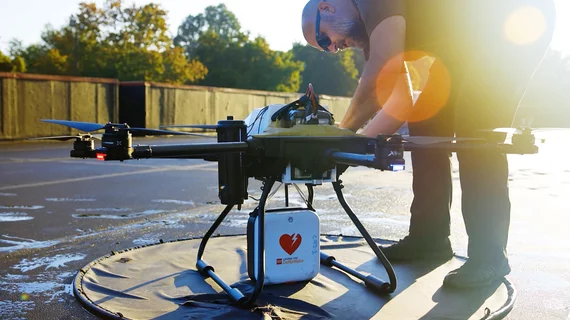
For the first time in the United States, drones will be used to quickly deliver automated external defibrillators (AEDs) to bystanders who call 911 for patients in cardiac arrest. The idea is to deliver an AED before police or paramedics arrive on scene, saving critical minutes in an effort to boost survival.
Survival is less than 10% of the 350,000 Americans who suffer cardiac arrest each year. According to previous research, if an AED can be used within two to three minutes of cardiac arrest, survival rates can increase to 70%. But the average response time for emergency medical services (EMS) to arrive is about eight to 10 minutes, well outside the window to help patients.
Duke Health in North Carolina is now coordinating a research project through the Duke Clinical Research Institute to see if drones can help change that survival curve. Partnering with the Forsyth County Sheriff’s Office, which has already used drones as part of its law enforcement operations, Duke will dispatch AED drones in response to 911 calls for evident cardiac arrest.
The drones will launch at the same time as traditional EMS is dispatched. The initial aim is to see if bystanders using the defibrillators can improve patient outcomes.
“This study represents a major step forward in how we respond to cardiac arrest in the United States,” explained Monique Starks, MD, principal investigator and associate professor at Duke University School of Medicine, in a statement. “By integrating drone technology into emergency care, we’re working to close the critical gap between cardiac arrest and treatment, and that has the potential to save thousands of lives.”
A drone pilot will launch the drone to fly autonomously at 200 feet to the location of the emergency. The drone will then drop to 100 feet and winch the AED safely to the ground. Meantime the 911 dispatcher will guide the bystander to the drop point and instruct the untrained responder in how to use the device.
The goal is to deliver an AED in less than five minutes.
“Launching drone-delivered AEDs is a promise to our citizens that their safety and quality of life are paramount,” said Forsyth County Sheriff Bobby Kimbrough Jr. in a statement. “When seconds matter, this technology gives us the ability to reach people in need faster than ever before. It’s about saving lives, building trust and showing our community that we will always lead with care and commitment.”
The project has support from the American Heart Association and has many contributors, including University of Washington, Hovecon Consulting, Emory University, Virginia Commonwealth University, and University of Toronto. The study area for drone AED deliveries also includes James City County, Virginia.
“This project is laying the groundwork for what we hope will become a large, multicenter randomized clinical trial,” Joseph Ornato, MD, co-principal investigator on the study and professor of emergency medicine at Virginia Commonwealth University, said in a statement. “That future research will help us understand critical questions about how well this works, what it costs and how we can get AEDs to people as quickly as possible whether they live in a city or rural community.”
Several European studies looked at the use of drones to quickly deliver AEDs and reported positive results.

Dave Fornell has covered healthcare for more than 17 years, with a focus in cardiology and radiology. Fornell is a 5-time winner of a Jesse H. Neal Award, the most prestigious editorial honors in the field of specialized journalism. The wins included best technical content, best use of social media and best COVID-19 coverage. Fornell was also a three-time Neal finalist for best range of work by a single author. He produces more than 100 editorial videos each year, most of them interviews with key opinion leaders in medicine. He also writes technical articles, covers key trends, conducts video hospital site visits, and is very involved with social media. E-mail: [email protected]