
Abbott’s dissolving stent picks up a key approval
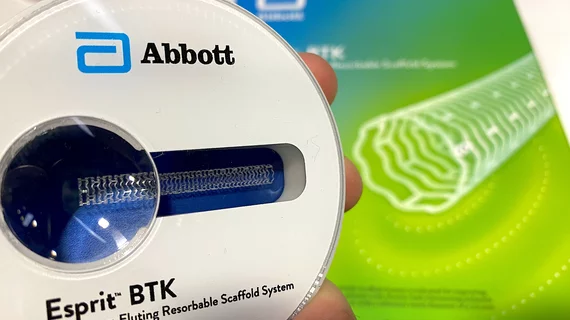
Abbott’s Esprit BTK Everolimus Eluting Resorbable Scaffold System has gained CE mark approval for the treatment of people with below the knee (BTK) peripheral artery disease (PAD). The stent dissolves over time once the patient’s blood flow has been restored, helping improve the outcomes for these high-risk patients who have previously had limited treatment options.
“With the Esprit BTK System, we're helping to restore blood flow without leaving a permanent implant behind,” Samih Al Mawass, divisional vice president of Europe, Middle East and Africa within Abbott's vascular business, said in a statement. “Our resorbable program is focused on delivering meaningful innovation in the peripheral anatomy to help patients live healthier, fuller lives.”
“For too long, patients with severe PAD BTK have had limited treatment options and were often faced with potential amputations,” added Dierk Scheinert, MD, a professor with University Hospital Leipzig. “With CE mark, the Esprit BTK System offers a resorbable scaffold backed by strong data and proven superiority over balloon angioplasty—giving physicians a novel, innovative tool to treat the most severe forms of PAD more effectively and improve patient outcomes across Europe.”
Esprit BTK System has now received both FDA and CE mark approval
The Esprit BTK System gained U.S. Food and Drug Administration (FDA) in April 2024. The FDA primarily based its decision on data from LIFE-BTK, an Abbott-funded clinical trial focused on data from 225 patients randomized in a 2:1 ratio to receive treatment with the Espirit BTK System or angioplasty. Initial results from LIFE-BTK were presented at TCT 2023 in San Francisco and published in the New England Journal of Medicine; they suggest the resorbable scaffold was safe and associated with superior patient outcomes.[1]
Additional LIFE-BTK data were presented at VIVA 2024 in November 2024. These new two-year results showed 90.3% of patients in the Esprit BTK arm did not require a reintervention after 24 months. Compared to balloon angioplasty, patients treated with the scaffold had significantly greater freedom from chronic limb-threatening ischemia (CLTI), which was the primary efficacy clinical event (61.5% vs. 32.8%).

Michael has more than 19 years of experience as a professional writer and editor. He has written at length about cardiology, radiology, artificial intelligence and other key healthcare topics.