
BATMAN to the rescue: TMVR technique helps cardiologists reduce risk of LVOT obstruction
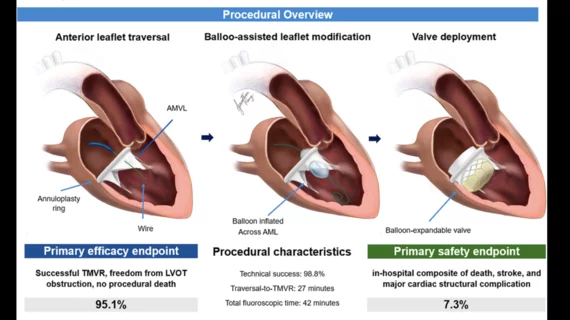
Balloon-assisted translocation of the mitral anterior leaflet (BATMAN) is an effective treatment option for patients who face an increased risk of left ventricular outflow track (LVOT) obstruction during transcatheter mitral valve replacement (TMVR), according to new data published in JACC: Cardiovascular Interventions.[1]
LVOT obstruction is a serious complication of TMVR. Cardiologists often turn to other techniques—LAMPOON or SESAME, for example—to minimize the risk of LVOT obstruction, but these are challenging to perform and can lead to much longer procedure times. BATMAN is seen as a potential alternative to these techniques It involves advancing a steerable catheter in the left atrium, traversing the base of the anterior mitral leaflet and then inflating a balloon until achieving complete laceration. Not all BATMAN procedures are the same, however, and one variant is even known as the retrograde radiofrequency balloon-assisted optimization of no-LVOT (ROBIN) technique. Preemptive alcohol septal ablation is performed in some cases to further help reduce the risk of LVOT obstruction following TMVR.
Previous research has pointed to BATMAN’s potential. This analysis evaluated 83 patients with mitral valve disease who faced a high risk of LVOT obstruction. Patients were treated from 2023 to 2026. While 30.1% of patients underwent a valve-in-valve (ViV) procedure due to a failed surgical valve, another 47% underwent a valve-in-ring (ViR) procedure due to a failed surgical ring and 22.9% underwent treatment for severe mitral annular calcification (MAC).
Overall, BATMAN was associated with a technical success rate of 98.8% and short procedure times. The primary efficacy endpoint—TMVR free of LVOT obstruction and procedural death—was met in 95.1% of cases. The primary safety endpoint—the composite of in-hospital death, stroke and major cardiac structural complications—occurred in 7.3% of patients, primarily in those being treated for severe MAC. In addition, one patient with severe MAC experienced a major cardiac structural complication directly associated with the BATMAN technique.
“Further studies are needed to evaluate the comparative effectiveness of BATMAN vs. LAMPOON and to inform clinical decision-making between the two techniques according to the substrate of mitral valve disease,” wrote first author Gennaro Giustino, MD, an interventional cardiologist with the Atlantic Health System’s Gagnon Cardiovascular Institute, and colleagues.
Giustino et al. also highlighted the slightly worse outcomes for patients undergoing TMVR for valve-in-mitral annular calcifications, saying clinicians should keep this difference in mind going forward.
Click here for the full analysis in JACC: Cardiovascular Interventions, an American College of Cardiology journal.
Click here for an earlier look at the potential benefits of BATMAN.

Michael has more than 19 years of experience as a professional writer and editor. He has written at length about cardiology, radiology, artificial intelligence and other key healthcare topics.