
Cardiologists perform first TTVR of its kind on recent heart transplant recipient
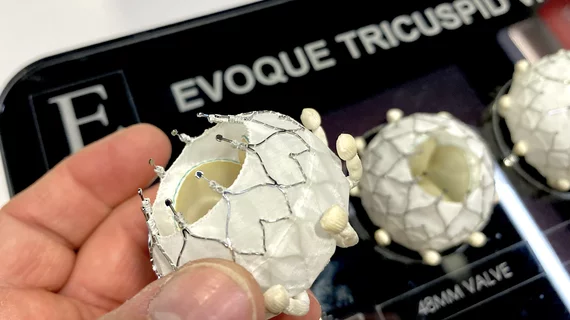
The care team at Vanderbilt University Medical Center (VUMC) has performed what is believed to be the first transcatheter tricuspid valve replacement (TTVR) of its kind. The procedure was performed on a recent heart transplant recipient undergoing surveillance via right heart catheterization (RHC) and endomyocardial biopsy (EMB).
The group shared its story in The Journal of Heart and Lung Transplantation.[1]
The case began with a 50-year-old man with nonischemic cardiomyopathy receiving a heart transplant. Two months later, he had developed severe tricuspid regurgitation (TR) and clinicians identified signs of irreversible right ventricle (RV) dilation and RV dysfunction. Due to fears that a surgical intervention was too risky—due to both the patient’s symptoms and the recent heart transplant—clinicians decided the best treatment option was TTVR with the FDA-approved Evoque TTVR device from Edwards Lifesciences.
The care team was forced to adjust its approach a few times, but the TTVR procedure was ultimately a success. The authors highlighted the importance of their work and shared advice for any teams considering such a procedure in the future.
“We suggest the feasibility of TTVR with Evoque in heart transplant recipients as well as present a reproducible method of performing RHC and EMB through the prosthetic valve,” wrote corresponding author Kashish Goel, MD, a cardiologist with VUMC. “After implantation of an Evoque valve, future RHC and EMB are likely unsuccessful via conventional methods from the internal jugular vein with a Swan-Ganz catheter. RHC and EMB can be performed under fluoroscopic guidance in the catheterization lab with the aid of a steerable guide catheter to direct the catheter through the Evoque valve without interacting with and causing damage to the prosthetic valve.”
Goel et al. added that their surveillance data includes evidence of RV reverse remodeling.
“With the increased usage of TTVR with the Evoque system to treat severe TR, heart transplant recipients now have transcatheter options to treat severe TR,” the authors concluded. “We highlight this successful case of TTVR with Evoque in a heart transplant recipient and demonstrate the ease of performing subsequent rejection surveillance procedures. Frequent invasive hemodynamics provide confirmatory data on the effects of TTVR on right ventricular recovery.”
Click here to read the full analysis.

Michael has more than 19 years of experience as a professional writer and editor. He has written at length about cardiology, radiology, artificial intelligence and other key healthcare topics.