
CRT 2026: Key takeaways for interventional cardiologists
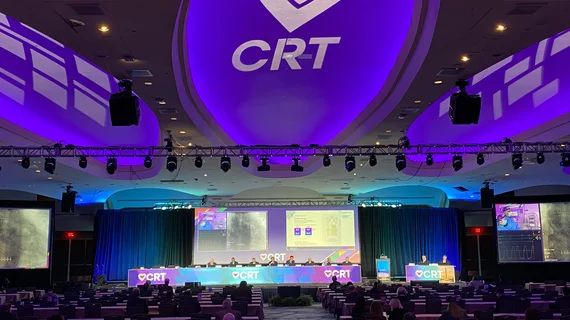
Several interventional cardiology late-breaking studies were presented at the Cardiovascular Research Technologies (CRT) 2026 meeting in Washington, D.C. Experts from the Society for Cardiovascular Angiography & Interventions (SCAI) highlighted what they felt were the most impactful presentations to clinical practice.
Seven-year TAVR/SAVR outcomes in low surgical risk patients with severe aortic stenosis: New data from a PARTNER 3 substudy found that low-risk patients undergoing transcatheter aortic valve replacement (TAVR) or surgical aortic valve replacement (SAVR) have similar outcomes at seven years. At one month, TAVR had a moderate to large improvement in health status outcomes, which was much greater than SAVR. TAVR maintained statistically significant outcomes over SAVR for the first two years, but there was no significant difference in overall health status between the groups after three years.
There has been a concern that rapidly increasing the number of younger patients getting TAVR will mean worse outcomes for these patients later in life
"This study demonstrates that while there is an early improvement in health status outcomes with TAVR compared to SAVR, both provide similar long-term health status outcomes," said Tamara Atkinson, MD.
Standard cath lab shielding vs. enhanced radiation protection devices (ERPDs): This study of 135 angiography and PCI cases showed ERPDs using novel shielding between the X-ray source and all staff showed a noticeable difference in dose level drop. "When ERPDs are utilized, operators may safely transition to ultralight or potentially no-lead aprons while maintaining exposures well within accepted occupational safety thresholds," explained Luai K. Tabaza, MD.
Plaque modification with orbital atherectomy vs. conventional balloon angioplasty prior to drug-eluting stent (DES) implantation: The two-year outcomes of the ECLIPSE trial showed orbital atherectomy was not superior to conventional balloon angioplasty prior to DES deployment. This shows that orbital atherectomy should not be recommended for routine lesion preparation.
Sirolimus DEB compared to a DES: The one-year SELUTION trial data from 3,323 patients show non-inferiority of a DEB compared to a DES for de novo coronary lesions between 2 to 5 mm. The technology reduced target vessel failure after PCI, and 80% of patients with a DEB did not require a stent, explained S. Tanveer Rab, MD.
Paclitaxel coated vs. conventional drug-coated balloons: Positive three-year outcomes of the AGENT IDE Trial showed Boston Scientific's AGENT paclitaxel-coated balloon was better than using an uncoated balloon in patients with coronary in-stent restenosis (ISR).
Comparison of radial and femoral access in lower limb artery interventions: The CARPOOL Study showed radial-to-peripheral (R2P) has emerged as an alternative to common femoral artery (CFA) access. Data showed the R2P approach does not have increased risk of poor outcomes. However, it was not adequately powered to demonstrate the superiority of either approach.
Clopidogrel vs. aspirin monotherapy beyond 12 months after PCI: This study suggests that after one year of dual antiplatelet therapy in high-risk patients, clopidogrel provides greater clinical efficacy than aspirin without increasing bleeding complications.
Medical Therapy and revascularization for asymptomatic carotid stenosis: The CREST-2 trial showed that carotid artery stenting (CAS) is effective, safe and accessible for patients with asymptomatic carotid artery stenosis. There had been uncertainty if transfemoral CAS offers stroke-prevention benefit in asymptomatic patients, especially with recent advancements in medical therapy. This study showed CAS is still safe and relevant to stroke prevention.
Tirzepatide reduced subclinical leaflet thrombosis and paravalvular leak (PVL) after TAVR: The TAVR-MET trial showed tirzepatide initiated pre-TAVR and continued after the procedure significantly reduced subclinical leaflet thrombosis and PVL in obese patients. "The TAVR-MET trial provides the first evidence that metabolic modulation can improve bioprosthetic valve healing and hemodynamics in obesity-associated aortic stenosis," explained Emad Abdel Hay, MD, PhD.

Dave Fornell has covered healthcare for more than 17 years, with a focus in cardiology and radiology. Fornell is a 5-time winner of a Jesse H. Neal Award, the most prestigious editorial honors in the field of specialized journalism. The wins included best technical content, best use of social media and best COVID-19 coverage. Fornell was also a three-time Neal finalist for best range of work by a single author. He produces more than 100 editorial videos each year, most of them interviews with key opinion leaders in medicine. He also writes technical articles, covers key trends, conducts video hospital site visits, and is very involved with social media. E-mail: [email protected]