
FDA confirms Class I recall for Impella heart pump controllers
The U.S. Food and Drug Administration (FDA) has concluded its investigation of an ongoing issue with Johnson & Johnson MedTech’s Automated Impella Controllers (AICs), finalizing a recall and sharing recommendations for all customers going forward.
In August, the FDA shared an alert that all Johnson & Johnson MedTech AICs should be removed from where they are used and sold due to ongoing issues with purge cassette recognition. The issue has been linked to 37 serious injuries and three deaths, the agency reported, but clinicians can still continue to use these devices as they await a replacement.
Johnson & Johnson shared a statement with Cardiovascular Business at the time of that first announcement. The company emphasized that this issue has been seen in just 0.2% of cases.
“Hospital inventory can continue to be used to ensure continuity of care,” a spokesperson said. “Patient safety remains our top priority, and existing alarms and monitoring support the safe and effective use of Impella.”
With its latest update, the FDA has confirmed this is a Class I recall, which means using the devices could cause “serious adverse health consequences or death.”
The Class I recall covers three products:
- Impella Controller, Packaged – 0042-0000-US
- Impella Optical Controller, Packaged – 0042-000010-US
- Optical, AIC, Impella Controller, Packaged – 0042-0040-US
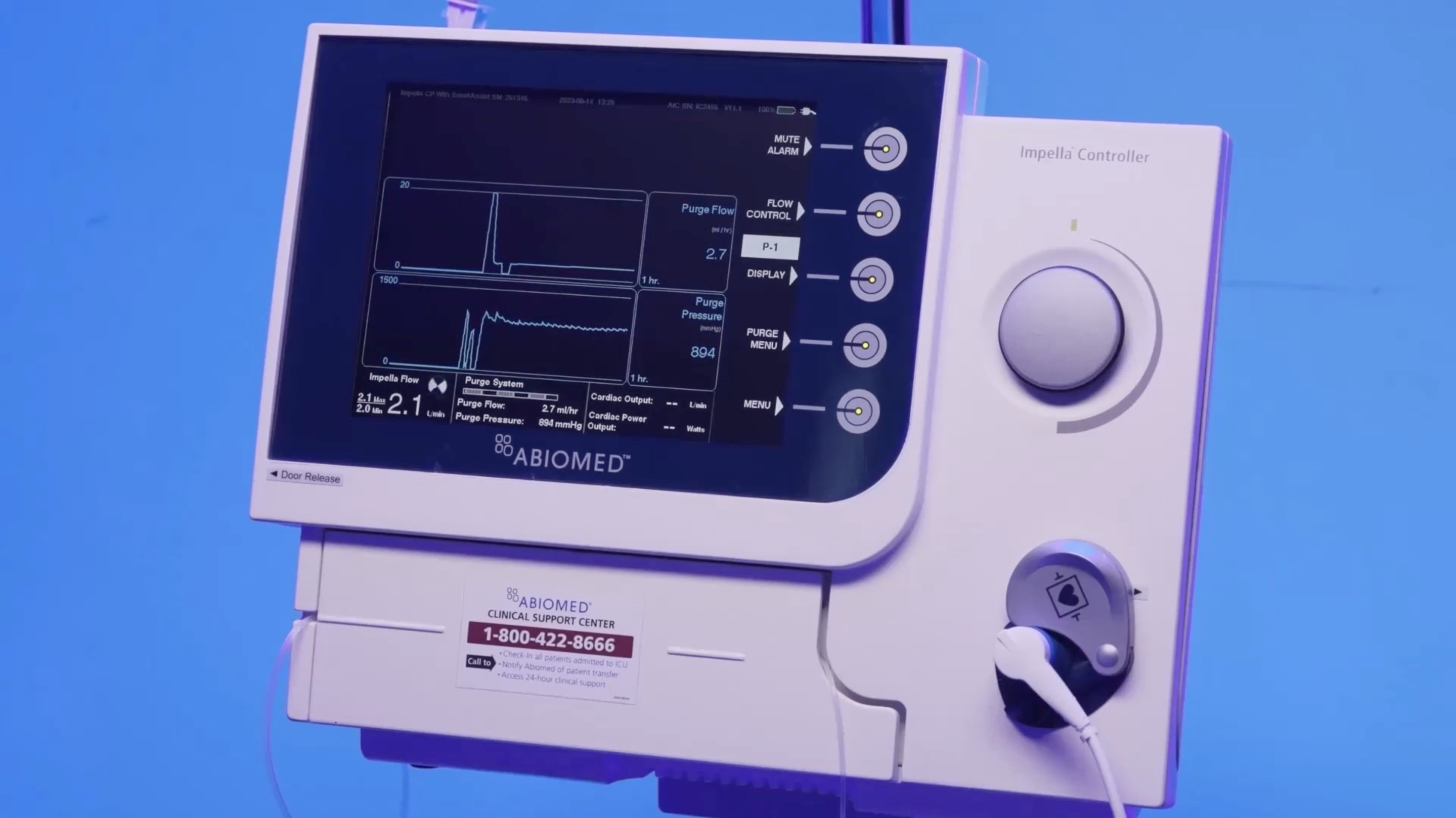
Image courtesy of Johnson & Johnson MedTech.
Why were these devices recalled?
The purge cassette recognition issue at the heart of this recall is due to failures with the AIC’s purge flag component within the purge pressure sensor assembly.
If that purge flag component fails as a procedure is being set up, it sets off a “Purge Disc Disconnected” alarm that can be addressed by reinserting the purge disc. When that does not stop the alarm, the user should then move on to a backup AIC. On the other hand, if that purge flag component fails while hemodynamic support is being provided, it sets off a “Purge Disc Not Detected” alarm that can be addressed in the same way. Again, if that does not correct the problem, the user should use a backup AIC instead.
If the purge flag component fails during active Impella support, the heart pump should still work as intended as the care team prepares to exchange the AIC.
Recent recalls
In the last several months, Johnson & Johnson MedTech’s Impella devices have been associated with several recalls and safety alerts. As the company has said in multiple statements, this is in part due to its policy of constantly reviewing service records to ensure problems are addressed as quickly as possible. AIC issues were linked to one recall in July 2025, a second recall in September 2025, third and fourth recalls in October 2025, a fifth recall in December 2025 and a sixth recall in May and this recall in August. Meanwhile, a separate recall was announced in September due to certain devices needing software and/or hardware updates.
There have been recalls unrelated to the AICs as well. In April, the FDA announced a recall related to a risk of purge cassettes leaking. Approximately two months later, the agency warned that certain 14 French low-profile introducer kits were recalled due to a risk of thrombus formation. In early August, certain introducer sheaths used with Impella devices were recalled due to a risk of leaking.
Johnson & Johnson acquired Abiomed in 2022
The Impella line of heart pumps was previously sold under the Abiomed brand before Johnson & Johnson acquired Abiomed in 2022 for approximately $16.6 billion. In 2024, Abiomed started operating under the name Johnson & Johnson MedTech.

Michael has more than 19 years of experience as a professional writer and editor. He has written at length about cardiology, radiology, artificial intelligence and other key healthcare topics.