
New Heartflow tech delivers AI-powered PCI planning for cardiologists
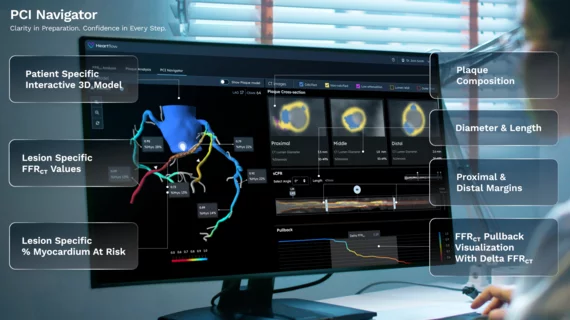
Heartflow, the California-based medtech company known for its advanced imaging evaluations, is offering a sneak peek of PCI Navigator, a brand new artificial intelligence (AI) offering, at TCT 2025 in San Francisco.
This latest addition to the Heartflow One platform was designed to help cardiologists plan ahead for percutaneous coronary intervention (PCI) procedures before they even step foot into the cath lab. It assesses the patient’s coronary CT angiography (CCTA) results and provides the care team with an accurate 3D model detailing the patient’s anatomy, plaque composition and lesion-specific physiology. This is designed to help maximize the likelihood of a successful stent placement and reduce the risk of any unexpected complications.
“Interventional cardiologists make some of the most critical decisions in coronary care, often with limited information before a case begins. CT-guided PCI addresses that information gap, harnessing insights from the CCTA pathway into a pre-procedural plan to provide physicians the clarity they need for each case,” Campbell Rogers, MD, chief medical officer of Heartflow, said in a statement. “PCI Navigator puts Heartflow at the forefront of that shift. CCTA with Heartflow analysis helps ensure that all patients warranting invasive management are directed to the cath lab, while also reducing invasive angiograms and improving efficiency. PCI Navigator enhances planning for these patients by integrating anatomy, plaque, and lesion-specific physiology for the interventionalist’s review and input before the procedure.”
Heartflow will enroll more than 2,500 U.S. patients in the NAVIGATE-PCI Registry to evaluate the safety and effectiveness of PCI Navigator compared to standard care. The goal is to make the new offering available to the public in 2026.
Heartflow’s busy TCT 2025
Heartflow is riding a significant wave of momentum after going public in August, and it hopes to keep that going with a busy TCT 2025. In addition to debuting PCI Navigator, the company will see the release of new data from PLAN CALCIUM study. PLAN CALCIUM tracked the impact of using Heartflow’s Plaque Analysis technology to help care teams assess CCTA results. These new data will highlight that impact, showing that Heartflow software helped improve the treatment of more than 50% of all lesions.
“Incorporating AI-driven plaque analysis into CCTA and lesion-specific FFR-CT workflows has great potential to change how we think about lesion preparation,” interventional cardiologist Ankitkumar Patel, MD, medical director of the cath lab at Hackensack Meridian Mountainside Medical Center, said in the same statement. “PLAN CALCIUM data suggest that having information about plaque composition and distribution available ahead of time can help clinicians make more informed decisions about calcium modification and device selection for our patients.”

Michael has more than 19 years of experience as a professional writer and editor. He has written at length about cardiology, radiology, artificial intelligence and other key healthcare topics.