
Canon launches new TAVR technology to help structural heart programs meet rising demand
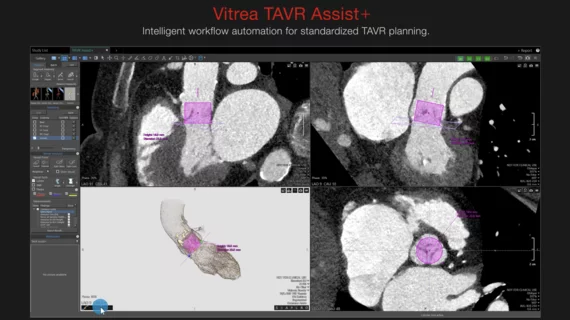
Canon Medical Informatics has officially launched a new application for its Vitrea Advanced Visualization system that helps clinicians before, during and after transcatheter aortic valve replacement (TAVR) procedures.
TAVR continues to gain momentum as a go-to treatment option for severe aortic stenosis, especially now that the U.S. Centers for Medicare and Medicaid Services (CMS) has approved Medicare coverage for treating asymptomatic patients. Canon had the procedure’s growing demand in mind when it built Vitrea TAVR Assist+, a new workflow automation application that makes care teams much more productive.
TAVR Assist+ automates key steps of the process while still ensuring clinicians oversee procedures every step of the way. This helps cardiologists spend less time entering data, for example, and gives them more time to review patient data and make critical decisions.
“Structural heart programs are growing, and with that growth comes increasing pressure on the specialized teams responsible for TAVR planning,” Karthick Nalladevan, senior product manager of Canon Medical Informatics, told Cardiovascular Business. “It's a complex workflow, and highly skilled clinicians often spend too much of their time on mouse mileage with repetitive post-processing tasks rather than the work that most benefits from their expertise. That's the challenge we set out to address with TAVR Assist+. By automating key planning steps and helping standardize the workflow, we're helping reduce repetitive mouse mileage while keeping the clinician firmly in control.”
TAVR Assist+ was designed to help capture measurements related to the patient’s valve plane, annulus, coronary heights, left ventricular outflow tract, sinuses of Valsalva and aortic root angle. These measurements can all be reviewed and edited when necessary by the clinicians performing the procedure. The application also provides time-saving assistance with delivery path assessments, tortuosity evaluations and C-arm planning.
“We're proud to deliver a solution that isn't just about automating more tasks, but about creating more capacity for clinical focus and helping structural heart programs prepare for continued growth,” Nalladevan added.

Michael has more than 19 years of experience as a professional writer and editor. He has written at length about cardiology, radiology, artificial intelligence and other key healthcare topics.