
TAVR linked to key benefits for select heart patients with moderate aortic stenosis
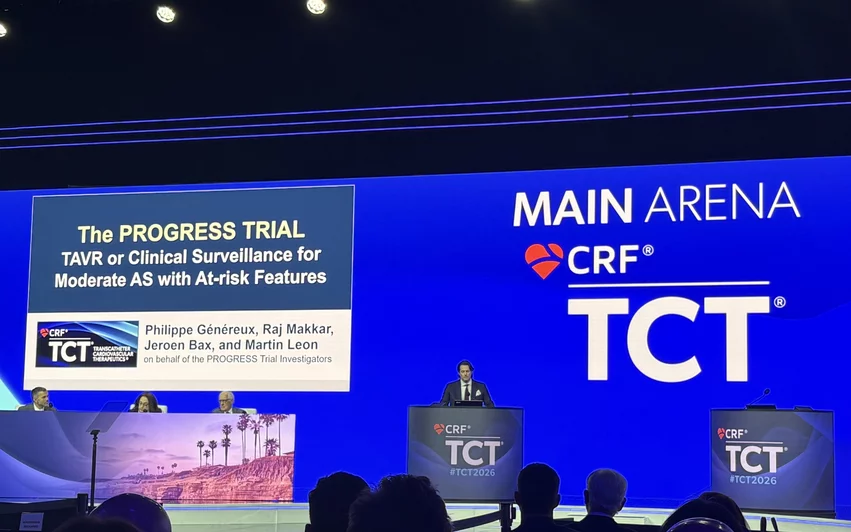
Early transcatheter aortic valve replacement (TAVR) may be a safe and effective treatment strategy for certain at-risk patients with moderate aortic stenosis (AS), according to new late-breaking data presented at TCT 2026 in San Diego. The findings were simultaneously published in The New England Journal of Medicine.[1]
Philippe Généreux, MD, director of the structural heart program at Atlantic Health Morristown Medical Center, presented the highly anticipated PROGRESS data in front of a packed TCT audience on Monday, Nov. 2.
“Moderate AS is not benign,” he said. “These patients would benefit from earlier referral to a valve clinic for comprehensive evaluation to establish the optimal management strategy. Rather than waiting for progression to severe AS, PROGRESS supports TAVR for patients with moderate AS and at-risk features.”
Key details about the PROGRESS trial
Like EARLY TAVR before it, PROGRESS was funded by Edwards Lifesciences. The prospective, multicenter, randomized trial included nearly 800 patients with moderate AS and at least one prespecified at-risk feature. The at-risk features this study focused on included valve-related symptoms categorized as at least New York Heart Association Class II, a left ventricular ejection fraction < 60%, a diastolic dysfunction grade ≥ 2, a stroke volume index < 35 mL/m2, a recent history of atrial fibrillation, a NT-Pro BNP more than three times the upper limit of normal and an elevated CT calcium score.
Between October 2021 and January 2024, 744 patients were randomized 1:1 to undergo either transfemoral TAVR with a balloon-expandable Sapien 3 transcatheter heart valve from Edwards Lifesciences or traditional clinical surveillance. Patients were treated in the United States, Japan, Australia, Europe and Canada. The mean age was 78.4 years old, 60.9% were men and the mean Society of Thoracic Surgeons score was 3%.
Genereux emphasized that 35.5% of PROGRESS patients presented with severe symptoms. In fact, 72% had at least two of at-risk features, and 40% had three or more at-risk features. The mean baseline Kansas City Cardiomyopathy Questionnaire (KCCQ) score was 64.2.
Exploring the data
The study’s primary safety endpoint was composite of death, stroke, major bleeding events, stage four acute kidney injury, device- or procedure-related hospitalization and valve dysfunction-related reintervention within 30 days. This occurred in 5.9% of patients who underwent TAVR, primarily driven by procedure- and device-related hospitalizations. That number was significantly lower than the performance goal of 13.7%.
The study’s primary effectiveness endpoint, meanwhile, was a composite of death or a heart failure event. This occurred in 16.7% of TAVR patients and 23.9% of clinical surveillance patients. In addition, heart failure events and heart failure hospitalizations were more common among clinical surveillance patients (19% and 14.9%, respectively) than TAVR patients (10.8% and 7.4%, respectively).
Another key finding from this study involved the prespecified hierarchical secondary endpoint of death, stroke or heart failure hospitalization within two years. That endpoint was seen in 17.7% of TAVR patients and 23.3% of clinical surveillance patients.
Genereux also noted that 57.4% of patients in the clinical surveillance group ended up undergoing TAVR within two years. A majority of the patients chosen for delayed TAVR procedures were experiencing severe, not moderate, AS by the time they underwent treatment.
In addition, as one might expect, the KCCQ overall summary scores improved much more for TAVR patients than it did for participants randomized to undergo clinical surveillance.
After his presentation, Genereux said these data help highlight the importance of watching patients closely instead of letting them go too long without a clinical evaluation.
“I think we have been very complacent waiting for [AS] to be severe,” he said. “We don’t want to go too early, obviously, but I think there is a sweet spot and I think the PROGRESS trial identified the optimal timing of intervention based on safety and efficacy. We will need 10 years to determine that, but that’s the main contribution of PROGRESS.”
A ‘practice-changing study’ in the field of TAVR care
Pinak B. Shah, MD, director of the cath lab at Brigham and Women’s Hospital and an associate professor at Harvard Medical School, commented on these findings during a TCT press conference.
“This is an incredible, practice-changing study,” Shah said. “This really underscores the importance of close follow-up and the fact that AS is not a benign disease. Certainly we have to be very careful about patient selection with these particular patients with moderate AS … I think it’s important that we’re dealing with patients who have a good anatomy for TAVR and that TAVR is going to be very safe.”
Shah added that clinicians should remain focused on the lifetime management of these patients when considering possible treatment decisions.
“As we intervene on these patients earlier … a lot of them are going to be coming back for repeat procedures,” he said. “We have to think about what that repeat procedure is going to look like in 10 or 12 years. The nice thing here is that we have a device that is durable and the data is getting stronger as time goes on.”
On the TCT stage, Mohamad Alkhouli, MD, a veteran interventional cardiologist with Mayo Clinic, asked Genereux if it may be time to change the way clinicians classify AS. If moderate AS is actually quite significant, for instance, should it be described in a different way?
Genereux agreed with this line of thinking, suggesting the term “clinically significant AS” as a way to “give power back to the clinician” and improve the way these symptoms are communicated.
Edwards Lifesciences celebrates positive results
Edwards Lifesciences, the sponsor of this research, published a statement highlighting the benefits associated with the early treating of at-risk patients with moderate stenosis.
“The PROGRESS trial represents a paradigm shift in the way the clinical community considers and treats patients with moderate AS,” said Dan Lippis, the company’s corporate vice president of TAVR. “These findings build on Edwards’ decades-long commitment to generating rigorous clinical evidence that advances the understanding of the serious impact and unpredictable progression of aortic stenosis.”

Michael has more than 19 years of experience as a professional writer and editor. He has written at length about cardiology, radiology, artificial intelligence and other key healthcare topics.