
World’s first polymeric TAVR valve impresses cardiologists—could improve durability, reduce costs

The world’s first transcatheter aortic valve replacement (TAVR) device with polymeric leaflets is associated with “encouraging” one-year outcomes, according to a new analysis published in JACC: Asia.[1]
The device, the Sikelia transcatheter heart valve from China-based MitrAssist Lifesciences, was implanted in 12 patients with severe symptomatic aortic stenosis (AS) from 2022 to 2024. All patients were treated in one of four high-volume facilities in China. The mean patient age was nearly 74 years old, 75% were men and the mean Society of Thoracic Surgeons score was 4.51%.
The study’s authors noted that device durability “remains a challenge” for care teams performing TAVR. The belief is that polymer-based valves can provide a “promising solution” that helps limit the risk of long-term valve degeneration and could even lower healthcare costs.
Overall, 10 of 12 patients underwent a successful transfemoral TAVR under general anesthesia. There was also one device retrieval and one case of coronary obstruction that led to myocardial infarction and the patient’s death. No major bleeding events, major vascular complications or strokes were reported during the initial hospitalization. The mean implant depth was 2.6 mm and mean implant time was 13.6 minutes. The mean fluoroscopy time, meanwhile, was 22.5 minutes.
Significant improvements in symptom burden were confirmed in all patients. Kansas City Cardiomyopathy Questionnaire scores and six-minute walk distances all improved over time. The authors also found that patients showed signs of “robust and sustained hemodynamic performance” after one year, including a significantly improved mean effective orifice area and significantly reduced mean pressure gradient.
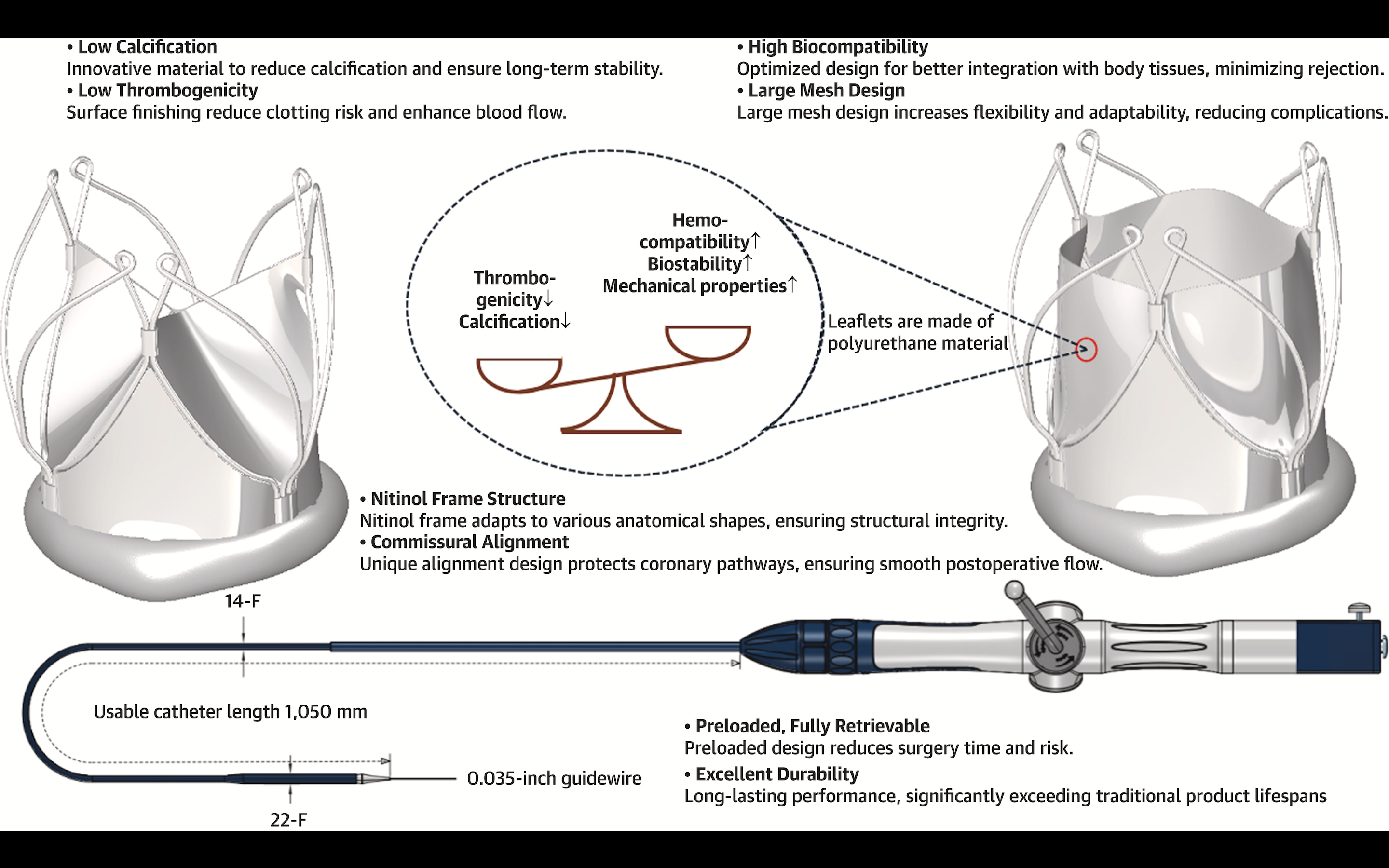
The Sikelia transcatheter heart valve for TAVR. Graphic courtesy of JACC: Asia, Ge et al.
“In this study, we report the first clinical experience that incorporates a novel transcatheter heart valve with polymeric leaflets in a series of symptomatic severe AS patients,” wrote Junbo Ge, MD, a cardiologist with Zhongshan Hospital in China, and colleagues. “Despite the small sample size, an acceptable safety profile alongside favorable hemodynamic and clinical outcomes at one year was shown for TAVR with this novel transcatheter heart valve, even in patients with bicuspid aortic valve anatomy.”
“These findings lend robust support to the recent shifts in clinical guidelines, which now advocate for the broader application of TAVR, including in younger patients and those at lower surgical risk who anticipate maintaining an active lifestyle,” the authors wrote. “This adjustment reflects an evolving understanding of the potential for TAVR to offer substantial improvements not only in survival rates, but also in the overall quality of life for a wider spectrum of patients with severe AS.”
The group also noted that follow-up CT images showed no signs of subclincical leaflet thrombosis, a significant concern with the valve’s polymeric leaflets.
“It is consistent with a previous in vitro study that the polymeric material has significantly improved hemocompatibility and biostability and reduced thrombogenicity and calcification,” they concluded. “Further studies with longer-term follow-up data on larger sample sizes will help validate the findings of the current study.”
Click here to read the full study in JACC: Asia, an American College of Cardiology journal.
Polymeric valve could be a ‘real breakthrough’ for TAVR patients
Ge et al. shared an early look at these data at TCT 2024.
“The initial outcomes we are seeing from Sikelia could represent a real breakthrough in the TAVR field,” he said at the time. “The potential for improving patients' outcomes is immense, and we are eager to continue gathering data and enhancing the application of this technology. These results are just the beginning, and they pave the way for more comprehensive studies in the near future.”
“The initial clinical results of Sikelia mark a significant milestone in our mission to transform patient care,” added Peggy Wang, CEO of MitrAssist. “We are excited about the potential Sikelia has to improve outcomes for patients suffering from severe aortic stenosis.”

Michael has more than 19 years of experience as a professional writer and editor. He has written at length about cardiology, radiology, artificial intelligence and other key healthcare topics.