
'Compelling' study shows promise of new pulmonary embolectomy system
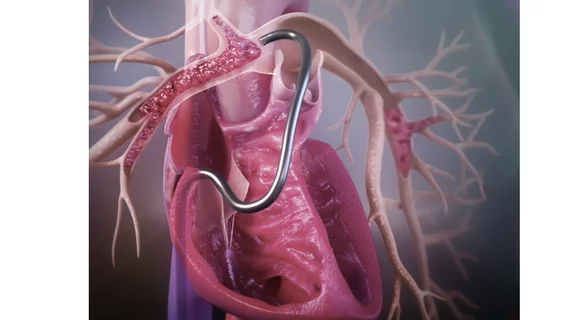
A new pulmonary embolism (PE) thrombectomy system was linked to substantial right heart recovery in a new late-breaking study presented at EuroPCR 2026. The device may provide value as a way to simplify vessel access within the pulmonary vasculature.
The SPIRARE II pivotal trial evaluated the Vertex Pulmonary Embolectomy System from California-based Jupiter Endovascular in patients with an acute, intermediate-risk PE. The technology met both of its primary endpoints for meaningful heart recovery and clinical safety. This was a prospective, single-arm, multicenter pivotal study that enrolled 123 patients across 19 European and U.S. centers
"PE is fundamentally a cardiovascular disease, where restoration of hemodynamic stability, beyond simple clot removal, is the key determinant of patient recovery,” Sameh Sayfo, MD, director of the pulmonary embolism response team (PERT) at Baylor Scott & White The Heart Hospital in Plano, Texas, and global co-principal investigator for the SPIRARE II trial, said in a statement. “Historically, the ability to achieve both safe right-heart navigation and the procedural stability necessary for controlled PE thrombectomy has represented a significant limitation in consistently normalizing hemodynamics. What makes SPIRARE II particularly compelling is the opportunity to evaluate a system that may enhance not only clot extraction, but also the overall quality, precision, and physiologic impact of the intervention.”
The Vertex system uses an innovative catheter system designed to navigate through the right heart and then stabilize in the pulmonary arteries for precise intervention. It is seen as a noteworthy device because it can provide both flexible navigation and stable support to reduce cardiac strain and enable more reliable vessel access within the lungs.
The trial met its primary endpoint for reducing right heart strain, with a right venticular/left ventricular (RV/LV) ratio mean reduction of 0.39 at 48 hours. The safety endpoint was also met with a 2.4% major adverse event (MAE) rate, where only three patients experienced issues.
The data show thrombectomy achieved meaningful afterload reduction and right heart recovery beyond clot extraction. This was demonstrated by paired invasive hemodynamic measurements with a 29% reduction in mean pulmonary artery pressure (mPAP), 29% reduction in systolic pulmonary artery pressure (sPAP), and a 26% reduction in total pulmonary vascular resistance (TPVR).
The trial achieved 100% technical success with no need for adjunctive thrombolytics. The characteristics of the procedure also showed it was efficient, with 83% of patients not requiring re-crossing of the pulmonic valve, 39% not needing a super-stiff guidewire, and a 40.2 minute mean procedure time.
"The SPIRARE II results are especially impressive, recognizing the hemodynamic severity of the patient population, where 54% presented with normotensive shock and 93% were classified in C3 or D2 risk categories under the 2026 ACC/AHA PE guidelines,” said Catalin Toma, MD, co-principal investigator and director of interventional cardiology at the University of Pittsburgh Medical Center Heart and Vascular Institute, in the same statement.
He added that thrombectomy was consistent and had reproducible recovery across all patient classifications
"We believe this was achieved by having stable, controlled access to target vessel obstructions. Future post-hoc analyses will help us better understand the relationship between vessel access and the depth of physiologic recovery we observed. We believe these findings will meaningfully inform the approach to PE intervention moving forward,” Toma explained.

Dave Fornell has covered healthcare for more than 17 years, with a focus in cardiology and radiology. Fornell is a 5-time winner of a Jesse H. Neal Award, the most prestigious editorial honors in the field of specialized journalism. The wins included best technical content, best use of social media and best COVID-19 coverage. Fornell was also a three-time Neal finalist for best range of work by a single author. He produces more than 100 editorial videos each year, most of them interviews with key opinion leaders in medicine. He also writes technical articles, covers key trends, conducts video hospital site visits, and is very involved with social media. E-mail: [email protected]