
Custom blood vessel grafts in minutes? Harvard engineers share vision of the future
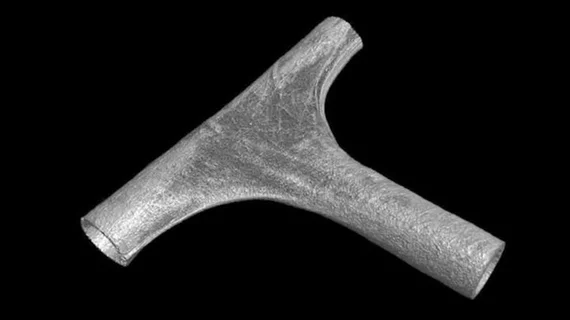
Bioengineers from Harvard have developed a new way to craft custom synthetic vascular grafts in a matter of a minutes. The group shared its findings in Advanced Materials, highlighting the potential to provide on-demand care for patients in need.
The technology at the heart of this technique can turn liquid polymer solutions into ultra-thin fibers that are then organized to resemble natural blood vessels. The goal is to give care teams the ability to make these grafts on-demand when necessary to provide immediate relief when time is of the essence.
“We are trying to enable what we call ‘intraoperative manufacturing,’” first author Michael Peters, PhD, a Harvard graduate now with startup NTT Research, explained in a statement. “The manufacturing speeds and customizability and flexibleness of our fabrication platforms can realize grafts that are made for a particular injury or a particular patient.”
The team’s grafts are made from a synthetic co-polymer of polylactic acid and polycaprolactone. They maintain the structure of the vessel and then degrade over time as the patient’s own cells rebuild their tissue as necessary. Their latest study focused on the use of this technique in small animals; the researchers are already looking ahead to what they may take on next.
“We want to scale up into larger animal models and see how these grafts perform, in different hemodynamic conditions at different pressures and volumetric flow rates over longer periods of time,” Peters said.
This new-look technique was developed in the lab of Kit Parker, PhD, a professor of bioengineering and applied physics at Harvard. In the same statement, Parker noted that similar techniques are already being used to treat dental patients.
“Dentists are doing it now with 3D printing,” he said. “In the case of our high-speed additive manufacturing platforms, if you are talking about limb salvage, or repairing a damaged or deformed heart, we are approaching a day where FDA-required Good Manufacturing Practices can be met in the operating suite while the patient is on the table.”
Read the team’s full analysis here.

Michael has more than 19 years of experience as a professional writer and editor. He has written at length about cardiology, radiology, artificial intelligence and other key healthcare topics.