
First heart procedure of its kind performed in US after careful planning
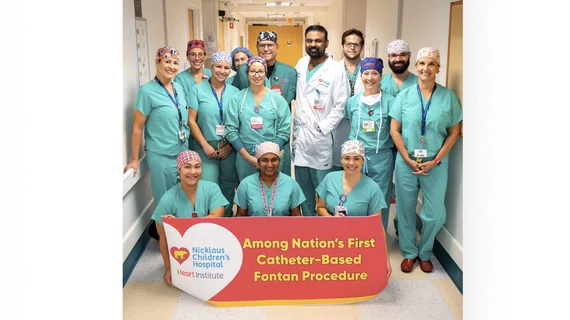
The Nicklaus Children’s Hospital Heart Institute has performed what is believed to be the first completely catheter-based Fontan procedure in U.S. history. Rather than using open-heart surgery to complete the child’s Fontan circulation, the 2-year-old born with a double-outlet right ventricle underwent a catheter-based approach that resulted in a shorter hospital stay and faster recovery time.
The Fontan is the last of three surgeries to reroute the circulatory system to enable a child with single ventricle congenital heart disease to survive into adulthood. It is preceded by the Norwood procedure, which enables the right side of the heart to pump blood to the body and lungs, and the Glenn procedure, which redirects venous blood from the inferior vena cava (IVC) into the lungs. The Fontan directly connects the IVC to the pulmonary arteries so blood can be oxygenated in the lungs before being pushed to heart.
Thanks to this catheter-based approach, the pediatric patient was able to avoid a third sternotomy and did not require cardiopulmonary bypass. In addition, there was no need for chest tubes and the recovery process should be smoother.
"A handful of centers outside the U.S. have described related techniques, but no U.S. center has attempted a transcatheter Fontan in over two decades—earlier attempts weren't very successful," Shyam Sathanandam, MD, chief of cardiovascular medicine at Nicklaus Children’s Hospital, co-director of the Nicklaus Children's Heart Institute and clinical professor at FIU Herbert Wertheim College of Medicine, told Cardiovascular Business. "This is the first fully catheter-based Fontan completion performed successfully in the United States."
He said preplanning was required during the child's earlier Glenn-stage surgery, when the surgical team built in a modification in preparation for the transcatheter Fontan. This included a controlled connection between the Glenn pulmonary artery pathway and the atrium to make a later catheter-based completion possible.
"We advanced a covered endograft through the vessels and deployed it to establish the definitive conduit, converting that prebuilt pathway into a protected channel carrying IVC blood to the pulmonary arteries, which is functionally similar to the extracardiac conduit used in a surgical Fontan, but built entirely from inside the blood vessels," Sathanandam explained.
He added that the success of the transcatheter procedure depended on a precise 3D understanding of the IVC, pulmonary arteries, Glenn pathway and the surrounding anatomy. The anatomy was assessed with advanced imaging from CT, MRI and invasive angiography. The interventional cardiology and cardiovascular surgery teams planned the procedure and rehearsed it on a virtual 3D model digital twin of the patient's own anatomy before they proposed the option to the patient's family.
“This achievement reflects an extraordinary level of collaboration and coordination between our surgical and interventional cardiology team,” Sathanandam said in a hospital statement. “It demonstrates what is possible when clinical expertise, innovation and teamwork come together to expand treatment options for children with the most complex heart conditions.”
The procedure was led Sathanandam with help from David Kalfa, MD, chief of cardiovascular surgery and professor and researcher at FIU Herbert Wertheim College of Medicine.
Patient selection is a key element of advanced transcatheter procedures like this one, because some candidates may ultimately not end up being a good fit. Sathanandam said it depends on careful anatomic and hemodynamic factors.
Overall, the team behind this breakthrough sees the successful procedure as an important step forward.
"Rather than assuming every stage requires surgery, transcatheter techniques may eventually let some children reach Fontan circulation with a substantially less invasive intervention," Sathanandam explained.

Dave Fornell has covered healthcare for more than 17 years, with a focus in cardiology and radiology. Fornell is a 5-time winner of a Jesse H. Neal Award, the most prestigious editorial honors in the field of specialized journalism. The wins included best technical content, best use of social media and best COVID-19 coverage. Fornell was also a three-time Neal finalist for best range of work by a single author. He produces more than 100 editorial videos each year, most of them interviews with key opinion leaders in medicine. He also writes technical articles, covers key trends, conducts video hospital site visits, and is very involved with social media. E-mail: [email protected]