
AI-powered FFR-CT software linked to considerable cost savings, accurate predictions
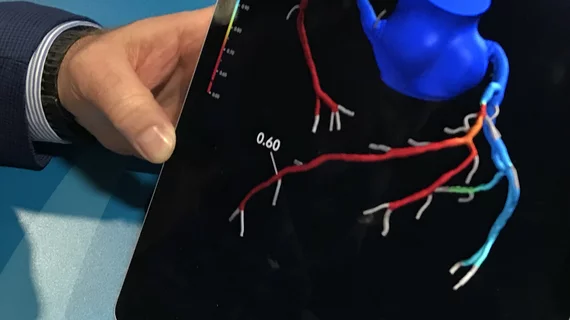
Major cost savings of about $1,394 per patient were realized in a new analysis from FISH&CHIPS, the largest fractional flow reserve computed tomography (FFR-CT) study of its kind. The study, conducted by the National Health Service (NHS) in England, looked at more than 90,000 patients and found integrating FFR-CT analysis into the NHS diagnostic pathway reduced downstream cardiovascular testing, reduced invasive coronary angiography and increased the appropriateness of revascularization ratios.
Per-patient savings exceeded what the NHS and National Institute for Health and Care Excellence had initially expected. The NHS estimates this could save the about $33.3 million in potential annual savings for the health system.
This was one of two new sub-analyses of FISH&CHIPS presented today at the European Society of Cardiology’s European Association of Cardiovascular Imaging (EACVI) conference in Vienna. The data focused on real-patients treated with Heartflow's FFR-CT analysis for evaluating noninvasive coronary CT angiography (CCTA) scans.
“These real-world data show that CCTA plus Heartflow FFR-CT analysis brings both clinical and economic value when utilized in a large health system,” explained Timothy Fairbairn, PhD, in a statement. He is the principal investigator for the FISH&CHIPS study at Liverpool Heart and Chest Hospital and associate professor at the University of Liverpool. “The introduction of Heartflow FFR-CT analysis into the NHS resulted in fewer avoidable tests, lower inpatient and outpatient costs and substantial overall savings for both the hospitals and patients. It’s a compelling example of how noninvasive AI-powered technology can reshape care pathways at scale.”
Lesion-specific FFR-CT predicts individual cardiovascular outcomes
A second analysis of 7,836 patients who underwent FFR-CT looked at the prognostic value across individual patient outcomes, including myocardial infarction (MI), cardiovascular mortality, all-cause mortality, and revascularization. The key finding was that the lower the FFR-CT values, the higher the risk of MI, revascularization, cardiovascular death and all-cause death, independent of traditional cardiovascular risk factors.
Patients with the lowest FFR-CT values faced a four-fold increased risk of heart attack and a three-fold increased risk of cardiovascular death.
Another retrospective analysis of symptomatic patients from a cohort of the FISH&CHIPS study presented at the American Heart Association (AHA) Scientific Sessions 2025 in November also provided strong validation of how total coronary plaque volume-based staging measured with Heartflow's Plaque Analysis can show strong predictions of future heart attacks or cardiovascular death.
FISH&CHIPS is a real-world, multicenter, observational clinical study designed to assess the incremental impact of adding FFR-CT to a CCTA-first diagnostic approach for coronary artery disease at a national level. The study includes data from 27 NHS hospital sites in England, including 90,553 patients followed for at least two years. The primary objective was to determine whether introducing a coronary CCTA plus FFR-CT diagnostic pathway was clinically useful and safe compared to a standard-of-care diagnostic chest pain pathway using CCTA alone.

Dave Fornell has covered healthcare for more than 17 years, with a focus in cardiology and radiology. Fornell is a 5-time winner of a Jesse H. Neal Award, the most prestigious editorial honors in the field of specialized journalism. The wins included best technical content, best use of social media and best COVID-19 coverage. Fornell was also a three-time Neal finalist for best range of work by a single author. He produces more than 100 editorial videos each year, most of them interviews with key opinion leaders in medicine. He also writes technical articles, covers key trends, conducts video hospital site visits, and is very involved with social media. E-mail: [email protected]