
ACC testifies in Washington to get funding for the HEARTS Act amid big cuts to healthcare
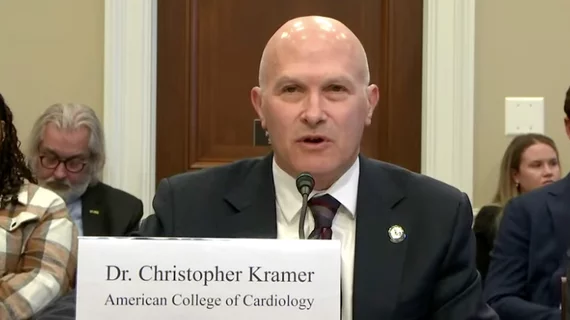
Just a week after taking office as the new American College of Cardiology (ACC) President, Christopher Kramer, MD, FACC, was in Washington, D.C., March 9 to testify before a congressional subcommittee asking for federal funding to support of a new law aimed at reducing sudden cardiac arrest deaths. He also spoke in strong support of the research conducted by the National Institutes of Health (NIH).
Kramer spoke at a hearing for the U.S. House Appropriations Subcommittee on Labor, Health and Human Services, Education, and Related Agencies March 9 to urge lawmakers to allocate full funding for the Cardiomyopathy Health Education, Awareness, Research, and Training in Schools (HEARTS) Act (H.R. 6829). It was signed into law in the closing weeks of the Biden administration, and was greeted with support and enthusiasm from ACC, the American Heart Association (AHA) and the Heart Rhythm Society (HRS).
Due to the politically sensitive nature of increased federal spending, the funding portion was not included in the original bill so that it could gain strong bipartisan support. But without the funding, the legislation will not have much effect. Kramer stressed that the science shows this is the right thing to do if the federal government is serious about saving lives and improving public health.
The legislation ensures that public elementary and secondary schools in the U.S. can develop cardiac emergency response plans, provide cardiopulmonary resuscitation (CPR) and automated external defibrillator (AED) training to staff, and to have AEDs available on school property. However, with the Trump administration now making large cuts to federal healthcare agencies and programs, there is growing concern among cardiology groups that HEARTS may remain unfunded.
"This new law is so important because it builds upon the foundation of sustained investment in the NIH, the Centers for Disease Control and Prevention (CDC), and the Department of Health and Human Services (HHS). The HEARTS Act is not solely about providing AEDs in schools, it’s about leveraging the power of NIH-funded research to understand and prevent heart disease and utilizing valuable public health programs at the CDC and HHS to educate and protect our patients," Kramer explained during his testimony.
He said every year in the U.S., more than 2,000 people under the age of 25 die from sudden cardiac arrest, but that number could be greatly reduced with wider access to AEDs and public education, which is what this law is about.

"We cannot overstate the value of continued investment in the NIH. It is through NIH-funded research that we have learned how to prevent, treat and manage heart conditions that once seemed untouchable," ACC President Christopher Kramer, MD, told he U.S. House Appropriations Subcommittee on Labor, Health and Human Services. "America’s leadership in medical science depends on strong investments in our nation’s research infrastructure—and the HEARTS Act is a worthy and impactful addition to that legacy."
Kramer urged members of the subcommittee to provide full funding for the HEARTS Act in fiscal year 2026. This would include:
• $25 million for grants to help schools purchase AEDs and develop cardiac emergency response plans.
• $5 million for the CDC to develop risk assessments and distribute educational materials to schools and families about conditions that lead to cardiac arrest among youths.
• $20 million for the NIH to conduct cardiomyopathy research.
Kramer also took the opportunity to emphasize the value of investment in research, describing the impact that NIH-funded projects have had in advancing the prevention, treatment and management of heart conditions.
"We cannot overstate the value of continued investment in the NIH. It is through NIH-funded research that we have learned how to prevent, treat and manage heart conditions that once seemed untouchable," Kramer said. "America’s leadership in medical science depends on strong investments in our nation’s research infrastructure—and the HEARTS Act is a worthy and impactful addition to that legacy."
Since 1950, death rates from cardiovascular disease have declined 60% and the number of people in the U.S. dying of a heart attack each year has dropped from 1 in 2 in the 1950s, to 1 in 8.5 today, Kramer explained.
"The American Heart Association says up to 50% of people with sudden cardiac arrest could be saved with the immediate use of an AED, so this is about saving lives, so we will have to work on getting that $25 million. Keep up the testimony, the fight and the advocacy," committee ranking member Rep. Rosa DeLauro (D-Conn.) told Kramer.

Dave Fornell has covered healthcare for more than 17 years, with a focus in cardiology and radiology. Fornell is a 5-time winner of a Jesse H. Neal Award, the most prestigious editorial honors in the field of specialized journalism. The wins included best technical content, best use of social media and best COVID-19 coverage. Fornell was also a three-time Neal finalist for best range of work by a single author. He produces more than 100 editorial videos each year, most of them interviews with key opinion leaders in medicine. He also writes technical articles, covers key trends, conducts video hospital site visits, and is very involved with social media. E-mail: [email protected]