
ACC-AHA release first cardiovascular-kidney-metabolic syndrome guidelines
In recent years, there has been a large uptick in sessions and discussions on cardiovascular-kidney-metabolic (CKM) syndrome at cardiac conferences and how this plays a bigger role in cardiovascular disease than previously thought. While decades ago nephrology and cardiology rarely mixed, science has evolved to show they are actually closely interconnected and can significantly increase the risk of multiorgan complications and negative cardiovascular outcomes.
This prompted the American Heart Association (AHA) and the American College of Cardiology (ACC) to publish its first-ever CKM guidelines on Tuesday.[1] The document was developed and endorsed with collaboration from the American Diabetes Association, the ADA's Obesity Association, and the American Society of Nephrology.
The guidelines aim to prevent and manage CKM syndrome, since nearly 90% of U.S. adults have at least one risk factor. These include excess weight, high blood glucose in the prediabetes range, hypertension, abnormal lipids, or reduced kidney function. It covers CKM clinical staging, risk factor screening, prevention, and treatment strategies. Higher stages of CKM syndrome are linked to a larger burden of serious health conditions, including type 2 diabetes, chronic kidney disease, and a higher risk of cardiovascular disease and mortality.
“Heart, kidney, and metabolic conditions don’t occur in isolation, they are deeply connected,” Chiadi E. Ndumele, MD, PhD, MHS, chair of the guideline committee, said in a statement. He is the director of obesity and cardiometabolic research at Johns Hopkins School of Medicine in Baltimore. “This guideline calls for earlier screening and care, focusing on prevention and coordinated action to reduce the risk of cardiovascular disease before serious complications develop or a major cardiac event occurs.”
The recommendations are meant to help clinicians and individuals identify CKM syndrome risk earlier and take action to protect long-term heart, metabolic and kidney health.
The guideline includes an improved risk assessment using the Predicting Risk of cardiovascular disease EVENTs (PREVENT) equations to estimate 10- and 30-year risk for cardiovascular disease. This can help guide personalized lifestyle and treatment plans. PREVENT includes factors such as food insecurity, housing instability and financial strain—better identifying those who are at higher risk of developing CKM syndrome.
Just as the document was created with a multidisciplinary team of experts, it calls for coordinated interdisciplinary care. This includes advocating for healthy lifestyle behaviors with an emphasis on physical activity, nutrition, weight, blood pressure, blood sugar and cholesterol. Other treatment options include medications and surgical therapies to protect the heart and kidneys. Metabolic and bariatric surgery is also suggested to treat CKM syndrome.
For the first time, GLP-1-based therapies are recommended for select individuals with obesity, type 2 diabetes and other risk factors for cardiovascular disease to reduce the risk of cardiac events.
One of the key takeaways in the document is the need to take early action to prevent a heart attack, heart failure, stroke or kidney failure. It is suggested patients follow the AHA’s Life’s Essential 8 recommendations to improve and maintain cardiovascular health.
“Life’s Essential 8 focuses on regular physical activity, heart-healthy eating, maintaining a healthy weight, managing blood pressure, blood sugar and cholesterol, as well as avoiding tobacco and getting enough quality sleep. These are all powerful tools to improve cardiovascular-kidney-metabolic health,” Fátima Rodriguez, MD, MPH, vice chair of the writing committee, said in a statement. She also is an associate professor of cardiovascular medicine at Stanford Medicine in California. “These actions reduce the risk of heart disease and also support kidney and metabolic health across the lifespan.”
Staging CKM syndrome
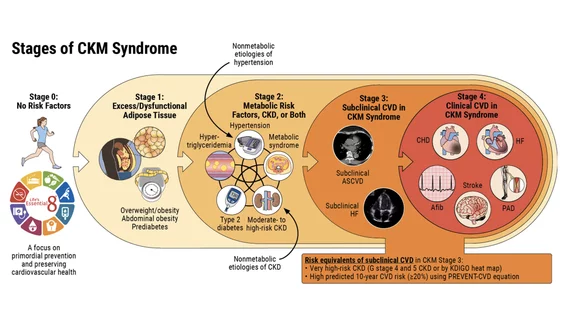
The guidelines outline the four stages of CKM syndrome that identify risk and can help tailor prevention strategies to slow or reverse progress.
• Stage 1 includes patients who are overweight or have prediabetes, but without other metabolic risk factors, kidney disease or cardiovascular disease.
• Stage 2 includes patients with one or more metabolic risk factors, such as hypertension, abnormal lipid levels, type 2 diabetes or metabolic syndrome, and/or kidney disease, but without cardiovascular disease.
• Stage 3 is for patients with asymptomatic cardiovascular disease and CKM risk factors. It also can include those with the risk equivalents of very-high-risk chronic kidney disease or high predicted 10-year risk of cardiovascular disease based on the PREVENT-CVD calculator.
• Stage 4 includes patients with diagnosed cardiovascular disease (coronary disease, heart failure, stroke, peripheral artery disease, and/or atrial fibrillation) who are overweight and have other metabolic risk factors or kidney disease.

Dave Fornell has covered healthcare for more than 17 years, with a focus in cardiology and radiology. Fornell is a 5-time winner of a Jesse H. Neal Award, the most prestigious editorial honors in the field of specialized journalism. The wins included best technical content, best use of social media and best COVID-19 coverage. Fornell was also a three-time Neal finalist for best range of work by a single author. He produces more than 100 editorial videos each year, most of them interviews with key opinion leaders in medicine. He also writes technical articles, covers key trends, conducts video hospital site visits, and is very involved with social media. E-mail: [email protected]