The new expert consensus decision pathway replaces a similar document from 2019 and is to be used in conjunction with heart failure guidelines published in 2022 by the ACC, American Heart Association and Heart Failure Society of America.
The Digital Health Advisory Committee is tasked with providing perspective and recommendations on a wide variety of topics. These insights will then help the FDA draft new policies and make other important decisions.
Cardiologist Dan Blumenthal, MD, MBA, explains how changes in Medicare payments will greatly impact cardiology in the years ahead. In just a few short years, the business side of cardiology could look substantially different than it does today.
Novolink Health, previously known as Duxlink Health, has a decade of experience treating high-risk, high-cost patients from the comfort of their own homes. It will now function as a division within Florida-based Cardiovascular Associates of America.
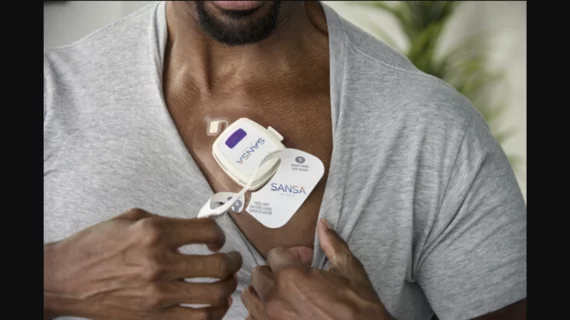
The new device from Huxley Medical offers care teams a way to monitor patients for signs of sleep apnea while also keeping a close eye on their heart health.
Treating severe MR with the popular device does not appear to increase a patient's risk of stroke or transient ischemic attack. When patients present with AFib, however, care teams may want to make certain adjustments to optimize outcomes.
Medtronic and Abbott are often seen as rivals in a competitive marketplace, but the two companies are collaborating with a simple goal in mind: improving patient access to high-quality CGM devices.
Researchers used OpenAI’s ChatGPT technology to build 100 patient-friendly echo reports, evaluating each one for accuracy, relevance and understandability. The AI reports passed the test with flying colors.
Early evidence suggests a new PET imaging agent from California-based Attralus can help evaluate all varieties of systemic cardiac amyloidosis. It has now been granted the FDA's breakthrough therapy designation.
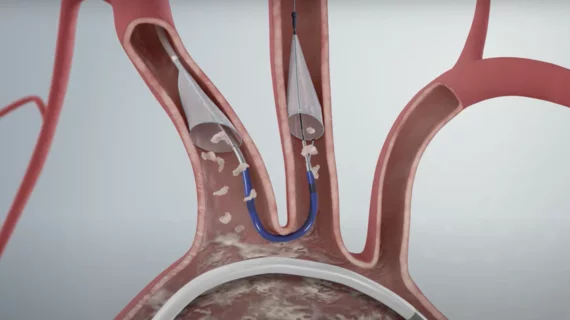
The Sentinel Cerebral Protection System. Image courtesy of Boston Scientific.
Using a cerebral protection device during TAVR was associated with lower readmission rates, shorter hospital stays—and, yes, a lower risk of patients suffering a major stroke. A team of specialists withCleveland Clinic shared their new findings in the Journal of the American Heart Association.





![Treating mitral regurgitation with transcatheter mitral edge-to-edge repair (TEER) using the MitraClip device is associated with a low risk of cerebrovascular accidents (CVAs) such as stroke and transient ischemic attack (TIA), according to new data published in The American Journal of Cardiology.[1]](/sites/default/files/styles/top_stories/public/2024-08/small-tech-big-impact-mitraclip-960x430.jpg.webp?itok=SWlQGHuS)