
Boston EP Party: Medtech companies share new electrophysiology data at AF Symposium 2026

The 31st Annual International AF Symposium in Boston included late-breaking presentations from many of the leading names in electrophysiology (EP). The companies all came to Boston to share their latest and greatest findings focused on the diagnosis, management and treatment of atrial fibrillation (AFib).
Johnson & Johnson MedTech
Johnson & Johnson MedTech, the company behind the U.S. Food and Drug Administration (FDA)-approved Varipulse Platform for pulsed field ablation (PFA), was featured in 11 different presentations during the three-day event in Boston.
One study found that Varipulse was linked to a reduced risk of neurovascular events—0.22%—in a study of nearly 7,000 patients. That study was simultaneously published in full in JACC: Clinical Electrophysiology, an American College of Cardiology journal.[1]
In addition, survey data tracking 850 different procedures found that same-day discharge after treatment with Varipulse occurred with 87.9% of patients. In addition, the primary adverse event rate was 1.9%.
Another multicenter clinical trial, OMNY-AF, examined the safety and effectiveness of the Johnson & Johnson MedTech’s investigational Omnypulse Platform, which includes both PFA and mapping capabilities. Overall, after one year, the technology was linked to an acute procedural success rate of 100% and no procedure-related adverse events. The study’s primary effectiveness endpoint was achieved in 90% of patients, and 56.7% of cases were performed without the use of fluoroscopy.
“In my cases during the ongoing OMNY-AF trial, the seamless integration of advanced mapping, ultrasound and PF Index with contact force were valuable for precise and efficient pulsed field energy delivery,” Dinesh Sharma, MD, section head of cardiac electrophysiology at the Naples Heart Institute, said in a statement. Sharma presented the data during AF Symposium.
The Omnypulse technology is not yet approved by the FDA.
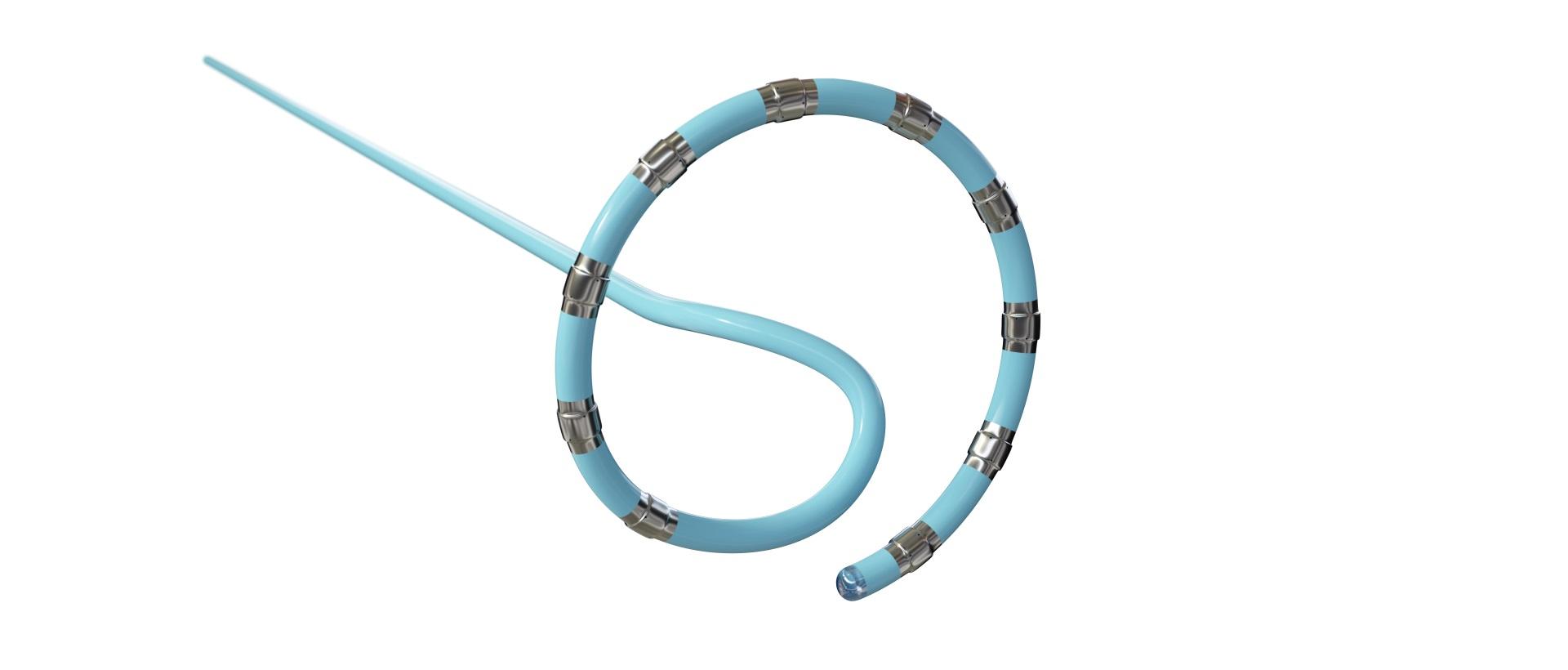
Johnson & Johnson MedTech's Varipulse PFA catheter. Image courtesy of Johnson & Johnson MedTech.
Abbott
Abbott’s investigational left atrial appendage (LAA) closure device for patients with non-valvular AFib was associated with positive early outcomes, according to one late-breaking study presented at AF Symposium.
The VERITAS study focused on 400 patients treated with the Amulet 360 LAA Occluder, Abbott’s next-generation take on its popular Amplatzer Amulet LAA Occluder. The mean age of the patients was 73.8 years old. Overall, the implant success rate was 99.8%, pericardial effusion and other adverse events were rare and every patient evaluated with echocardiography met the primary effectiveness endpoint. The full results were simultaneously published in JACC: Clinical Electrophysiology.[2]
“Abbott is committed to developing minimally invasive approaches that help doctors address AFib and prevent strokes, ensuring optimal safety and benefits for patients,” Christopher Piorkowski, MD, chief medical officer of Abbott's electrophysiology business, said in a statement. “With the next-generation Amulet 360, we are building upon the advancements we made with the introduction of our Amplatzer Amulet LAA Occluder, which was the first device in the industry to both close the LAA and create a seal over it, allowing people to forgo blood-thinning medication.’
Atraverse Medical
Atraverse Medical, the San Diego-based startup behind the FDA-cleared Hotwire Transseptal Access System, was at the heart of multiple AF Symposium presentations. The Hotwire Transseptal Access System includes the Hotwire radiofrequency (RF) generator and the Hotwire RF guidewire. It was built to deliver precise left-heart access in a way that minimizes RF exposure to the left atrium and offers “universal sheath compatibility.”
One study found that the Hotwire technology was associated with a significant reduction in the risk of left atrial injury when examining an ex vivo porcine model. Another study of approximately 500 patients linked the Hotwire Transseptal Access System to a procedural success rate of 100%, low RF duration and low total energy delivery. A third analysis found using the Hotwire RF guidewire across a wide range of procedures, introducer sheath types and workflows was consistently associated with a procedural success rate of 100% and no adverse events.
“These data reinforce the clinical importance of controlled RF delivery and impedance-guided shutoff during transseptal access,” EP pioneer Steven Mickelsen, MD, co-founder and chief translational science officer of Atraverse Medical, said in a statement. “The consistency of results across preclinical and first-in-human studies highlights the strength of the Hotwire platform and its potential to set a new standard for left-heart access.”

The Hotwire Transseptal Access System. Image courtesy of Atraverse Medical.
Field Medical
Field Medical, a PFA startup founded by Mickelsen in 2022, was the topic of a first-in-human study presented by Vivek Y. Reddy, MD, director of cardiac arrhythmia services at Mount Sinai Fuster Heart Hospital and a leading name in emerging EP technologies.
According to early data from Field PULSE, a high-voltage, sub-second PFA waveform delivered through Field Medical’s investigational FieldForce Ablation System and Catheter achieved “instantaneous” energy delivery, a median pulmonary vein isolation (PVI) time of 12.5 minutes and key benefits in terms of PVI durability. No device-related adverse events were reported.
“By eliminating the need for sustained tissue-catheter contact, sub-second pulsed field delivery enables both efficient point-by-point ablation and individualized lesion sets,” Reddy said. “This approach preserves the flexibility physicians expect from focal ablation while delivering the procedural efficiency associated with pulsed field technologies.”
“The Field PULSE results reinforce our approach of deliberately architecting focal PFA to address the fundamental limitations of existing methods, then validating its application through data,” added Mickelsen, who serves as chief technology officer of Field Medical. “By delivering each ablation point in a fraction of a second, we reduce dependence on prolonged catheter stability, limit the impact of cardiac motion and establish a platform approach for treating complex arrhythmias.”
Field Medical’s FieldForce technology was associated with positive first-in-human ventricular tachycardia in October 2025.
Pulse Biosciences
Pulse Biosciences, the California medtech company known for its proprietary nano-second PFA technology, was also featured at AF Symposium. A late-breaking clinical trial focused on a first-in-human feasibility study of the company’s nPulse Cardiac Catheter. Overall, tracking a total of 75 patients, researchers noted that the device was linked to a procedural success rate of 100% at six months, a procedural success rate of 96% after a full year and mean procedure and fluoroscopy times of 65 and 9.8 minutes, respectively. In addition, primary safety endpoint was seen in just 1.3 of patients.
“The conformable catheter design, differentiated energy, and zero rotation workflow have produced highly efficient and effective results when compared to other AFib feasibility studies in my experience, highlighting the nPulse Cardiac Catheter’s simple and effective workflow for PVI,” Reddy said in a statement.
“These results validate the safety, effectiveness, lesion quality and speed benefits that clearly differentiate the nPulse Cardiac Catheter as a first-in-class system showing the potential to be best in class,” added Paul LaViolette, CEO and co-chairman of Pulse Biosciences. “We extend our gratitude to all the electrophysiologists, staff and patients who continue to support our clinical work.”
Argá Medtech SA
Argá Medtech SA, a privately-held medical device company out of Switzerland, celebrated the release of new first-in-human data on its investigational Coherent Sine-Burst Electroporation (CSE) System for paroxysmal and persistent AFib.
The company’s PFA platform uses a CSE PFA generator and an all-in-one catheter built with flexibility in mind. The BURST-AF study included 101 patients who were followed for one year. Overall, the early data linked this technology to a procedural success rate of 100% and an overall lesion durability rate of 94%.
“Our ability to reach 50% enrollment in the investigational device exemption study in only four months underscores the high interest in our unique PFA solution and its potential benefits among the interventional electrophysiology community,” David Neale, co-founder and CEO at Argá Medtech, said in a statement. “We are committed to generating a robust body of data that will support regulatory and an eventual PMA submission for FDA approval of the CSE System.”
CardioFocus
CardioFocus, a Massachusetts-based medtech company, also saw its PFA technologies featured in multiple AF Symposium presentations. The company has multiple investigational devices in its portfolio, including the QuickShot Nav and OptiShot PFA catheters and the CardioWave System, a next-generation PFA generator.
“Our teams and clinical partners are moving quickly to advance our unique PFA portfolio, and AF Symposium represents a key opportunity to share our progress, highlight new data and engage with sites interested in participating in the next phases of our clinical programs,” CardioFocus CEO Steve Ogilvie said in a statement previewing the presentations.

Michael has more than 19 years of experience as a professional writer and editor. He has written at length about cardiology, radiology, artificial intelligence and other key healthcare topics.