
Laser IVL system for CAD impresses in first-in-human study
FastWave Medical announced positive early results from a first-in-human (FIH) feasibility study of its Sola laser intravascular lithotripsy (IVL) system for treating calcified coronary artery disease. The U.S. Food and Drug Administration (FDA) also recently approved an investigation device exemption (IDE) study for the company's U.S. pivotal trial of its Artero electric IVL (E-IVL) system for peripheral artery disease.
The FIH, 30-patient study showed calcium fracture in every treated lesion, and a 49% acute lumen gain prior to stenting using the laser IVL (L-IVL) system. Stent delivery was performed in 28 patients and the Sola achieved a 96.4% procedural success. The company said procedural success was defined as successful stent delivery with a final residual stenosis below 50%, and freedom from in-hospital major adverse cardiovascular events. Mean diameter stenosis was 79.1% at baseline and 12.1% following completion of the procedure.
No serious adverse events related to the device were reported through 30 days.
"What stood out to me with the Sola L-IVL system was its deliverability, along with the combination of control and speed," study participant Arthur Lee, MD, director of vascular services at The Cardiac and Vascular Institute (TCAVI), said in a statement. "The ability to translate the optical emitter provides a differentiated way to direct lithotripsy along the lesion, while the 5-Hz pulse rate enables rapid energy delivery. Seeing calcium fracture in every treated lesion and meaningful luminal gain before stenting is very encouraging."
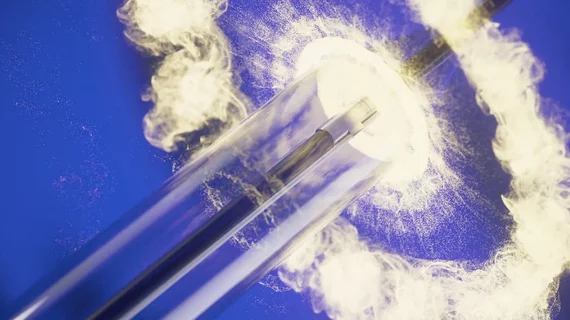
The device features a low-profile catheter with a single actuating optical emitter. The physician-controlled translating emitter is designed to deliver energy along the length of the target lesion. The energy is pulsed up to five times faster than conventional IVL systems.
FastWave said the results are encouraging and will help advance Sola toward a future FDA coronary IDE trial.
The single-arm feasibility study followed patients for 30 days. The treated lesions were complex, averaging 32.6 mm in length. The company said the results are based on investigator-reported data and will be subject to final analysis, including independent core laboratory assessment of angiographic and intravascular imaging data.

Dave Fornell has covered healthcare for more than 17 years, with a focus in cardiology and radiology. Fornell is a 5-time winner of a Jesse H. Neal Award, the most prestigious editorial honors in the field of specialized journalism. The wins included best technical content, best use of social media and best COVID-19 coverage. Fornell was also a three-time Neal finalist for best range of work by a single author. He produces more than 100 editorial videos each year, most of them interviews with key opinion leaders in medicine. He also writes technical articles, covers key trends, conducts video hospital site visits, and is very involved with social media. E-mail: [email protected]